



|
Getting your Trinity Audio player ready...
|
Whiteout Metropolis: A City Entombed in Ice as Historic Storm Paralyzes NYC and the Tri-State Region
By: Tzirel Rosenblatt
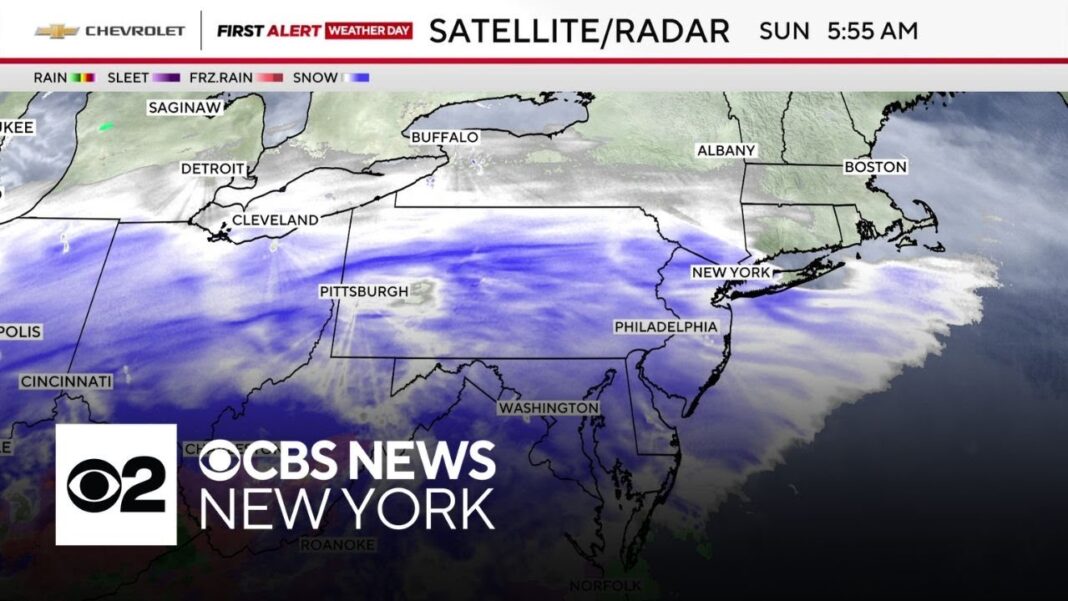
New York City awoke Sunday to a landscape transformed into a vast, blinding tableau of snow and ice, as a powerful winter storm slammed into the metropolitan region with a ferocity not witnessed in years. Streets vanished beneath thick drifts, airports fell silent, transit systems strained under the pressure, and millions of residents across New York, New Jersey, and Connecticut were forced into an uneasy stasis as the storm tightened its grip. According to CBS News report on Sunday afternoon, the system represents one of the most disruptive winter weather events to strike the Tri-State Area in nearly a decade, both in scale and in societal impact.
The storm arrived with ominous precision, delivering heavy snow, sleet, and freezing temperatures that rapidly overwhelmed infrastructure and emergency services. Meteorologists cited by the CBS News report confirmed that New York City itself is likely to receive at least eight inches of snow — a benchmark the city has not reached in years — while northern suburbs face accumulations that could exceed eighteen inches, pushing snowfall totals into historic territory. The scale of the event has forced unprecedented shutdowns across transportation networks and triggered emergency declarations in three states.
Governors in New York, New Jersey, and Connecticut issued states of emergency, warning residents that travel would be both hazardous and potentially life-threatening as snow turned to ice and roadways became treacherous. The CBS News report underscored the gravity of the situation, noting that officials uniformly urged residents to remain indoors, conserve resources, and avoid all nonessential movement.
Nowhere was the storm’s disruptive power more visible than in the skies above the city. According to the CBS News report, more than 2,700 flights across the New York metropolitan area were canceled as airports ground to a halt. LaGuardia Airport was formally shut down, with the Federal Aviation Administration confirming that operations would not resume until conditions improved. Over 90 percent of LaGuardia’s scheduled flights were canceled, while massive disruptions rippled through John F. Kennedy International Airport and Newark Liberty International Airport, paralyzing air travel across the Eastern Seaboard.
Rail and transit systems were similarly affected. NJ Transit suspended all services system-wide, halting rail, bus, and light rail operations as conditions deteriorated. Rail service ended in the early afternoon, while bus and light rail operations were terminated before dawn, leaving commuters stranded and travel corridors silent. The agency announced that service would not resume until weather conditions stabilized, underscoring the severity of the crisis.
In New York City, the Metropolitan Transportation Authority attempted to maintain core subway and bus operations, but officials warned riders to expect delays, modified schedules, and service disruptions. The CBS News report confirmed that while trains continued to run, the system was operating under emergency protocols, with crews battling snow accumulation, frozen switches, and power fluctuations across the network.
The storm’s human toll quickly became evident in the public response. Mayor Zohran Mamdani, speaking from the city’s Emergency Management Office in Brooklyn, delivered stark warnings to residents. Citing data highlighted in the CBS News report, he described road conditions as dangerously overcrowded and urged New Yorkers to stay home.
“The single most helpful thing that New Yorkers can do is stay off the roads,” the mayor said, emphasizing that hazardous travel advisories were in effect across the city and surrounding areas. Despite repeated warnings, sanitation officials reported that too many vehicles remained on the streets, obstructing snow removal operations and increasing the risk of accidents.
The storm has also revived long-standing concerns about the city’s most vulnerable populations. Mayor Mamdani confirmed that the city’s Code Blue emergency declaration remains in effect, ensuring that no one seeking shelter can be turned away. According to theCBS News report, at least five individuals were found deceased outdoors before the storm even reached full intensity, a tragic reminder of the lethal consequences of extreme cold in an urban environment.
In response, the city opened ten warming centers — two in each borough — housed in school buildings and supported by emergency staff. Food, medical assistance, and basic services are being provided, supplementing the city’s network of shelters, hospitals, and safe havens. The CBS News report emphasized that these facilities are operating on an open-door basis, with capacity restrictions lifted to prevent anyone from being left in the cold.
Education systems were also forced into rapid adaptation. Public schools across New York City transitioned to remote learning for Monday, with Mayor Mamdani confirming that in-person classes would not resume until conditions improved. The decision reflects both safety concerns and legal obligations under New York State’s education statutes, which mandate a minimum number of instructional days.
More than 162,000 students and 77,000 teachers logged into digital platforms in preparation for remote classes, demonstrating the scale of the city’s virtual education infrastructure. After-school programs, adult education, and school-based activities were canceled entirely, further illustrating the storm’s systemic disruption.
Beyond the city, the storm’s intensity was equally severe. In Suffolk County, Long Island, County Executive Ed Romaine described the situation as an ongoing battle against relentless snowfall. According to theCBS News report, Romaine warned that snow accumulation was occurring so rapidly that plowed roads were quickly reburied, forcing crews into continuous cycles of clearing and re-clearing.
“We are fighting that battle,” Romaine said, noting that even after roads were plowed, they became impassable again within minutes. MacArthur Airport, he added, was effectively closed, underscoring the region-wide paralysis gripping transportation infrastructure.
Snowfall measurements across the Tri-State Area reflected the storm’s extraordinary reach. Brooklyn’s Sheepshead Bay recorded over eight inches by early afternoon, while River Vale in Bergen County, New Jersey, surpassed nine inches. Long Island’s Nesconset approached eight inches, and Norwalk, Connecticut, registered more than seven inches. The CBS News report described the storm as a “regional immobilizer,” affecting communities hundreds of miles apart with near-uniform severity.
At Port Authority Bus Terminal, all services were suspended, further isolating the city from regional travel corridors. Emergency officials warned that even essential travel should be avoided, as snow, sleet, and sub-freezing temperatures combined to create dangerously unstable conditions.
The economic consequences of the storm are already mounting. Airline losses, supply chain disruptions, retail shutdowns, and workforce absenteeism are expected to cost the region hundreds of millions of dollars. According to analysts cited in the CBS News report, the cascading impact of flight cancellations alone could ripple through national transportation networks for days, as aircraft and crews remain stranded far from their scheduled routes.
Energy systems are also under strain. Extreme cold has driven electricity demand to peak levels, raising concerns about grid stability and localized outages. Municipal utilities have activated emergency protocols, while hospitals and critical infrastructure facilities operate under contingency power planning.
Yet beyond the logistics and infrastructure, the storm has exposed deeper societal vulnerabilities. The CBS News report highlighted how extreme weather events increasingly function as stress tests for urban resilience, revealing inequalities in access to shelter, transportation, healthcare, and digital infrastructure.
For homeless residents, the storm represents not merely inconvenience but mortal danger. For low-income families, heating costs and food access become urgent challenges. For elderly residents, mobility and medical access risks multiply. And for emergency responders, the storm transforms routine operations into life-or-death missions.
Mayor Mamdani’s leadership during the crisis is also under scrutiny, with the storm serving as a defining early test of his administration’s crisis-management capacity. The CBS News report noted historical parallels, recalling how previous mayors faced political consequences for perceived failures in storm response. Mamdani’s visibility, messaging discipline, and coordination across agencies reflect an effort to avoid those precedents.
From sanitation crews working twelve-hour shifts to emergency responders escorting ambulances through unplowed streets, the city’s operational machinery has been placed under maximum strain. The mayor’s decision to deploy large-scale warming centers and maintain open-door shelter policies reflects an attempt to balance logistical efficiency with humanitarian responsibility.
As the storm continues, meteorologists warn that conditions may worsen before they improve. Snow is expected to transition into sleet in parts of the region, increasing the risk of ice accumulation and power disruptions. Temperatures are forecast to remain below freezing for days, meaning snowmelt will be minimal and cleanup operations prolonged.
This storm may prove to be not only one of the most severe weather events of the decade but also one of the most socially and politically consequential. It has halted commerce, paralyzed transportation, reshaped daily life, and exposed the fragile interdependence between infrastructure, governance, and public trust.
In the end, this is not merely a story about snow. It is a story about a metropolis confronted by nature’s raw power, about systems pushed to their limits, and about a society forced to confront its vulnerabilities in real time. As the storm rages on and the city remains locked in ice and silence, New York’s defining resilience is once again being tested — not in rhetoric, but in action, coordination, and collective endurance.
