



|
Getting your Trinity Audio player ready...
|
By: Fern Sidman
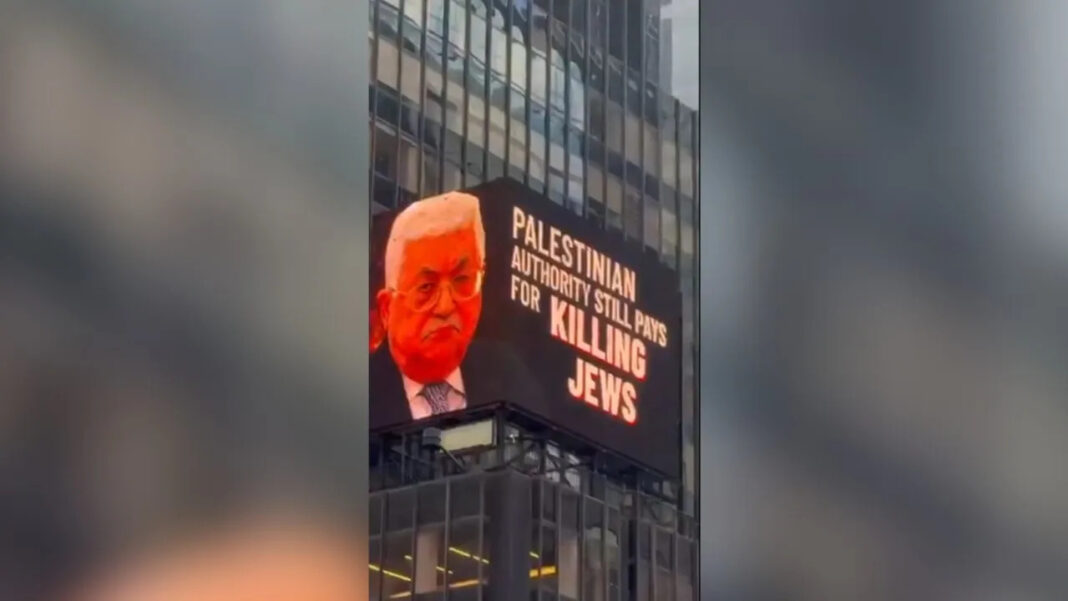
On Friday in New York City’s Times Square, amid the relentless choreography of screens and slogans that define the world’s most iconic crossroads, a billboard rose that sought not to sell a product but to confront a moral controversy long simmering beneath the surface of international diplomacy. The image depicted Palestinian Authority President Mahmoud Abbas accompanied by the stark declaration, “Palestinian Authority still pays for killing Jews.”
The message, unvarnished and accusatory, was designed to rupture complacency, and according to a report on Saturday at The Jewish News Syndicate (JNS), it immediately drew global attention, reigniting debate over the Palestinian Authority’s long-criticized policy of financially rewarding individuals convicted of attacks against Israelis and the families of those who carried out deadly violence.
View this post on Instagram
The billboard was unveiled as part of the “End Pay-for-Slay” campaign, sponsored in part by Israel’s Foreign Ministry. The ministry’s official X account amplified the message by releasing a video the same day, framing the display as “the truth the world needs to see.” JNS reported that the campaign’s architects intended the Times Square placement not merely as a publicity gesture but as a strategic intervention in the global conversation about terror financing, aimed at confronting international audiences with evidence that, despite repeated assurances of reform, the Palestinian Authority continues to maintain financial incentives linked to acts of violence.
For years, the “pay-for-slay” issue has been a point of contention in diplomatic forums, often invoked by Israeli officials and watchdog organizations as proof that the Palestinian Authority’s rhetoric of moderation is undermined by institutionalized policies that valorize and subsidize terrorism. JNS has chronicled how the program operates through stipends provided to individuals imprisoned in Israel for attacks against Israelis, as well as to the families of those killed while perpetrating such acts. These payments, critics argue, not only provide material support but also confer social honor upon violence, embedding a perverse incentive structure within Palestinian political culture.
The billboard’s message was sharpened by the release earlier this month of a report by Palestinian Media Watch, a Jerusalem-based watchdog group that has long monitored Palestinian media and financial practices. According to the information provided in the JNS report, the report concluded that the Palestinian Authority’s so-called “Martyr’s Fund,” the central conduit for these stipends, remains fully operational despite official claims of reform.
The report asserted that in 2025 alone, the Palestinian Authority paid approximately 23,500 terrorists a total of around $315 million. These figures, stark in their magnitude, lend empirical weight to accusations that the program persists under new administrative guises intended to placate international donors while preserving the underlying policy.
The Palestinian Authority has repeatedly insisted that it has curtailed or restructured the program, presenting changes as evidence of responsiveness to international pressure. Yet watchdog groups have documented how payments were rebranded or routed through alternative bureaucratic channels, enabling officials to claim compliance while continuing disbursements. This pattern of ostensible reform followed by substantive continuity has fueled skepticism among critics who view donor fatigue and geopolitical distractions as factors that have allowed the issue to recede from the forefront of international scrutiny.
The symbolism of Times Square as the site of this intervention is not incidental. The choice of location reflects a calculated effort to elevate what might otherwise be perceived as a regional policy dispute into a matter of global moral urgency. Times Square, with its daily influx of international visitors and its reputation as a megaphone for commercial and political messages alike, transforms a policy critique into a spectacle that demands attention. The billboard’s language, unambiguous and confrontational, was crafted to provoke conversation, discomfort, and, ideally, accountability.
Supporters of the campaign argue that such public confrontations are necessary precisely because diplomatic channels have failed to produce durable change. JNS reported that despite repeated condemnations from Israel and legislative measures in several Western countries to condition aid on the cessation of terror stipends, the Palestinian Authority has maintained the financial architecture of the program. In this view, the billboard functions as an act of moral whistleblowing, a reminder to international donors that their contributions risk being fungible in a system that diverts resources to incentivize violence.
Critics, however, have accused the campaign of oversimplification and of weaponizing public space to inflame tensions. They argue that such messaging risks reinforcing collective blame and hardening attitudes on both sides of an already polarized conflict. The JNS report acknowledged these critiques but emphasized that the factual basis of the allegations, as documented by Palestinian Media Watch and other organizations, complicates attempts to dismiss the campaign as mere propaganda. The underlying question, as framed by JNS, is not whether the billboard is rhetorically aggressive, but whether it reflects an uncomfortable reality that international actors have been reluctant to confront with sustained resolve.
The financial scale of the payments, as reported by Palestinian Media Watch, raises profound ethical and policy dilemmas. In a region grappling with economic hardship and humanitarian needs, the allocation of hundreds of millions of dollars to individuals convicted of acts of violence appears, to critics, as a distortion of priorities that entrenches a culture of martyrdom. For proponents of the “End Pay-for-Slay” campaign, the billboard’s bluntness is proportionate to the moral gravity of the issue: a demand that the international community reconcile its commitment to peace-building with its tolerance of policies that, in their view, reward bloodshed.
The billboard’s appearance also intersects with broader debates about conditionality in foreign aid. JNS has reported on legislative efforts in the United States and elsewhere to link financial assistance to demonstrable reforms within the Palestinian Authority. The persistence of the “Martyr’s Fund,” despite ostensible administrative changes, complicates these efforts by obscuring accountability and enabling plausible deniability. In this context, the Times Square display can be read as an attempt to re-anchor the conversation in empirical claims rather than diplomatic euphemisms.
As the image of Mahmoud Abbas and the incendiary caption flickered above the crowds of Midtown Manhattan, it served as a reminder that conflicts rooted in distant geographies can intrude upon the symbolic heart of global public life. The JNS report characterized the billboard as both an act of exposure and a provocation, one that forces a reckoning with the moral contradictions embedded in international engagement with the Palestinian Authority.
Whether the campaign will catalyze substantive policy shifts remains uncertain. What is clear, however, is that the billboard has succeeded in transposing a long-running policy dispute into the visual vernacular of global consciousness, compelling passersby to confront a question that diplomats have long deferred: can the pursuit of peace coexist with the institutionalization of incentives for violence?
