



|
Getting your Trinity Audio player ready...
|
By: Jamie Herndon
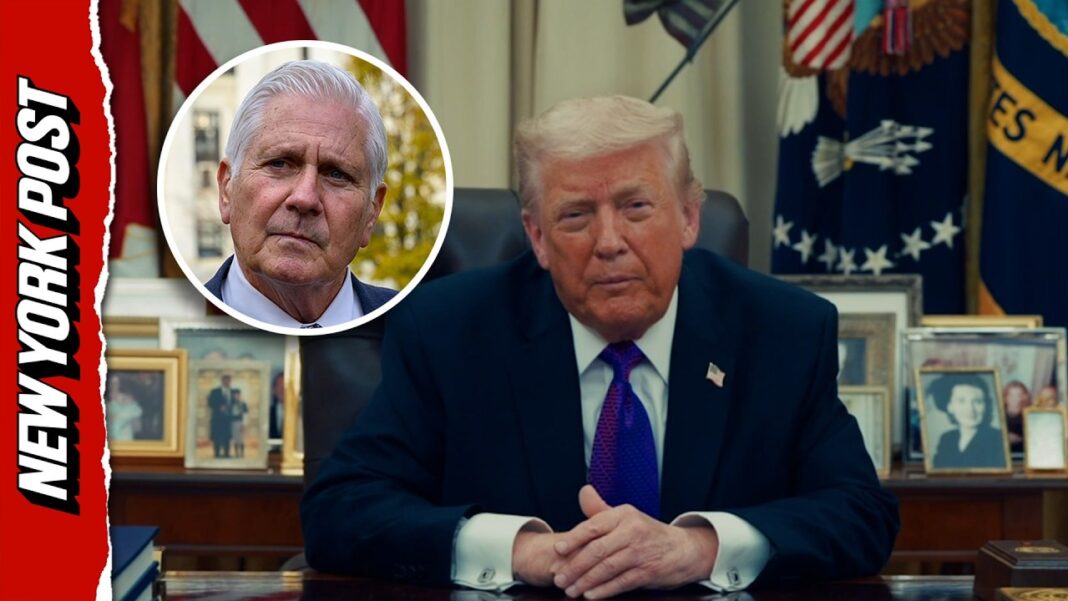
In the ritualized theater of party conventions, moments of rupture are rare. Yet at the Republican state convention this week, amid three days of choreography and caucus-room intrigue, one such rupture arrived in the form of a video message that electrified the hall. President Trump appeared on screen to endorse Bruce Blakeman, and with that surprise intervention, the Republican nomination for governor in New York acquired not merely a candidate but a nationalized narrative.
The New York Post reported on Friday that Blakeman formally accepted the nomination Wednesday to a crowd already primed for confrontation, transforming a state contest into a referendum on crime, affordability, immigration, and the future direction of New York’s Democratic establishment.
“The Bruce is loose,” declared party operatives in the hallways, a slogan that The New York Post noted captured both the carnival atmosphere of the moment and the insurgent tenor of Blakeman’s campaign. In his acceptance speech, Blakeman did not traffic in euphemism. He trained his rhetoric on Gov. Kathy Hochul, his Democratic opponent, assailing her handling of a prison labor stoppage last year and condemning what he characterized as a betrayal of essential workers.
The New York Post reported that Blakeman accused Hochul of lavishing billions on migrants while turning her back on corrections officers, nurses, and transit workers—labor constituencies whose grievances, he argued, have gone unanswered by the current administration. “Quite frankly, it was un-American,” Blakeman declared, framing the dispute in the idiom of national loyalty rather than bureaucratic disagreement.
The speech unfolded against a backdrop of disaffection within segments of organized labor. The New York Post reported exclusively that Transport Workers United President John Samuelson indicated his organization would not back Hochul amid continuing labor disputes with the state. The symbolism of this defection is not lost on strategists: in a state where Democratic candidates have long relied on labor support as a pillar of electoral coalition-building, fissures within that alliance signal vulnerabilities that Republicans are eager to exploit. Blakeman’s rhetoric sought to widen those fissures by presenting himself as an advocate for workers allegedly sidelined by progressive governance priorities.
Crime and affordability formed the twin pillars of Blakeman’s argument. According to the information provided in The New York Post report, he castigated Hochul for endorsing bail reforms that critics contend have curtailed judicial discretion by barring bail for low-level offenses.
In Blakeman’s telling, these reforms exemplify a governing philosophy that privileges the accused over victims and public safety. “Kathy Hochul has turned her back on the rule of law and those who uphold it,” he said, accusing the governor of siding with criminals over law-abiding citizens. The New York Post report contextualized these remarks within a broader Republican strategy to nationalize concerns about urban crime, situating New York’s policies within a wider debate about the balance between decarceration and deterrence.
Blakeman also took aim at the “Raise the Age” legislation, which elevated the age of criminal responsibility to eighteen, effectively shielding most sixteen- and seventeen-year-olds from adult prosecution. Law enforcement advocates have linked the policy to a surge in youth crime in New York City in 2025, citing figures indicating that a notable proportion of shooting victims and perpetrators were under eighteen. While criminologists continue to debate causality, Blakeman’s campaign has seized upon these statistics to argue that well-intentioned reforms have yielded unintended consequences. In the rhetorical economy of his speech, Hochul’s reluctance to revisit the policy became emblematic of a broader unwillingness to recalibrate progressive reforms in light of evolving realities.
The candidate’s critique extended beyond crime to encompass the quotidian economics of urban life. Blakeman warned of the potential expansion of congestion pricing, the toll imposed on drivers in Midtown Manhattan that took effect last year. He portrayed the policy as a regressive imposition on working families, characterizing it as a fee levied for the “privilege of driving on a public road that you already paid for.”
In this formulation, congestion pricing became not merely a transportation policy but a symbol of what Blakeman depicted as elite indifference to the lived experience of commuters and small business owners. His warning that the tolling regime could spread to other communities if Hochul secures another term was calibrated to resonate beyond Manhattan, tapping suburban anxieties about fiscal encroachment.
The dramatic inflection point of the convention, however, arrived with the video endorsement from President Trump. The New York Post report described the moment as galvanizing, with the president praising Blakeman’s tenure in Nassau County, where he credited the hiring of hundreds of new police officers and proclaimed the county the safest in America. Trump’s message cast Blakeman as an executive capable of translating law-and-order rhetoric into measurable outcomes. “As governor, Bruce will fight hard to grow the economy, cut taxes, job-killing regulations, protect New York industry and bring businesses and great-paying jobs back to the Empire State,” Trump said, according to The New York Post.
The endorsement, first extended last month after Rep. Elise Stefanik withdrew from the gubernatorial race, effectively nationalized Blakeman’s candidacy, tethering it to Trump’s populist brand and the broader currents of Republican politics.
The Hochul campaign responded swiftly, framing Trump’s intervention as evidence that Blakeman would subordinate New York’s interests to a national agenda. The New York Post reported that Hochul spokesperson Ryan Radulovacki accused Blakeman of placing Trump’s approval above the welfare of New Yorkers, warning that a Blakeman victory would amount to Trump “running the state of New York right alongside him.”
The spokesperson’s litany of concerns—rising costs for families, aggressive federal immigration enforcement, and purported threats to youth policy—reflected Democratic anxieties about the reintroduction of Trump-era governance priorities into Albany’s political bloodstream.
The historical context amplifies the stakes of this confrontation. The New York Post noted that no Republican has won statewide office since 2002, when former Gov. George Pataki secured his third term. Pataki’s presence at the convention lent a note of institutional memory to the proceedings. He told attendees that Republicans have a genuine opportunity to reclaim the governor’s mansion, attributing this possibility to what he described as the Democratic Party’s leftward drift, catalyzed by the emergence of figures such as democratic socialist New York City Mayor Zohran Mamdani.
In Pataki’s telling, the ideological transformation of the state’s Democratic apparatus has created an opening for a Republican message centered on public safety, economic pragmatism, and resistance to what he termed “far left radicals.”
Blakeman’s ticket, which pairs him with lieutenant governor candidate Todd Hood, will face Hochul and her running mate, former City Council speaker Adrienne Adams, in November. The New York Post report framed the matchup as a collision between divergent visions of governance: one rooted in progressive reforms and multilateral policy initiatives, the other animated by a populist critique of crime policy, fiscal burden, and cultural alienation.
Whether Blakeman can overcome the structural advantages enjoyed by Democrats in New York remains an open question. Yet the fervor of the convention, amplified by Trump’s endorsement and by visible fractures within traditional Democratic constituencies, suggests that this race will test the elasticity of New York’s political order.
In the end, the spectacle of “The Bruce is loose” is less about a slogan than about a wager. It is a wager that New Yorkers, unsettled by crime, cost-of-living pressures, and ideological polarization, may be receptive to a Republican challenger who frames himself as a corrective to progressive governance.
The New York Post report portrayed Blakeman’s nomination not as a foregone gesture of party ritual but as the opening gambit in a campaign that seeks to translate national populist energy into state-level upheaval. Whether that energy will prove sufficient to breach a two-decade Democratic hold on statewide office will be determined not in the echo chamber of a convention hall, but in the contested terrain of New York’s diverse electorate this November.
