



|
Getting your Trinity Audio player ready...
|
Travel Disruption in NYC Persists with Colossal Snowbanks, Slushy Streets, and Overflowing Trash Bins
By: David Avrushmi
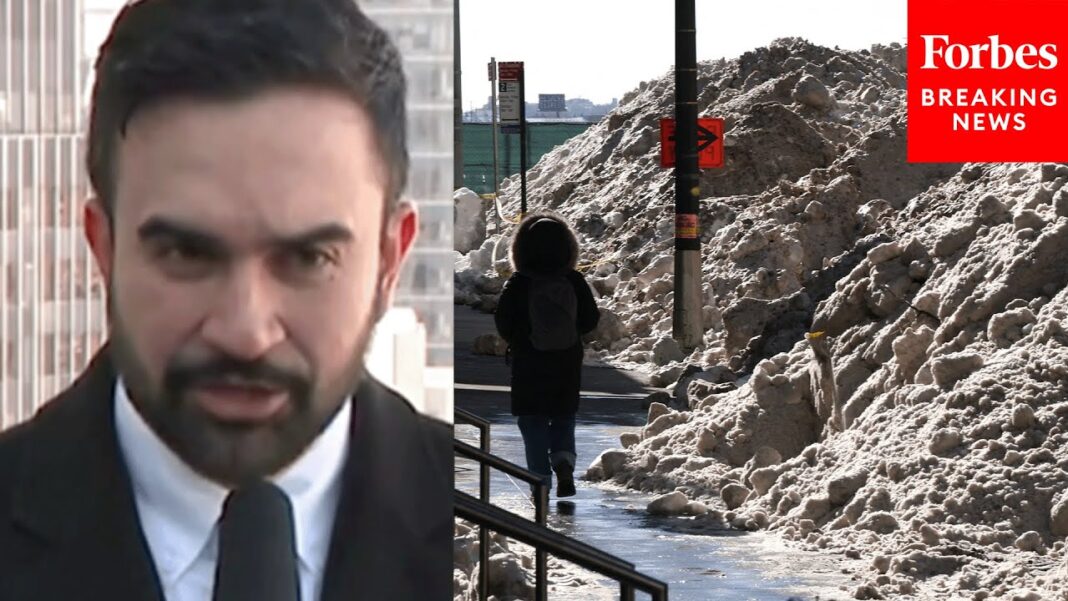
As the remnants of Winter Storm Fern linger in New York City, residents are grappling with the fallout of an unprecedented snowfall that has left the metropolis ensnared in a veritable winter maelstrom. More than a week after the storm deposited over a foot of snow across the five boroughs, New Yorkers find themselves contending with iceberg-sized snow piles obstructing roadways, bike lanes, sidewalks, and parking spots. Amidst this chaos, Mayor Zohran Mamdani faces mounting criticism for his administration’s sluggish response to the crisis, exacerbated by rising cold-related fatalities and an increasingly discontented populace.
As reported by The New York Post on Wednesday, on January 25, the storm unleashed its fury, blanketing the city in a layer of white that soon devolved into a treacherous landscape of frozen obstructions. The sheer magnitude of the snowfall has led to frustration among locals, epitomized by the experiences of residents like Michelle Perera, a doctor who lamented the slow clean-up efforts as “cold comfort.” Standing next to a massive dirt-encrusted mound of plowed snow at Midtown’s 43rd Street and 10th Avenue, she articulated a sentiment shared by many: “There is a lot of snow still left on the streets and now with trash pickups, it just feels like it’s magnified and it’s really unsafe and unsightly.”
The frustrations extend beyond mere aesthetics; they permeate the very fabric of daily life, affecting transportation and public safety. Drivers along Eighth and Ninth avenues in Midtown have been stymied by the unruly frozen snow piles that block entire lanes, creating significant hazards for pedestrians and motorists alike. In the Financial District, food deliveryman Juan Santos, 47, recounted his struggles navigating the icy terrain. “I’ve slipped. I’ve fallen off my bicycle,” he remarked, chuckling despite the discomfort. “Sometimes they don’t plow the bike lane, and I have to ride in the street, and that’s dangerous.”
The implications of the storm’s aftermath have reached far beyond inconveniences; they have directly impacted the lives of New Yorkers. As the toll for cold-related fatalities rose to 17 by Wednesday, the mayor’s response has come under scrutiny. The New York Post report indicated that during an unrelated event in Far Rockaway, Mamdani provided an update on the city’s storm response, emphasizing that sanitation crews had cleared 59,000 crosswalks and 12,000 fire hydrants, while also boasting of the removal of 183 million pounds of snow and the application of 227 million pounds of salt. However, this triumphal assessment fell flat for many lifelong city dwellers, who were unconvinced by the mayor’s claims.
“I’ve never seen this in my life, the piles and everything,” declared 70-year-old John Michael Bolger, who bluntly criticized Mamdani’s leadership in comments to The New York Post. “This guy, Mamdani, is full of s–t.” His frustration was underscored by the mayor’s penchant for fashionable outerwear, as Bolger noted, “He’s more concerned about getting jackets that look cool when he does press conferences.” This commentary reflects a broader disillusionment among the public, as the mayor’s attention to style seemingly overshadows pressing issues of public safety and effective governance.
As the storm’s effects linger, the treacherous conditions have transformed New York’s streets into slip-and-slide zones. Speaking to The New York Post, William Rogers, 67, an architect residing in the Financial District, recounted a near-miss he witnessed: “I caught a lady yesterday who slipped and almost fell backwards, and she landed right in my lap. She wasn’t injured, and she thanked me sweetly.” Such incidents underscore the perilous situation for pedestrians navigating blocked crosswalks, forcing them into the street and heightening the risk of accidents.
The city’s bike-sharing program, CitiBike, has also felt the storm’s impact, with approximately 500 of its 2,925 active stations rendered inoperable due to snow accumulation. The repercussions extend to those whose livelihoods depend on mobility and accessibility. For instance, Naadiya Yasin, an attorney, expressed her frustrations over the parking situation while sitting at the corner of Hoover Avenue and Queens Boulevard. “I go to courthouses in all boroughs, and everywhere I go, it’s an additional 30 minutes to an hour looking for parking,” she lamented, when speaking to The New York Post. She noted how delays have affected her ability to meet court schedules. “Judges are yelling at me for not getting to court on time.”
Jeff Smith, a 32-year-old construction worker from Kew Gardens, managed to secure a parking spot on Queens Boulevard but lamented the ongoing challenges. “The streets aren’t as brutal as the first week after the storm, but they’re no winter picnic,” he remarked to The New York Post, echoing the sentiments of many New Yorkers who feel a sense of betrayal by their city’s leadership. “The mayor should have done a better job,” he added, emphasizing the growing frustrations among residents trying to navigate the post-storm landscape.
Business owners are also feeling the sting of the city’s slow recovery efforts. George Kulangivey, the owner of George’s Hair Styling in the Financial District, has witnessed a decline in clientele as the combination of atrocious road conditions and snow piles has deterred customers. “My customers, they don’t want to jump 2 or 3 feet over snow and garbage to come in here,” he explained to The New York Post, lamenting the cancellations he has received. “Some are not cleaned; it’s slow going. My customers come from Queens, Brooklyn, Staten Island. They can’t even take the ferry.”
In an attempt to address the crisis, the city reports that it is currently melting over 30 million pounds of snow daily at 13 different snow melters. Despite these efforts, the challenges remain substantial. With alternate-side parking suspended through Sunday, the streets may not be fully cleared until then, leaving residents and business owners in a state of limbo. Sanitation officials have encouraged New Yorkers to dig out their cars as temperatures rise above freezing this week, yet the expectation of a swift resolution seems increasingly optimistic.
The discontent among New Yorkers is palpable, as many feel that the city’s leadership has failed to respond effectively to the challenges posed by Winter Storm Fern. The New York Post report captured the frustration and anxiety of citizens who have come to expect more from their government. The ongoing difficulties in navigating the city’s streets, coupled with the rising death toll attributed to the cold, paint a grim picture of life in New York City post-storm.
In the face of adversity, community resilience has emerged as a defining characteristic of the city. Neighbors have banded together to help one another navigate the icy conditions, offering assistance to those who may be struggling. Yet, the question remains: how long can this spirit of solidarity endure in the face of inadequate governmental responses? The discontent brewing in the hearts of New Yorkers represents not merely a reaction to a single storm, but a broader indictment of the city’s leadership and its capacity to address the pressing needs of its citizens.
As the city continues to grapple with the aftermath of Winter Storm Fern, the calls for accountability and effective governance grow louder. New Yorkers are not merely seeking snow removal; they are demanding a commitment from their leaders to prioritize public safety, ensure accessibility, and foster a sense of community in the face of adversity. The snow may eventually melt, but the scars left by this winter blunderland will linger, challenging the city to rise to the occasion and fulfill its responsibilities to its residents.
In the coming weeks, as the investigation into the city’s handling of the storm unfolds, it will be imperative for Mayor Mamdani and his administration to acknowledge the grievances of the populace and respond with actionable solutions, as was observed in The New York Post report. The lessons learned from Winter Storm Fern must inform future policies to ensure that New York City remains a bastion of resilience and adaptability, even in the face of nature’s wrath.
As the snow slowly recedes and the city begins to emerge from its winter cocoon, the hope remains that the voices of New Yorkers will not be forgotten. Their struggles should serve as a catalyst for change, prompting a renewed commitment to public safety, effective leadership, and a community spirit that exemplifies the best of what New York City can be. In the words of those who endure the winter’s challenges, the city must rise to the occasion and reclaim its status as a vibrant, accessible, and resilient urban landscape.