



|
Getting your Trinity Audio player ready...
|
By: Carl Schwartzbaum
The battle over a proposed $3 billion casino complex in Coney Island has intensified, with critics warning that the project would transform the historic Brooklyn neighborhood into a year-round gridlock zone. As reported by The New York Post on Monday, opponents are raising alarms about sweeping quality-of-life concerns, from traffic congestion to increased crime, in the lead-up to a critical state advisory council vote next month.
Marissa Solomon, one of the six members of the state’s Community Advisory Council(CAC)tasked with reviewing the bid, delivered a stark assessment in an interview with The New York Post. “It’s not just going to be the summer of hell. It will be traffic hell all year round, and garbage hell, noise hell, crime hell,” said Solomon, who was appointed by Assemblyman Alec Brook-Krasny and is herself a Coney Island resident.
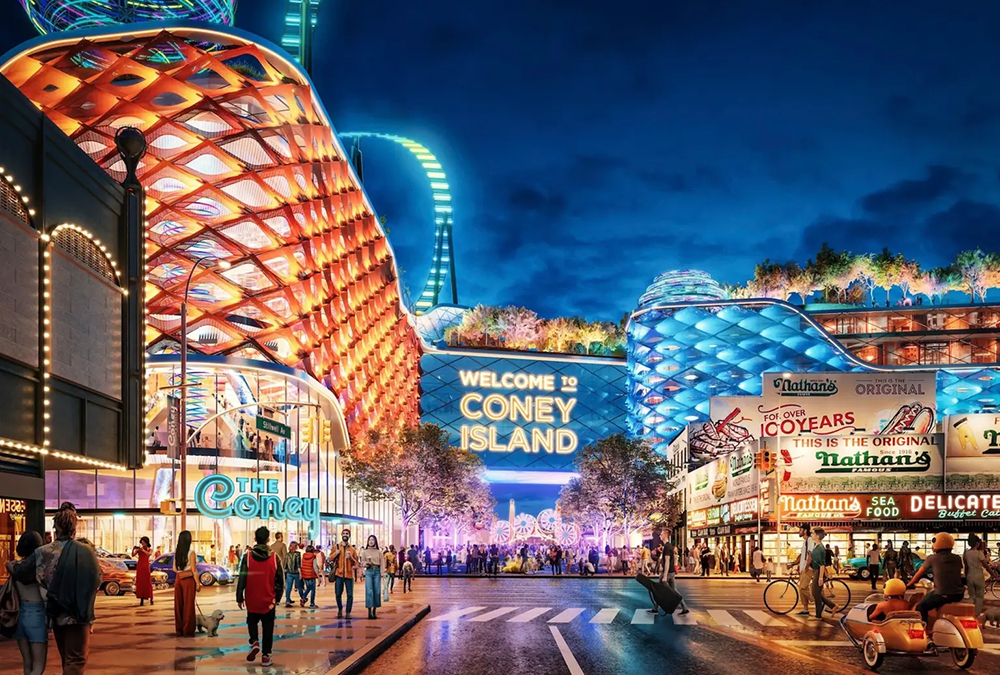
The high-profile proposal, which would stretch along Surf Avenue from West 12 th to West 15 th streets, envisions a luxury complex anchored by a 500-room hotel, a convention center, and a large-scale concert venue. But before the developers can compete for one of three coveted New York City-area casino licenses – to be awarded by the end of the year – they must secure support from at least four of the six CAC members.
The partnership behind the Coney bid includes Thor Equities, the Chickasaw Nation’s Global Gaming Solutions, Saratoga Casino Holdings, and Legends Hospitality Group, part-owned by the New York Yankees. According to the report in The New York Post, the proposal is facing entrenched opposition from residents, community boards, and local businesses, including Luna Park Amusement.
At a July 30 CAC meeting, Solomon criticized the developers’ own environmental and traffic studies, highlighting findings that severe congestion would occur at numerous intersections, including 15 th Street, Surf Avenue, and Stillwell Avenue. While the plan provides for 1, 500 on-site parking spaces, the traffic study admits that up to 912 additional spaces would be required off-site – even during the off-season.
“Your own transportation study said there would be significant adverse impacts at multiple intersections… and your only mitigation is two new lights and some new stripes? Really?” Solomon asked, according to The New York Post report. “Is that going to be able to handle what your own report says is a complete breakdown in traffic?”
Coney project representatives have pushed back against these concerns. Speaking to The New York Post, Robert Cornegy, a former Brooklyn councilman representing the bid, argued that the casino would reduce rather than worsen congestion by spurring mass transit use. Plans include upgrades to the Stillwell Avenue subway station, traffic light realignments, street rerouting, and new ferry service. Cornegy added that guests and employees would be offered discounted or free subway fares and that the developers would partner with the MTA to create express service from Manhattan to Coney Island.
Still, gaming industry insiders quoted by The New York Post questioned whether high-spending casino patrons would realistically choose public transit over driving.
Community resistance has been vocal. Luna Park’s website features a petition stating that “casinos are not engines of sustainable development–they are predatory institutions that exploit financial vulnerability, depress surrounding businesses, and increase social burdens such as crime, addiction, and poverty.” The petition calls for investment in education, healthcare, and small businesses rather than a project it says will “siphon wealth from the community under the guise of economic development.”
The CAC – which also includes representatives for Gov. Kathy Hochul, Mayor Eric Adams, Brooklyn Borough President Antonio Reynoso, state Sen. Jessica Scarcella-Spanton, and Councilman Justin Brannan – will be the first hurdle for the proposal. If approved, the bid moves to the New York Gaming Facility Location Board for further review before the final decision is made by the state Gaming Commission.
For now, the future of the Coney Island casino remains a high-stakes gamble, with powerful developers, political appointees, and a divided community all invested in the outcome.