



|
Getting your Trinity Audio player ready...
|
By: Jason Ostedder- Jewish Voice News
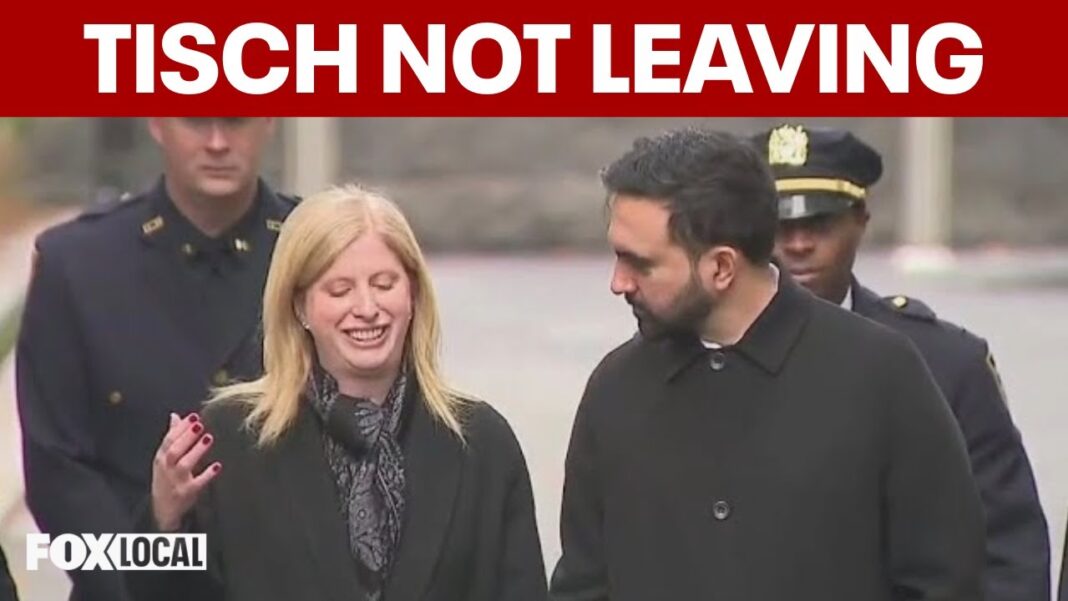
In a decisive and carefully calibrated message aimed at steadying the nerves of the nation’s largest police force, NYPD Commissioner Jessica Tisch informed officers early Wednesday that she will remain atop the department under incoming Mayor Zohran Mamdani — a move that surprised many inside the ranks given the mayor-elect’s long record of criticism toward police and his alignment with far-left politics. As The New York Post reported on Wednesday, Tisch’s department-wide email, circulated shortly after dawn, was a bid to assert continuity, reinforce her credibility with officers, and reassure a department wary of major political upheaval at City Hall.
The email, described to The New York Post by multiple sources, opened with an unmistakably personal tone. Tisch emphasized that her decision to stay was motivated not by political pressure, personal ambition, or ideological alignment with the incoming administration, but by her loyalty to the department’s workforce. “I wanted you — the men and women of the NYPD — to hear this directly from me first,” she wrote. “Because the reason I have chosen to stay is you. I believe deeply in the nobility of your work, in what you do every day to keep this city safe, in your commitment, and in your sacrifice.”
Her remarks, according to the information provided in The New York Post report, were delivered after days of widespread speculation about whether Tisch, who has become one of the most respected police executives in recent history, would be willing to serve under a mayor-elect who had repeatedly condemned police actions, criticized department culture, and aligned himself with some of the city’s loudest anti-police voices. In the email, Tisch acknowledged these political and philosophical differences openly, writing, “Do the Mayor-elect and I agree on everything? No, we don’t.”
Yet Tisch insisted that the tone and substance of her recent meetings with Mamdani convinced her that she would be able to “lead the department honorably going forward.” She pointed to shared commitments — specifically “the importance of public safety, the need to continue driving down crime, and the need to maintain stability and order across the department” — as the basis for her decision. Mamdani’s transition team had stressed a desire to preserve continuity in NYPD leadership despite stark ideological differences.
The decision marks a highly notable collaboration between two figures from nearly opposite ends of the city’s political spectrum. Tisch, a technocratic administrator known for her disciplined management, data-driven strategies, and no-nonsense communication style, has long enjoyed strong support among rank-and-file officers and union leadership. Mamdani, by contrast, emerged as one of the most left-wing mayoral candidates in modern city history, associated with outspoken criticisms of policing, support for criminal-justice overhauls, and rhetoric that had often put him at odds with law-and-order constituencies.
Nevertheless, Mamdani publicly committed during his campaign to retaining Tisch — a decision, according to The New York Post, intended to ease deep public concerns that crime would surge under his administration. The paper repeatedly noted that Tisch has presided over substantial declines in major crime categories, including what officials described as record-low shootings this year. Members of Mamdani’s team, speaking to The New York Post, praised her leadership as “instrumental” in sustaining public safety during a politically tumultuous period.
In her email, Tisch nodded to these crime reductions, attributing them not to politics but to the work of officers themselves. “This year, we are having tremendous success fighting crime — shattering records across the board,” she wrote. “It is extraordinary, and it is because of you.”
Almost immediately, Tisch’s message drew enthusiastic support from police unions, who expressed relief that the next administration would maintain continuity in leadership rather than usher in sweeping, destabilizing changes.
Patrick Hendry, president of the Police Benevolent Association, praised the commissioner’s commitment in comments to The New York Post. “We are very glad to hear that there will be stability and continuity in the NYPD’s leadership going forward,” Hendry said. “Commissioner Tisch understands all of the many challenges police officers face on the streets and has been working productively with us to address them.”
Scott Munro, head of the Detectives’ Endowment Association, echoed these sentiments, telling The New York Post, “This is a great day for New York City detectives, the NYPD, and the citizens we are proud to serve. Commissioner Tisch will lead us through the challenges we will face.”
For many within the department, the symbolism of Tisch announcing her intention directly to officers — before any formal public statement was made — carried significant weight. One NYPD source told The New York Post, “Very classy to tell the rank and file first. Shows the deep respect she has for the cops and the work they do.”
In the statement announcing Tisch’s continued tenure, Mamdani praised her achievements and sought to frame the appointment as a testament to his intention to build a City Hall that welcomes varied viewpoints. As quoted by The New York Post, the mayor-elect said, “I have admired her work cracking down on corruption in the upper echelons of the police department, driving down crime in New York City, and standing up for New Yorkers in the face of authoritarianism.”
The phrase “standing up for New Yorkers in the face of authoritarianism” was regarded by some political observers as a pointed effort by Mamdani to align himself with Tisch’s reputation for internal discipline and her high-profile reforms targeting misconduct within the department. It also signaled his attempt to bridge the perception gap between his campaign rhetoric and the expectations of a mayor who must govern a sprawling, complex metropolis with major public-safety concerns.
Mamdani, facing skepticism from moderates, conservatives, and many in the Jewish community — a demographic that dominated much of the outspoken opposition to his candidacy, emphasized his desire to build a city where “rank-and-file police officers and the communities they serve alike are safe, represented, and proud to call New York their home.”
His remarks paralleled Tisch’s appeal for unity within the department. “I appreciate that the Mayor-elect wants a team with different points of view — a team where ideas and policies are debated on their merits,” she wrote in her email. Tisch concluded by pledging to serve as a “fierce advocate” within those debates, adding pointedly, “You know how I operate: I don’t mince words. When I say something, I mean it. And that is not going to change.”
As The New York Post report indicated, Mamdani’s decision to retain Tisch may be one of the most consequential political calculations of his incoming administration. The announcement arrives amid widespread anxiety that crime could spike under a government led by a self-described socialist whose campaign often aligned with anti-police activists. Retaining Tisch allows Mamdani to temper those concerns while avoiding early clashes with unions — a key constituency that remains powerful both politically and operationally.
For Tisch, the choice positions her as a stabilizing force at a moment of profound political transition. Her tenure under Mayor Eric Adams had earned her high marks for organizational discipline, digital modernization, crime-reduction strategies, and efforts to curb internal misconduct. By reaffirming her commitment to the rank-and-file and to measurable, data-driven public safety outcomes, she reinforced her standing as one of the few senior officials capable of navigating the enormous ideological gulf between the mayor-elect and the NYPD.
In her closing appeal to officers, Tisch articulated both urgency and resolve. “We can never rest easy, and we can never accept the idea that our best days are behind us,” she wrote. “We owe the people of New York City more. Let’s meet that challenge together.”
With the transition of power looming in January, the partnership between the NYPD commissioner and the incoming mayor will likely become one of the most closely watched dynamics in city politics. As The New York Post report emphasized, the future of public safety in New York — and the stability of the nation’s largest police department — may hinge on the delicate and unlikely alliance forged this week between Jessica Tisch and Zohran Mamdani.