



|
Getting your Trinity Audio player ready...
|
By: Jerome Brookshire- Jewish Voice News
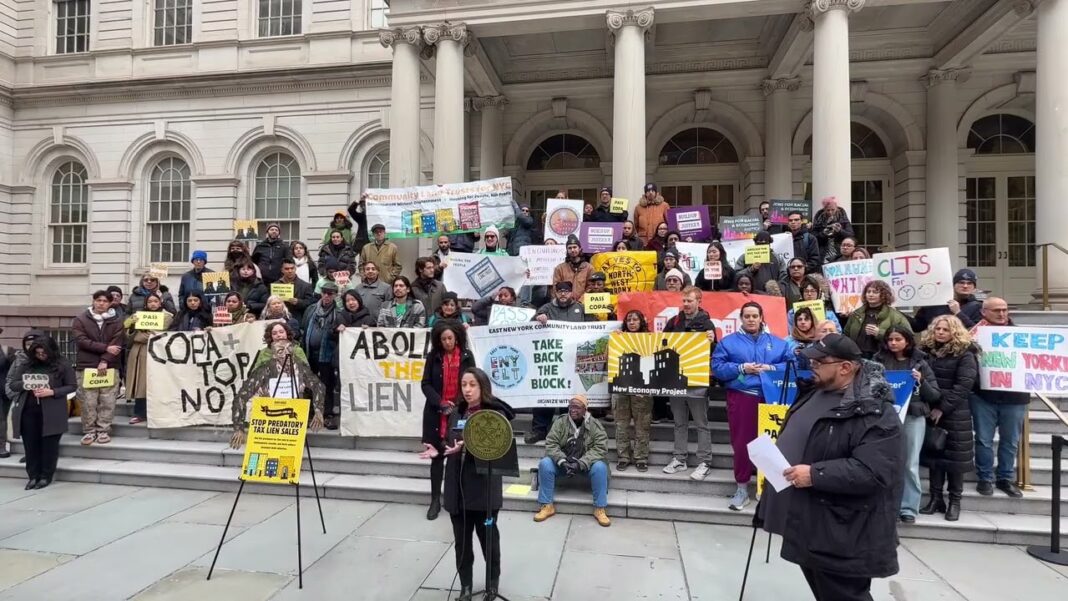
New York City stands once again at an ideological precipice, edging closer to what critics warn is a dramatic restructuring of private property rights unprecedented in the city’s modern history. The legislative flashpoint is the increasingly controversial Community Opportunity for Purchase Act, known as COPA, a bill that the Council’s dominant left-wing bloc is pushing toward a final vote before year’s end. Designed to enable nonprofit housing organizations and community land trusts to purchase multi-unit buildings before any private buyer may do so, the legislation has prompted fierce backlash from property owners, market watchdogs, and minority council members, who argue that the measure represents nothing less than a state-engineered seizure of the private real estate market.
As The New York Post reported on Saturday, opponents see COPA as a “Stalinesque” intrusion into private transactions — a phrase that may strike some as hyperbolic until one reads the bill’s fine print. Under the proposal, any owner of a residential property with three or more units would be compelled to notify the Department of Housing Preservation and Development (HPD) and a city-approved roster of “qualified” nonprofits before they may list their building on the open market. Those nonprofits would then be given 60 days to declare interest and up to 120 days to make an offer — a mandatory period during which the owner would be legally barred from negotiating freely with private buyers.
Failure to comply could result in civil penalties of up to $30,000, a punitive measure opponents describe as extortionate and designed to intimidate owners already navigating one of the nation’s most complex regulatory landscapes. In the words of Council Minority Leader Joann Ariola, the Republican who represents southwest Queens: “We’re sliding headfirst into a communist dystopia where the government and their apparatchik developers own all the property, and the rest of us get forced into perpetual rentorship.” Her comments to The New York Post captured the fears of thousands of small-property owners who see the bill not as a tool for equity but as a jackhammer aimed at the city’s economic foundations.
But the bill’s sponsors — most prominently Brooklyn Councilwoman Sandy Nurse — view the matter differently. Nurse, who introduced COPA in May 2024, insists the measure is essential for “growing affordable housing” and “keeping families here,” as she told The New York Post. She argues that escalating rents, a deepening affordability crisis, and the shrinking dream of homeownership demand new mechanisms to preserve stability in neighborhoods vulnerable to speculative investment. With 32 of the Council’s 51 members already signed on — surpassing the 26 votes needed for passage and only two shy of the 34 required to override a mayoral veto — COPA’s momentum appears less like a progressive experiment than a legislative inevitability.
Yet the backdrop against which COPA has gained traction is as significant as its text. As The New York Post notes, the bill accelerated sharply after Democratic Socialist Zohran Mamdani won the June Democratic primary and subsequently cruised through the November general election. Mamdani’s ascendance helped consolidate the influence of far-left legislators in the Council, many of whom are closely aligned with the Democratic Socialists of America (DSA) and prioritize transferring land and housing stock into non-market, nonprofit, or government-controlled models. COPA, to them, is not merely a housing bill but an ideological down payment on a broader transformation of urban ownership.
To understand COPA’s explosive reception, one must first appreciate how it restructures the very architecture of a free real estate market. Under the current system, building owners may list their properties when they choose, negotiate freely, entertain multiple offers, or accept all-cash bids that shorten closing times. COPA would upend these norms.
If a qualified nonprofit indicates interest in a building, the owner must freeze all negotiations and wait out a lengthy, bureaucratically defined process during which the nonprofit assesses, organizes, finances, and eventually submits a “competitive” offer. Even if the nonprofit’s offer falls below market value, the owner must still entertain it as a legitimate bid. Only after rejecting the offer — and documenting that rejection with HPD — may the owner re-enter the open market.
Critics say this compulsory delay will artificially suppress prices, scare away potential buyers, and create a chilling effect on investment and development citywide. Ann Korchak, the board president of Small Property Owners of New York, described the legislation as “a slow and painful demise” for small landlords. Representing more than 5,700 owners, Korchak told The New York Post that COPA would establish chaos and property devaluation, while enriching politically connected nonprofits that stand to benefit from depressed sale prices.
To Korchak and her members, COPA is not an affordable housing tool but an act of systemic sabotage — one that would transform the business of property ownership into a bureaucratic labyrinth dominated by government-approved intermediaries.
Her warning is echoed by the New York State Association of Realtors, a statewide organization of more than 61,000 brokers and agents. The group denounced COPA as “an unwarranted government intrusion into private real estate transactions” that would “negatively impact buyers, sellers, real estate professionals, and state and city coffers.” They point to the more than $1 billion New York City receives annually from real property transfer taxes — revenue that could fall sharply if COPA depresses the market.
Moreover, as the Realtors noted to The New York Post, many building owners are “not wealthy corporate entities,” but middle-class New Yorkers whose rental income or property sales constitute their retirement or long-term financial stability. Forced delays, declining valuations, and potential penalties could devastate those who do not have massive portfolios to fall back on.
Supporters of COPA argue that the bill is modeled after similar laws in Washington, D.C. and San Francisco — two cities that have enacted “right-of-first-offer” or “community opportunity” laws that place nonprofits at the front of the line for acquiring multi-unit housing stock. Yet even in those cities, the results have been mixed.
Washington’s version, for example, has been mired in criticism for creating opportunities for corruption, enabling predatory middle-man nonprofits to extract fees, and slowing transactions to a crawl. San Francisco’s model has been plagued by financing delays, contentious evaluations, and a system so cumbersome that many property owners bypass the city entirely, selling through channels that avoid triggering COPA’s requirements.
The New York Post report noted that New York — with its vastly larger, denser, and more complex housing ecosystem — could face amplified consequences.
Meanwhile, Nurse and her allies frame COPA as a long-overdue corrective to speculative buyers and corporate landlords who they argue accelerate displacement. They contend that COPA gives neighborhoods a fighting chance to preserve affordability before large, profit-driven entities acquire buildings and push existing tenants out.
But critics counter that this narrative ignores economic reality: the overwhelming majority of New York’s property owners are small landlords, not large corporations. These mom-and-pop owners cannot endure the prolonged uncertainty and potential financial losses COPA would impose.
The political drama unfolding around COPA is not only about housing—it is about the future of New York City’s governance philosophy. As The New York Post report emphasized, the bill reflects the growing dominance of the Council’s far-left caucus, which increasingly prioritizes ideological purity over market pragmatism.
Opponents argue that COPA is animated by a worldview in which private ownership is suspect, profit is immoral, and community land trusts — often poorly managed and ideologically driven — should gradually replace the backbone of New York City’s housing market. In that context, the $30,000 fine is not merely a penalty but an ideological cudgel, designed to herd independent owners into compliance with a collectivist vision.
Mayor Eric Adams, whose administration is already battling crises in public safety, migrant housing, and budget shortfalls, has said only that he is “reviewing the legislation.” But with 32 sponsors and momentum still growing, COPA could easily approach the threshold needed to override a veto.
As one senior City Hall source told The New York Post, the bill puts Adams in a politically precarious position: veto it, and risk attacks from the left for obstructing affordable housing strategies; sign it, and watch the city’s real estate community — already anxious about rising taxes, crime, and regulatory burdens — erupt in fury.
COPA represents far more than a technical shift in housing policy. It signals a profound ideological battle over whether New York City will remain a market-driven metropolis or evolve into a patchwork of quasi-public housing enclaves governed by politically appointed nonprofits and community land trusts.
As The New York Post report indicated, the stakes are nothing less than the city’s character, identity, and economic future. Is New York a place where property rights are foundational, transactions are free, and markets determine value? Or is it, as critics warn, becoming a city where ideology supersedes ownership, where private transactions are subordinate to political agendas, and where the American dream of property ownership becomes a relic of the past?
The City Council appears ready to choose. New Yorkers must now decide what they are willing to accept.
And whether the next era of the city will be defined by opportunity — or by obligation.
Any family that cannot afford to be here, belongs somewhere else without our sponsorship. No reason on earth why these should be in one of the most expensive cities in the world at our expense. Talk about
privilege.
whatever happened to FREE enterprise, America the land of opportunity….Survival of the fittest…get a job you freeloaders!!