



|
Getting your Trinity Audio player ready...
|
Terror-Themed Merchandise Triggers Funding Suspension for NYC Muslim Organization
By: Jeff Gorman
A storm of political, legal, and civic scrutiny has descended upon the New York chapter of the Muslim American Society (MAS) after a Brooklyn-based community event allegedly featured merchandise praising U.S.-designated terrorist organizations—an incident that has now prompted City Hall to freeze public funding and initiate a formal review. According to a report that appeared on Monday at VIN News, the controversy has ignited a fierce debate over public accountability, municipal oversight, and the ethical boundaries governing taxpayer-funded community organizations in New York City.
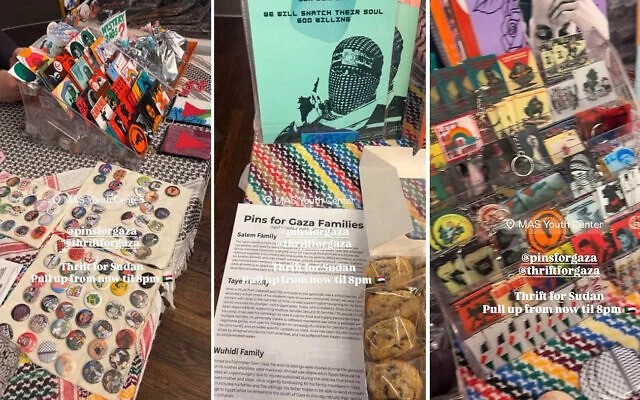
At the center of the controversy is a January 18 event known as “Thrift4Sudan,” hosted at the MAS youth center in Brooklyn. The gathering, which was framed publicly as a charitable fundraiser, was intended to support humanitarian causes linked to Sudan. However, footage that later circulated on social media—before being deleted—allegedly showed vendors selling merchandise that referenced extremist organizations formally designated as terrorist groups by the United States government, including Hamas, Hezbollah, and the Popular Front for the Liberation of Palestine (PFLP).
The footage, first reported by the New York Post and later cited by VIN News, reportedly depicted key chains, stickers, pins, and other paraphernalia emblazoned with imagery and slogans associated with these groups. Among the most controversial items were alleged depictions of Hassan Nasrallah, the late leader of Hezbollah, and Yahya Sinwar, the Hamas leader killed during the ongoing multifront war that erupted following the Hamas-led terrorist attacks of October 7, 2023. Both figures are widely viewed in the West as architects of mass violence and terrorism, making their appearance in merchandise at a New York City community event particularly incendiary.
The allegations quickly reverberated through City Hall. MAS New York has received approximately $265,000 in New York City Council discretionary funding since fiscal year 2023, with allocations designated for youth programming, community initiatives, and local services. Notably, $150,000 of that funding was linked to discretionary allocations from former City Council Speaker Adrienne Adams. In the wake of the controversy, City Council Speaker Julie Menin announced that the city would immediately pause the disbursement of $80,000 in funding allocated for the current fiscal year.
As VIN News reported, Speaker Menin confirmed that the funding freeze would remain in place while city attorneys conduct a comprehensive internal review of the incident, the organization’s activities, and compliance with municipal funding requirements. The move represents one of the most serious financial sanctions that can be imposed short of permanent defunding and reflects the gravity with which city leadership is treating the allegations.
The implications extend far beyond a single event. For New York City, the episode underscores the complexities and vulnerabilities embedded in discretionary funding systems, where millions of dollars are allocated annually to nonprofit organizations with varying ideological, religious, and political orientations. According to the information provided in the VIN News report, the current case is rapidly becoming a test case for how far municipal authorities are willing to go in enforcing ethical and legal boundaries when public funds intersect with politically charged content.
City officials have emphasized that discretionary funding is contingent on strict compliance with city policies, including prohibitions against the promotion of violence, extremism, and terrorism. While the review process is ongoing, sources familiar with municipal compliance standards told VIN News that any verified connection between publicly funded organizations and the glorification of designated terrorist groups could constitute a serious violation of funding agreements and potentially trigger long-term consequences.
The political ramifications are equally significant. New York City’s City Council discretionary funding system has long been criticized for its opacity and vulnerability to political favoritism. The MAS funding allocations—particularly those tied to high-ranking political figures—are now being scrutinized not only for their content but for the oversight mechanisms that allowed such funding to flow in the first place. VIN News reports that several council members privately expressed concern that the scandal could undermine public trust in the discretionary funding process as a whole.
Community leaders across the city have also weighed in. Jewish organizations, interfaith coalitions, and civic watchdog groups have voiced alarm at the allegations, warning that the normalization of extremist symbolism in public spaces—even under the guise of humanitarian fundraising—poses serious risks to social cohesion and public safety. Several advocacy groups cited by VIN News argued that the sale of such merchandise, if verified, represents not merely poor judgment but a dangerous erosion of moral and legal boundaries in civic life.
At the same time, Muslim community leaders and civil rights advocates have urged caution, emphasizing the need for due process and factual verification. They have warned against broad-brush stigmatization of Muslim organizations and stressed that any investigation must be evidence-based, transparent, and free of collective blame. VIN News reported that several interfaith leaders are calling for dialogue rather than polarization, even as the review process unfolds.
The incident has also revived longstanding debates over the boundaries between political expression and material support for terrorism. Under U.S. law, providing material support to designated terrorist organizations is a serious federal offense. While merchandise sales at a community event do not automatically meet the legal threshold for such charges, legal experts told VIN News that the symbolic promotion of extremist groups in publicly accessible spaces raises serious red flags, particularly when public funding is involved.
The MAS case also arrives at a moment of heightened global sensitivity surrounding extremist symbolism. Since October 7, 2023, the war involving Hamas and Israel has intensified international polarization, with ideological fault lines increasingly manifesting in Western cities. According to the information contained in the VIN News report, municipal authorities are now grappling with how to maintain civil liberties while preventing the normalization of extremist narratives within civic and nonprofit institutions.
Speaker Menin’s decision to freeze funding reflects this delicate balancing act. In her public statement, she emphasized that the pause is procedural, not punitive, and is intended to allow for a thorough legal and factual review. Yet the symbolic weight of the freeze is unmistakable. It sends a message that city funding is not unconditional and that organizations benefiting from public resources are expected to uphold standards consistent with democratic values and the rule of law.
The fiscal implications for MAS New York are potentially severe. Discretionary funding supports youth programs, community services, staffing, and operational costs. A prolonged freeze—or permanent withdrawal—could significantly impair the organization’s ability to function. VIN News noted that such financial pressure often has ripple effects, impacting not only the organization itself but the communities that rely on its services.
Beyond Brooklyn, the episode is already influencing policy discussions at City Hall. Sources told VIN News that council members are exploring stronger vetting procedures for discretionary funding recipients, including enhanced background checks, content monitoring, and post-allocation oversight mechanisms. While such measures could strengthen accountability, critics warn they may also increase bureaucratic burdens and politicize nonprofit funding even further.
The controversy also highlights the evolving nature of extremism in the digital age. The now-deleted Instagram footage that triggered the scandal underscores how social media has become both a platform for exposure and a battleground for narrative control. VIN News reports that investigators are now seeking archived copies of the footage as part of the internal review, illustrating how digital evidence has become central to modern accountability processes.
As the legal review proceeds, the MAS case is rapidly becoming emblematic of a broader national conversation: how democratic societies regulate the intersection of public funding, ideological expression, and extremist symbolism without eroding civil liberties or enabling radicalization. New York City, long a microcosm of global political tensions, now finds itself once again at the epicenter of that debate.
For now, the $80,000 funding freeze remains in place, and the future of MAS New York’s public funding hangs in the balance. As VIN News continues to report, the outcome of the city’s internal review will likely have consequences far beyond a single organization, shaping how New York—and potentially other cities—approach nonprofit oversight in an era defined by ideological polarization, security concerns, and heightened public scrutiny.
What began as a local charity event has thus evolved into a high-stakes test of governance, accountability, and civic responsibility. Whether the investigation ultimately confirms or refutes the allegations, the episode has already exposed the fragile fault lines that run through modern urban governance—and the profound consequences when public trust, public funding, and political symbolism collide.
