



|
Getting your Trinity Audio player ready...
|
By: Andrew Carlson
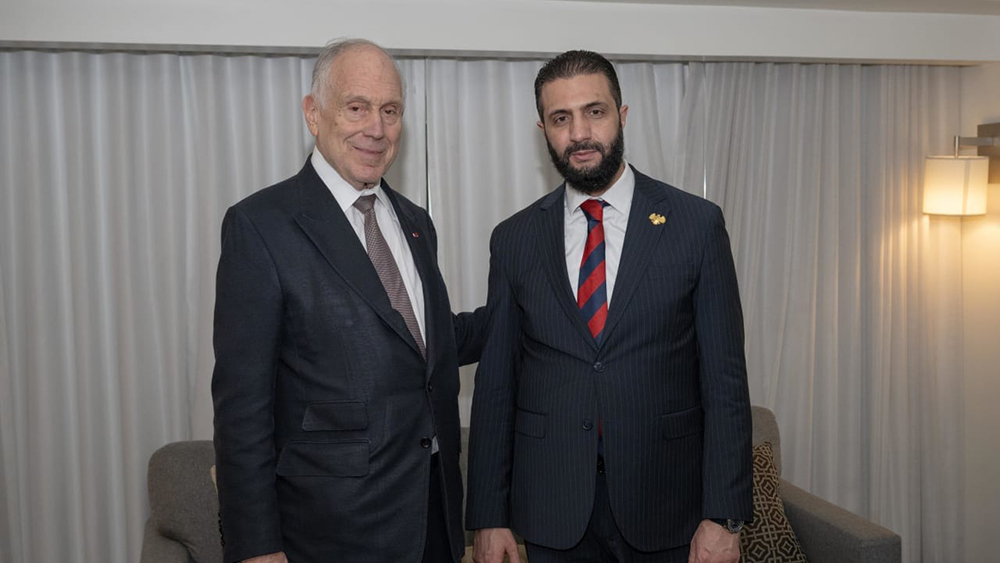
Syrian President Ahmad al-Sharaa held a rare and closely watched meeting on Sunday with World Jewish Congress President Ronald Lauder at Syria’s mission headquarters in New York, according to state-run Alikhbaria television. The encounter, taking place on the sidelines of the United Nations General Assembly, has drawn international attention as it coincides with ongoing U. S.-mediated discussions between Israel and Syria over a potential security arrangement.
Israel National News reported on Monday that the meeting revisits a historical connection, as Lauder himself played a discreet role in Syrian-Israeli peace initiatives during the 1990s. While the details of Sunday’s exchange remain sparse, the symbolism of the engagement calls attention to how seriously both Damascus and Jerusalem are weighing the regional stakes after months of heightened conflict.
Speaking last week, Sharaa voiced guarded optimism about the possibility of reaching a limited security pact with Israel. “I hope that that will lead us to an agreement that will keep the sovereignty of Syria and also resolve some of the security fears of Israel,” he told Alikhbaria. Yet, as the Israel National News report noted, the Syrian leader made clear that normalization with Israel was not an option on the table.
Sharaa underscored the distinction between Syria’s position and the Arab states that joined the Abraham Accords. “Syria is different, as those that are part of the Abraham Accords are not Israel’s neighbors. Syria has been subjected to more than 1,000 Israeli raids, strikes, and incursions from the Golan Heights into Syria,” he declared. His comments reflect a consistent Syrian posture: openness to pragmatic security arrangements but rejection of the broader normalization framework embraced by the UAE, Bahrain, and Morocco.
The cautious overtures come in the wake of Prime Minister Benjamin Netanyahu’s remarks that Israel’s recent military operations against Hezbollah had created what he termed a “new window of possibility” for peace with Syria and Lebanon. Israel National News quoted Netanyahu as acknowledging direct discussions with Damascus, while stressing that “there is still a long way to go” before any binding agreement could be reached.
Sharaa, for his part, has suggested that progress could be swift. Earlier this month in Damascus, he told reporters that negotiations on a security pact “could lead to results in the coming days.” He added that a successful outcome might pave the way for “additional agreements,” though he categorically ruled out normalization or a comprehensive peace deal at this stage.
According to the information provided in the Israel National News report, U. S. mediators remain cautiously engaged, seeking to leverage the fragile momentum. For Washington, progress on a security pact could stabilize Israel’s northern frontier, limit Hezbollah’s maneuverability, and potentially reduce Iran’s footprint in Syria.
While the meeting between Sharaa and Lauder does not signal imminent breakthrough, it highlights the subtle but significant shifts underway. As the Israel National News report observed, even the prospect of a narrow security pact between two longtime adversaries would mark a dramatic development in a region where conflict has long overshadowed diplomacy.