



|
Getting your Trinity Audio player ready...
|
Stuyvesant High School Under Fire for Antisemitism Cover-Up Following Holocaust-Themed Graffiti
By: Fern Sidman
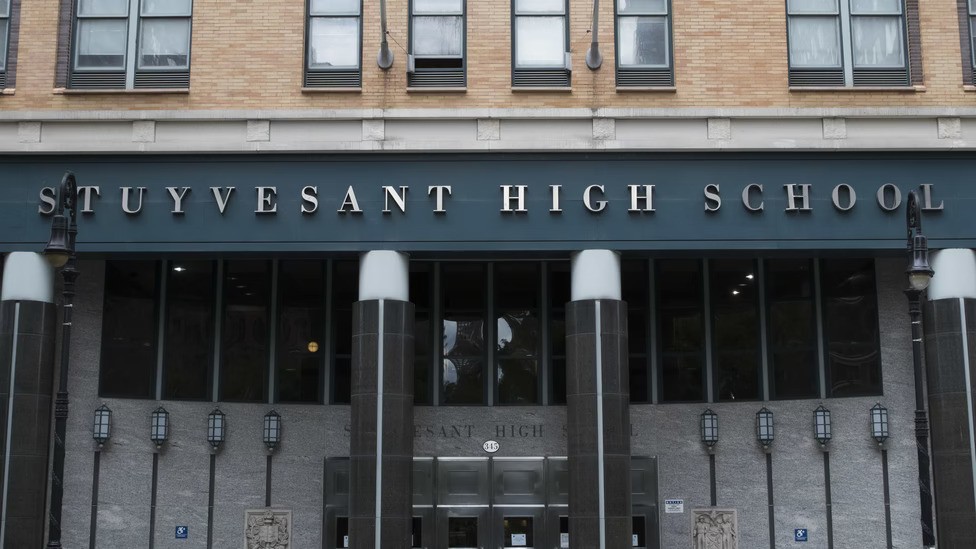
Elite Stuyvesant High School—one of New York City’s most academically prestigious public schools—is facing intense scrutiny following allegations that it failed to immediately notify parents and students about antisemitic graffiti discovered in one of the school’s boys’ restrooms. The incident, reported by The New York Post on Saturday, has provoked outrage among Jewish students, parents, and educators who accuse the school administration of attempting to “cover up” the deeply offensive content.
According to The New York Post report, school officials were aware of disturbing drawings found in the bathroom stalls but initially chose to focus public messaging on vandalism in general, rather than address the explicitly antisemitic nature of the graffiti. Only after parents voiced outrage did Principal Seung Yu send out an email late Friday night—at 10:16 p.m.—acknowledging the hateful content.
One stall contained a grotesque image of a person behind a counter with a speech bubble saying, “6 mil pizzas? We can only do 271K,”—a crude reference to Holocaust denial. A nearby figure, depicted as a bearded Jewish man wearing a black hat, exclaims: “Oy vey, stop noticing!” Additional graffiti included the initials “H.H.,” an apparent reference to “Heil Hitler,” a bear dressed in military garb, and drawings of buildings resembling a Nazi concentration camp with ghostly figures rising from it.
The New York Post interviewed Karen Feldman, a middle school teacher and Holocaust educator, who confirmed the graphic references were unmistakably antisemitic. “Using the 271,000 figure to deny the Holocaust dangerously distorts history and fuels antisemitism,” she explained. “Seeing this referenced in graffiti at Stuyvesant is shocking—and a clear sign that our education system is failing.”
Despite the gravity of the hate-filled messages, the school’s initial response did not mention antisemitism. Instead, Dina Ingram, the school’s business manager and director of family engagement, issued a vague email warning that due to “ongoing vandalism and graffiti,” most boys’ bathrooms would be locked beginning Tuesday, with only the second and seventh floor restrooms available under staff supervision. Students would now be required to sign in to use those facilities.
“This missive focused entirely on property damage,” a Jewish student told The New York Post, “with no acknowledgment of the trauma this causes Jewish students. They have more sympathy for the bathroom wall than for their Jewish student population.”
Only after growing parental backlash did Principal Yu concede that some of the graffiti contained antisemitic imagery. In his belated statement, he said: “I am deeply disappointed and angry that a young person in our school would choose to express such hateful sentiments.” Yu further described hate as “the highest form of cowardice and indignity”—words that failed to satisfy many Jewish families.
A Jewish parent who spoke to The New York Post accused the principal of trying to “sweep this under the rug.” She added, “He only sent the letter after it became apparent the parents and children knew and were upset.”
The incident is not isolated. As The New York Post has previously reported, Jewish students at Stuyvesant have long described a pattern of unchecked hostility and insensitivity. Despite its sterling academic reputation, Stuyvesant has repeatedly failed to establish a safe and respectful environment for Jewish families, critics say.
The school has 3,254 students enrolled, with a demographic breakdown showing 72% Asian-American, 17% white, 4% Hispanic, and 2% Black students. Religious affiliation is not officially tracked.
Karen Feldman, who contributed to a comprehensive report on antisemitism in New York City’s public school system, told The New York Post that administrators consistently fall short in enforcing Department of Education protocols meant to protect students from discrimination and harassment. “Administrators should promptly investigate and thoroughly document all reports of discrimination or harassment,” she stated. “They must notify the DOE’s compliance coordinator under the Dignity for All Students Act and support affected students immediately.”
The Department of Education (DOE) has launched an investigation into why Stuyvesant leaders failed to report the incident immediately, as required. A DOE spokesperson emphasized that the city’s schools have “zero tolerance for antisemitism, racism, and every other form of hate,” and vowed to work in tandem with the NYPD to “take quick and decisive action,” including disciplinary measures and appropriate educational interventions.
While the investigation unfolds, families are left demanding more than just promises. They want transparency, accountability, and meaningful support for Jewish students who now face the dual burden of hate and institutional apathy.
Many in the Stuyvesant community—and beyond—are watching closely to see whether New York’s elite public institutions are truly prepared to confront antisemitism in their own hallways.

Stuvesant High School, of which I am an alumnus, was named after New Netherland’s final Director-General Petrus Stuyvesant, who was a blatant and well known anti-Semite. The school’s name should be changed and until that takes place, it should not be surprising that Jew hatred breeds within the student body. Considering all the supposedly racist name and statue cleansing that the beautiful people of NY were so diligent about this past decade, why has no one worked on ridding the name of this staunch and disgusting Jew hater?