



|
Getting your Trinity Audio player ready...
|
By: Fern Sidman – Jewish Voice News
Rep. Elise Stefanik’s ascent from conservative firebrand to dominant gubernatorial frontrunner has accelerated with remarkable velocity, reshaping the political landscape in a state long defined by Democratic dominance. In the past week alone, Stefanik secured a sweeping series of endorsements from New York Republican leaders—an eruption of unified support that Jewish Breaking News described in a report on Wednesday as the most robust early consolidation behind a GOP candidate in more than a decade.
The congresswoman from upstate New York, who has steadily built a national profile while cultivating a loyal statewide base, now stands poised to seize the Republican nomination decisively at next year’s convention. With 58 GOP county chairs, 14 Republican state senators, 10 county executives, and 40 of the state’s 45 Conservative Party organizations backing her candidacy, she has locked down more than 75% of the party’s weighted vote.
Her campaign quickly noted the extraordinary breadth of her support. “Elise is honored to have earned endorsements from 58 GOP county party chairs representing over 75% of the New York Republican Party’s weighted vote at the convention,” her team said in a statement circulated on Jewish Breaking News. “New York Republicans are wholly united behind the common goal of firing Kathy Hochul to save New York, and they have entrusted their full confidence in Elise to do so.”
For a state Republican Party often criticized for factionalism and candidate fragmentation, Stefanik’s near-total consolidation of institutional support is a notable departure. As Jewish Breaking News reported, Republican county chairs from Western New York to Long Island announced their backing in near unison, praising Stefanik’s ability to articulate GOP values—particularly on crime, education, and the economy—while bringing national attention to issues of antisemitism and campus extremism.
Her endorsement haul is more than symbolic. At the state convention, the weighted vote is decisive; if Stefanik retains the support she holds today, the nomination becomes functionally uncontested. For any rival to make the primary ballot, they would need to gather at least 15,000 signatures from registered Republicans—a steep climb in the face of such overwhelming institutional alignment.
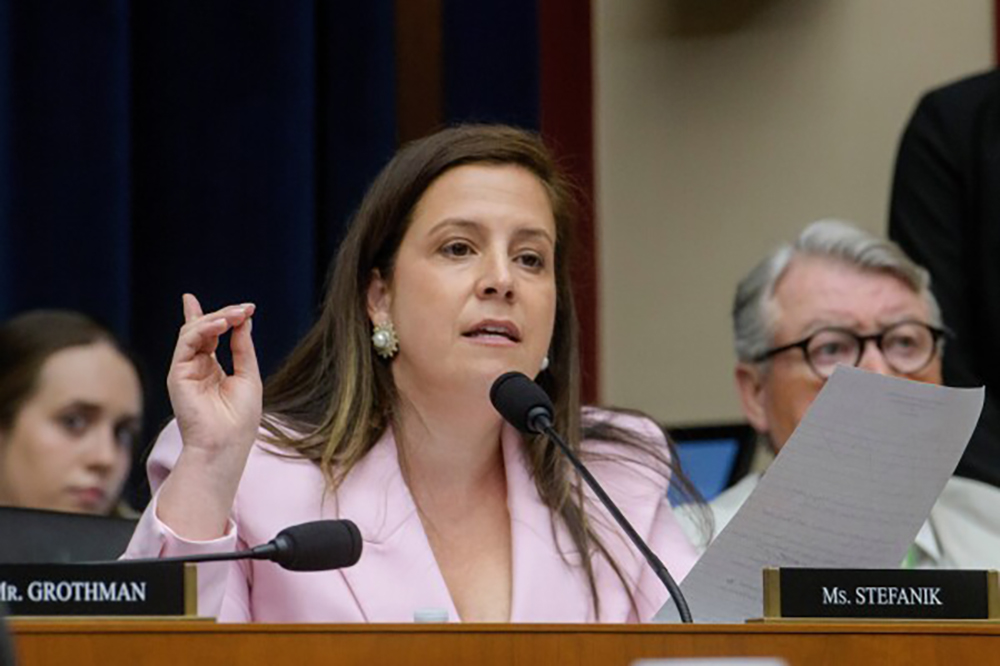
Stefanik’s rise is inseparable from her now-famous December 2023 House committee confrontation with the presidents of Harvard, the University of Pennsylvania, and MIT. In questioning that went viral within hours, Stefanik demanded clear acknowledgment of whether calls for the “genocide of Jews” violated campus harassment policies.
The presidents’ evasive, legalistic responses triggered immediate backlash. Within weeks, both Harvard’s Claudine Gay and Penn’s Liz Magill resigned under mounting pressure.
Stefanik later called the moment “a watershed that exposed the moral rot inside America’s elite institutions,” a line repeated in speeches, fundraising appeals, and interviews throughout 2024 and 2025. Her forceful stance catapulted her into the national consciousness as one of Congress’s most vocal critics of antisemitism on campuses—a theme amplified consistently by Jewish Breaking News, which has described Stefanik as a “leading public voice confronting the new wave of intellectualized antisemitism.”
Her gubernatorial campaign draws heavily on this credibility. Among Republican voters in New York—especially in suburban and outer-borough communities with significant Jewish populations—her outspokenness on antisemitism has deep resonance.
But if Stefanik has succeeded in galvanizing Republican voters, Democratic strategists see her national prominence as a liability in a state where Donald Trump remains deeply unpopular. Governor Kathy Hochul’s campaign did not wait long to respond.
In a new video advertisement released this week and cited prominently by Jewish Breaking News, Hochul labels Stefanik a “sellout,” calling her “Trump’s top ally in Congress.” The ad intercuts footage of Trump praising Stefanik as “phenomenal” with the narrator’s claim that she “has always put Trump first.”
The Hochul campaign specifically criticizes Stefanik for casting what it describes as the “deciding vote” for the One Big Beautiful Bill Act, signed into law in July—a vote Stefanik, ironically, has touted as evidence of her legislative influence.
Hochul’s messaging is clear: tie Stefanik as closely as possible to Trump, mobilize Democratic voters, and cast the 2026 race as a referendum on the former president’s ideology rather than on Hochul’s administration.
Early polling underscores why both campaigns are moving aggressively. According to the most recent Siena College survey, Hochul leads Stefanik 52% to 32%—a predictable advantage in a state where Democrats outnumber Republicans nearly two-to-one.
Yet, as the report at Jewish Breaking News emphasized, buried in those numbers is one critical figure: nearly half of all respondents said they would prefer “someone else” as governor. Hochul’s approval ratings have hovered precariously since she took office, weighed down by ongoing concerns about crime, cost of living, education, and perceived dysfunction within Albany.
Stefanik’s team has seized on this vulnerability, arguing that the race represents a rare opportunity to flip New York’s governorship for the first time since George Pataki’s victory a quarter-century ago. GOP leaders, quoted in the Jewish Breaking News report have framed 2026 as a referendum on “restoring livability, economic competitiveness, and public safety”—themes they believe transcend partisan identity.
Equally significant is Stefanik’s near-total lock on the state Conservative Party, with 40 of its 45 county organizations endorsing her early. Political analysts speaking to Jewish Breaking News noted that in New York’s unique electoral fusion system—where candidates can run on multiple party lines—Conservative Party backing is often critical for GOP viability.
The party’s weighted vote represents more than ballot position; it confers ideological legitimacy, financial resources, and grassroots mobilization networks. Securing it this early gives Stefanik a structural advantage over any hypothetical challenger.
The battle ahead is not merely partisan. It is demographic, ideological, and existential for a Republican Party that has struggled to gain statewide traction for years. Stefanik’s campaign has signaled it plans to compete aggressively in suburban counties like Nassau, Suffolk, Westchester, and Rockland, which remain politically fluid. These are also communities where concerns about antisemitism—especially following the October 7, 2023 Hamas massacre—have become deeply emotional political issues.
As Jewish Breaking News has reported, Jewish residents in these counties remain unsettled by rising campus rhetoric, hostile protests outside synagogues, and local disputes over Israel-related events. Stefanik’s visibility on these issues gives her a unique opening inside blocs of swing voters—an opportunity her campaign is already capitalizing on.
Stefanik is not merely a gubernatorial contender; she is a national figure whose trajectory is watched closely within Republican circles. Her decision to run is seen by GOP strategists as an attempt to reshape the party’s identity in deep-blue states by merging populist energy, suburban policy priorities, and hardline stances on antisemitism and campus extremism.
If she succeeds, she could redefine what a viable Republican candidacy looks like in states where winning statewide office has become nearly impossible. If she fails, Democrats will likely claim that no GOP candidate—regardless of profile—can break through New York’s partisan firewall.
Although the election is nearly two years away, the 2026 race already resembles a full-scale campaign, fueled by early endorsements, ideological combat, and the enduring shadow of national politics. With Republicans coalescing behind Stefanik and Democrats preparing to dig in behind Hochul, New York is bracing for one of the most consequential gubernatorial contests in a generation.
As the Jewish Breaking News report observed, the stakes are unmistakably high—not only for Stefanik and Hochul but for the political future of a state increasingly defined by polarization, demographic realignment, and intensifying debates over identity, education, and public safety.