



|
Getting your Trinity Audio player ready...
|
By: Fern Sidman – Jewish Voice News
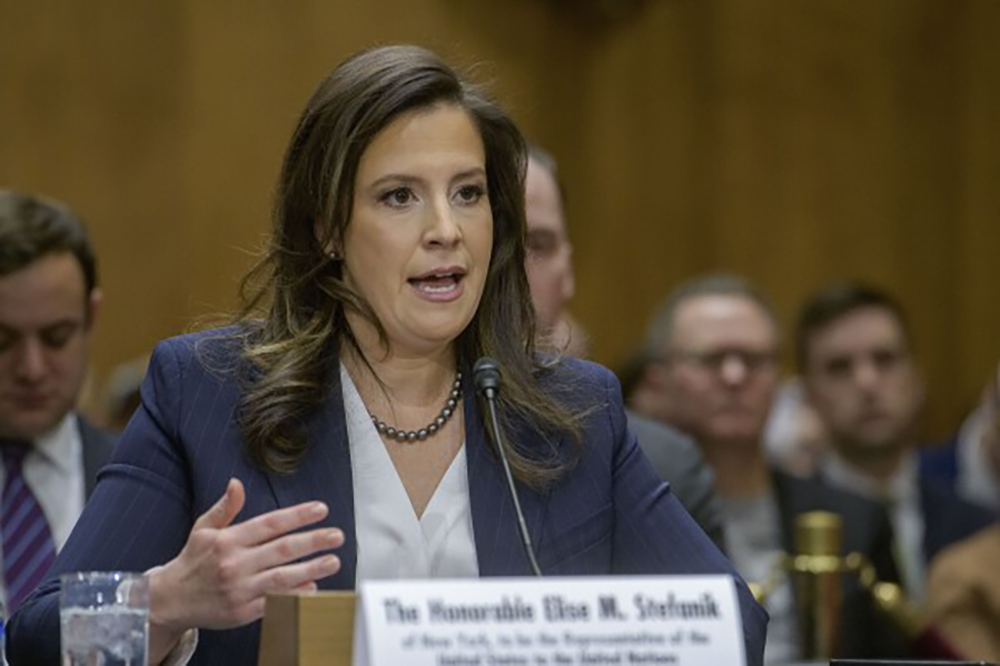
Congresswoman Elise Stefanik, now the Republican frontrunner in the 2026 New York gubernatorial race, unleashed one of her sharpest attacks yet on Governor Kathy Hochul on Thursday, accusing the Democratic incumbent of reneging on her pledge not to raise taxes and of accelerating what Stefanik has repeatedly labeled an “affordability crisis” devastating households across the state.
In a blistering statement, Stefanik said Hochul had once again demonstrated an instinct for “political desperation,” arguing that her willingness to consider broad-based tax increases—despite earlier assurances to the contrary—illustrates a deeper pattern of capitulation to New York’s ascendant progressive bloc. Stefanik charged that Hochul, under pressure from what she called “the Socialists,” is now prepared to inflict further financial burdens on families already strained by soaring costs in housing, utilities, and consumer staples.
“Like clockwork, the Worst Governor in America Kathy Hochul is making New York even more unaffordable after breaking her promise and committing to raising taxes,” Stefanik declared, asserting that the governor’s policy posture will “further crush hardworking New York families.”
Stefanik’s remarks call attention to a central theme of her gubernatorial bid: that Hochul’s stewardship has exacerbated a cost-of-living crisis disproportionately harming the middle class, and that only a change in leadership can reverse New York’s economic trajectory. The Republican congresswoman has made affordability, public safety, and government accountability pillars of her campaign, and Thursday’s broadside signaled yet another escalation in what is expected to become one of the most combative gubernatorial races in recent state history.
Stefanik’s critique zeroed in on what she characterized as Hochul’s long-standing “bait-and-switch” tendency, recounting past controversies to frame the governor as untrustworthy and politically opportunistic. Chief among these examples is Hochul’s handling of congestion pricing—a program she previously appeared ambivalent about, but ultimately championed before abruptly pausing it earlier this year amid intense backlash from business owners, commuters, and suburban leaders.
“New Yorkers saw the same bait-and-switch routine when she implemented her illegal congestion pricing tax after saying she wouldn’t,” Stefanik said. While Hochul later ordered a temporary halt to the contentious program, Stefanik and other critics insist that the governor’s reversal came too late and that the financial architecture behind the plan remains intact, leaving open the possibility of future reactivation.
By invoking congestion pricing—long a political lightning rod—Stefanik aimed to draw a straight line between what she views as broken commitments and the governor’s current willingness to raise taxes on businesses. The Republican hopeful argued that Hochul’s policies have consistently punished employers at a moment when commercial real estate vacancies remain elevated and small businesses continue to struggle with post-pandemic recovery.
“And now we’re about to see her biggest tax hike on businesses yet,” Stefanik said, asserting that Hochul’s approach will accelerate an exodus of employers to lower-tax jurisdictions and hobble the state’s efforts to maintain competitiveness in finance, technology, and manufacturing.
The tax debate comes as New York confronts a complicated fiscal landscape, including persistent budget pressures tied to rising migrant-related expenditures, inflation-driven increases in public-sector costs, and slowing revenue growth. Economists note that New York’s reliance on high-income taxpayers—who account for a disproportionate share of state tax collections—makes its budget especially vulnerable to economic downturns and relocation trends.
Stefanik’s campaign has seized on these vulnerabilities, arguing that Hochul’s proposed tax increases will accelerate a broader pattern of demographic and financial out-migration already underway. She contends that the state’s long-term viability depends on reversing both the perception and reality of economic decline.
“New York families can’t afford Kathy Hochul’s Socialist tax-hiking agenda on top of her affordability crisis,” she asserted, warning that the governor’s policies will deepen financial insecurity for households across the state. Stefanik’s allies have frequently noted that New York’s combined state and local tax burden remains the highest in the country, a distinction that has fueled debate over whether aggressive fiscal restructuring is necessary to retain residents and businesses.
Stefanik’s statement on Thursday reflects not only ideological opposition to Hochul’s fiscal policies but also the accelerating momentum of her own campaign. In recent weeks, she has secured an unprecedented wave of endorsements from Republican county chairs, state senators, and conservative party leaders—amassing more than 75% of the weighted vote needed to clinch the nomination outright.
Her high-profile appearance during the December 2023 congressional hearing on campus antisemitism propelled her into the national spotlight, elevating her stature among donors and party activists. The viral exchange—credited with catalyzing the resignations of the presidents of Harvard and the University of Pennsylvania—remains a central element of her political branding and continues to resonate with voters concerned about antisemitism, ideological extremism, and free speech on college campuses.
Democrats, by contrast, have worked to tie Stefanik closely to President Trump, framing her as an ideological extension of the Republican frontrunner. Hochul has leaned heavily into this strategy, calling Stefanik a “sellout” who has “always put Trump first,” while amplifying clips of the former president praising the congresswoman as “phenomenal.”
Stefanik’s campaign has dismissed these criticisms as distractions, maintaining that voters are more concerned with the cost of living, crime, and economic stagnation than partisan labels. Thursday’s statement reinforced this message, presenting her candidacy as a direct response to what she described as Hochul’s mismanagement and ideological drift.
As the race moves toward 2026, the emerging contrast between the two candidates is stark. Hochul argues that her policies—including investment in infrastructure, expanded social services, and targeted economic development—reflect a pragmatic approach to governing during turbulent times. Stefanik counters that the governor’s agenda has produced intolerable economic pressures and contributed to a broader climate of public frustration.
The upcoming debate over taxation is likely only the first of many intense policy battles ahead. Stefanik’s latest salvo, delivered with characteristic force, signals that her campaign will continue pressing its case that Hochul’s leadership has become synonymous with fiscal recklessness and broken promises.
And, as she made clear on Thursday, the Republican candidate believes a turning point is coming.
“Next November, New York will fire her and send her failed policies packing,” Stefanik said.
Whether voters agree remains to be seen. But as the state confronts profound economic and political challenges, both campaigns appear poised for an extraordinary contest—one that will shape the future of New York for years to come.