



|
Getting your Trinity Audio player ready...
|
Stefanik Blasts Hochul as ‘Heinous Hypocrite’ for Silence on Pro-Hamas Ally Mamdani
By: Fern Sidman
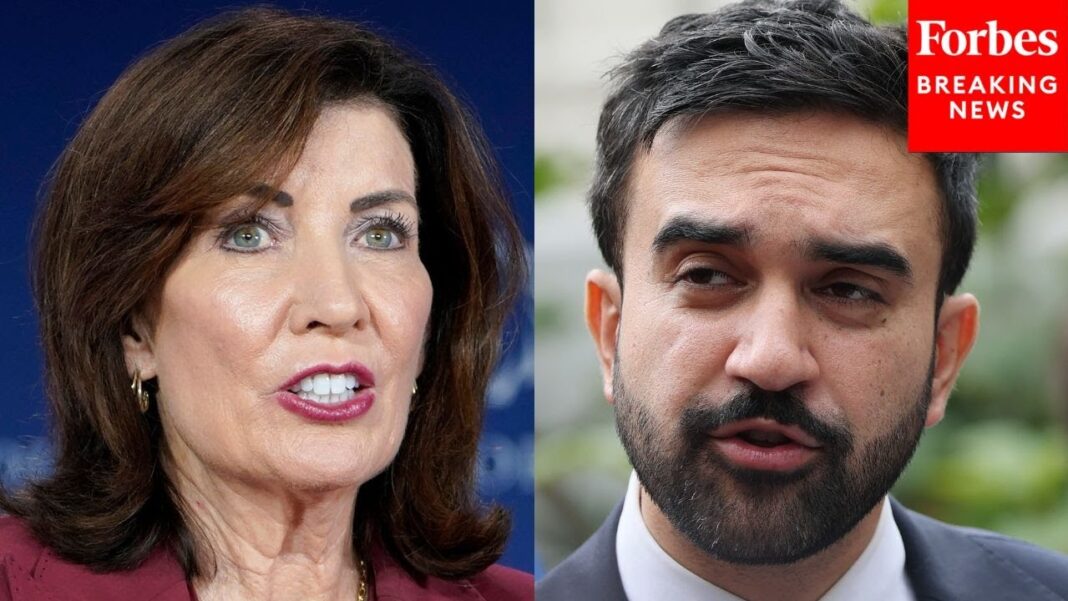
On Wednesday, House Republican Leadership Chairwoman Elise Stefanik delivered a searing and unapologetic statement that electrified the political landscape in New York and beyond — a fiery denunciation of Governor Kathy Hochul that pulled no punches and underscored Stefanik’s emergence as one of the most fearless voices in American politics. Declaring “Hochul the Hypocrite is back!,” Stefanik accused the embattled Democratic governor of moral cowardice, political duplicity, and abject failure to confront the dangerous rise of antisemitism, leftist extremism, and pro-Hamas sympathies festering within her own party.
Her statement — equal parts indictment and rallying cry — left no ambiguity: “There is no question that Kathy Hochul is truly the WORST Governor in America.”
Stefanik’s remarks reflected a broader frustration shared by many New Yorkers who feel that Hochul’s leadership has left the state morally adrift and politically rudderless. With escalating antisemitic incidents, surging violent crime, and radical activists openly sympathizing with Hamas after the October 7th massacre of Israelis, Stefanik made clear that silence from Albany’s top office is no longer acceptable. Her sharp words struck a chord across the political spectrum — particularly among voters who have watched Democratic officials dodge accountability as hate speech, political violence, and pro-terror rhetoric spread through college campuses and city streets.
“I condemned the vile statements and was the first elected and most senior Republican to do so,” Stefanik emphasized, highlighting her consistent record of moral clarity. “I called for them to step down — which they did. You, on the other hand, failed to condemn any of the heinous antisemitism in your own party.”
The statement, which spread rapidly across social media, contrasted Stefanik’s decisive leadership with Hochul’s passivity. Stefanik noted Hochul’s failure to lower state flags after the assassination of conservative activist Charlie Kirk, and her refusal to speak out against multiple violent threats made by Democratic operatives and candidates — including one who publicly declared a desire to “shoot a Republican in the head.” Stefanik’s message was clear: the double standard in moral outrage must end.
“You are a heinous hypocrite,” she charged. “You failed to condemn calls for violence against Republicans. You failed to condemn a Democrat candidate saying he wanted to shoot a Republican in the head and kill his children in his mother’s arms.”
But Stefanik saved her strongest rebuke for Hochul’s silence on her endorsement of Zohran Mamdani, the far-left, self-described Democratic Socialist running for NYC mayor — a candidate whose repeated defenses of Hamas and attacks on Israel have stunned many New Yorkers. “And of course,” Stefanik thundered, “where is your condemnation of your jihadist Mayor candidate you endorsed — the one who just went on TV saying Hamas terrorists shouldn’t lay down their arms? Hamas terrorists who killed New Yorkers on October 7th. Where is your condemnation of that? DEAFENINGLY SILENT.”
In taking direct aim at both Hochul and Mamdani, Stefanik articulated what many see as the moral divide defining modern New York politics: a choice between principled leadership that defends the rule of law, Israel, and Jewish communities — and a radical left that rationalizes terrorism and excuses antisemitism under the guise of “activism.”
Her words were not merely political theater; they were a moral reckoning. Stefanik’s forceful condemnation of Hochul’s hypocrisy comes amid growing concern that New York’s Democratic establishment has been infiltrated by extremist ideologies that are hostile to America’s allies and values. Figures such as Mamdani — who has publicly questioned Israel’s right to self-defense and derided bipartisan measures to define antisemitism under the IHRA standard — now represent the ideological fringe steering New York’s progressive movement.
Stefanik, by contrast, has been unwavering in her support for Israel and the Jewish community, especially in the wake of the October 7th atrocities. She was among the first federal officials to condemn Hamas’s barbaric attack and to demand accountability from those spreading antisemitic rhetoric on American campuses and in city government. Her leadership helped push congressional inquiries into university administrators who turned a blind eye to anti-Jewish hate. In doing so, she positioned herself as the moral compass of a Congress often paralyzed by political correctness.
By juxtaposing Hochul’s silence with her own decisive action, Stefanik drew a line in the sand: “You will be FIRED next year. The leaders in your own Democrat party admit it as well.”
That final declaration — part warning, part prophecy — echoed through conservative circles as a rallying cry for disaffected New Yorkers weary of spiraling taxes, urban decay, and ideological extremism. It also signaled Stefanik’s growing national prominence as a Republican powerbroker unafraid to confront hypocrisy head-on.
Supporters have lauded Stefanik for speaking the truth others fear to say. In a state dominated by Democratic machines and progressive media, her bluntness cuts through the fog of political evasion. Her defense of Jewish New Yorkers — and her willingness to name those enabling antisemitism — sets her apart from the performative moralism of the left.
Stefanik’s framing of Hochul as the embodiment of hypocrisy is not merely rhetorical. It resonates because the governor’s record provides ample material. Despite posturing as a defender of tolerance and inclusion, Hochul has repeatedly refused to condemn antisemitic activism tied to her political allies, while embracing far-left figures who have excused Hamas atrocities as “resistance.” Meanwhile, under her watch, crime continues to plague New York’s subways, small businesses are suffocating under regulation, and residents are fleeing the state in record numbers.
Against this backdrop, Stefanik’s call to “Fire Hochul. Save New York” has become more than a slogan — it is a movement for moral restoration. Her insistence that New York deserves leaders who value law, order, and life itself reflects a growing frustration among moderate and conservative voters who feel their values have been betrayed.
In contrast, Mamdani represents the ideological extremism that Stefanik and millions of New Yorkers find unacceptable. His refusal to condemn Hamas’s terrorism, his campaign to repeal the IHRA definition of antisemitism, and his alignment with the Democratic Socialists of America — an organization that has repeatedly celebrated “resistance” movements against Israel — have made him a lightning rod for controversy. Hochul’s endorsement of such a figure, Stefanik argues, exposes a moral bankruptcy that transcends politics.
The stakes, Stefanik insists, could not be higher. Her statement is a warning that the normalization of antisemitism and political violence must not be tolerated under any administration — Democrat or Republican. It is also a declaration that the Republican Party, under leaders like her, will not cower in silence while Jewish citizens are threatened, conservative voices are targeted, and radical ideologues hijack civic discourse.
As the 2026 election cycle looms, Stefanik’s message — bold, unapologetic, and morally clear — is likely to galvanize a growing coalition of New Yorkers who are exhausted by weak leadership and radical politics. Her unwavering commitment to truth over expedience, and her courage in confronting those who excuse hatred, have made her one of the most formidable figures in American public life.
With the phrase “Fire Hochul. Save New York,” Stefanik has distilled a movement into four words: a demand for integrity, safety, and the restoration of moral leadership in a state that once set the nation’s standard for governance.
And as her voice continues to reverberate across the state and nation, it’s increasingly clear that Elise Stefanik has become more than a political leader — she is the conscience of a movement determined to reclaim New York from hypocrisy, weakness, and moral decay.
Stefanik for Governor!
Kudos to Stefanik!