



|
Getting your Trinity Audio player ready...
|
Stay Warm, Spend Less: The ‘12-Inch Rule’ and Essential Survival Tips for Winter Storm Fern
By: Fern Sidman
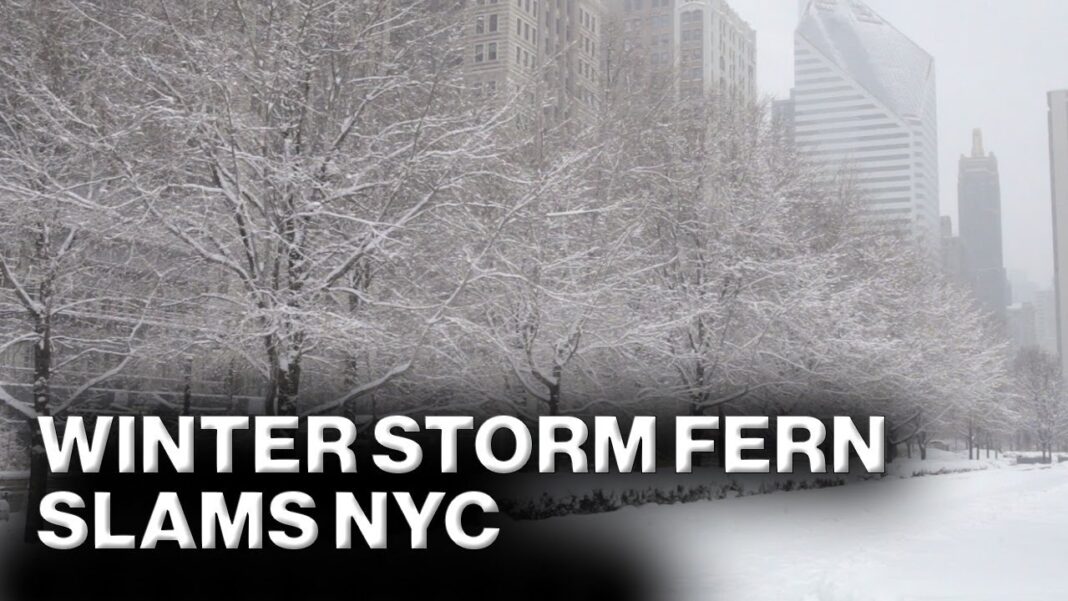
As Winter Storm Fern barrels toward the eastern half of the United States, the nation finds itself on the threshold of a vast meteorological confrontation—one that is shaping not merely weather forecasts, but daily life, household economics, workplace expectations, and personal safety. According to a report on Saturday in The New York Post, the storm is expected to affect as many as 220 million Americans, with the Northeast—particularly New York City—standing directly in the crosshairs of what forecasters warn could become one of the most disruptive winter systems in years.
The Big Apple, as The New York Post has consistently documented, is bracing for as much as 12 inches of snowfall on Sunday alone, accompanied by bone-chilling temperatures that will lock the region into a deep freeze. Yet Winter Storm Fern is not merely a story of accumulation totals and arctic air masses. It is also a story of economic vulnerability, domestic preparedness, labor rights, infrastructure resilience, and the delicate balance between personal responsibility and systemic protection in moments of environmental extremity.
In the days leading up to the storm, experts from across sectors have begun offering guidance not only on how to survive the cold, but on how to mitigate its financial and logistical toll. As The New York Post has reported, this storm is forcing Americans to rethink the way they heat their homes, commute to work, protect their possessions, and plan their movements through a landscape that may soon be rendered immobile by ice and snow.
At the center of domestic concern is the simple, unavoidable reality of heating costs. With millions of households preparing to remain indoors for prolonged periods, energy consumption is set to spike dramatically. Energy expert Matt Oberle, speaking to The Sun and cited in coverage amplified by The New York Post, offered a deceptively simple but strikingly effective strategy: what he calls the “12-inch rule.” The principle is rooted in thermodynamics rather than renovation. Heavy furniture—sofas, cabinets, beds—pressed against radiators blocks convective airflow, trapping heat before it can circulate through a room.
By moving large objects just one foot away from radiators, Oberle explained, warm air is allowed to rise and disperse naturally, reducing the load on thermostats and lowering overall energy demand. “You don’t need to redesign the entire room,” he noted. “Once the warm air has the space to rise and circulate freely, your thermostat won’t need to call for as much energy.” In a city such as New York, where heating bills already impose a heavy burden on working families, this small adjustment becomes a form of economic survival—a quiet resistance against energy inflation intensified by winter extremes. The New York Post report underscored how storms like Fern do not simply disrupt daily routines; they amplify existing cost-of-living pressures that millions already struggle to manage.
Yet the storm’s reach extends beyond the domestic sphere and into the legal and ethical terrain of labor. As The New York Post reported, many workers are already questioning whether they can safely commute if Fern delivers on its most severe forecasts. The answer, legally, is far more complex than many assume. Under the Occupational Safety and Health Administration’s General Duty Clause, employers are obligated to maintain safe working conditions—but this does not automatically grant employees the right to refuse to travel to work during hazardous weather.
Employment law guidance cited by The New York Post report makes clear that protections are narrow and highly contextual. Motor carrier employees possess limited rights to refuse driving if they fear for their safety, but for the majority of the workforce, the law offers far less latitude. Unless an employer formally agrees that conditions are too dangerous, failure to report to work can legally result in discipline or termination. This legal reality exposes a stark asymmetry: while storms threaten physical safety, economic vulnerability often compels individuals to choose between risk and livelihood.
This tension—between bodily security and financial survival—defines much of the storm’s psychological landscape. Winter Storm Fern is not simply a meteorological event; it is a social stress test, revealing how fragile the balance is between protection and precarity in modern American life. As The New York Post has emphasized in its broader storm coverage, climate disasters increasingly expose systemic inequalities, where those with resources shelter safely while others navigate risk out of necessity rather than choice.
The storm’s threat also extends into the intimate spaces of personal property and transportation. Experts warn that extreme cold transforms everyday objects into liabilities. Lithium-ion batteries, particularly those in e-cigarettes, become volatile in subzero temperatures. Medications left in vehicles can lose chemical stability, rendering them ineffective or dangerous. Even innocuous groceries—eggs, liquids, canned goods—can freeze and rupture, turning cars into scenes of frozen destruction rather than refuge.
The New York Post report highlighted how these details, often dismissed as minor inconveniences, accumulate into significant losses during major winter systems. A cracked windshield, a destroyed phone battery, spoiled medication, or frozen plumbing can carry financial consequences far beyond the storm itself. In this sense, Fern’s danger lies not only in immediate hazards, but in the cascade of secondary damage that follows prolonged exposure to extreme cold.
The National Weather Service, as cited in reporting circulated by The New York Post, has urged drivers to treat their vehicles as potential survival environments rather than mere transport. Emergency preparedness is no longer framed as paranoia but as rational risk management. In storms of this scale, mobility itself becomes uncertain, and vehicles transform from tools of movement into temporary shelters—places where a flashlight, phone charger, or first-aid kit may determine outcomes in moments of crisis.
What makes Winter Storm Fern particularly destabilizing is its sheer scale. Affecting potentially 220 million Americans, it represents not a regional disturbance but a continental event. Cities, suburbs, rural communities, highways, airports, and supply chains will all feel its impact. As The New York Post report noted, storms of this magnitude create ripple effects that extend far beyond snowfall totals: canceled flights, disrupted commerce, strained energy grids, delayed emergency services, and overwhelmed infrastructure.
For New York City, the storm carries symbolic weight as well as physical danger. The city’s relationship with winter storms is deeply historical, shaped by blizzards that have paralyzed transit systems, reshaped political careers, and defined collective memory. Fern now enters that lineage as another test of preparedness, governance, and resilience. The New York Post has chronicled how storms are not simply acts of nature in the urban context—they become civic events, measuring institutional competence and public trust.
Yet amid the anxiety and warnings, there is also a deeper narrative emerging—one of adaptation rather than panic. Americans are not merely bracing for Fern; they are learning to live within a new climate reality, where extreme weather is no longer exceptional but cyclical. Energy efficiency hacks, legal literacy, emergency preparedness, and domestic resilience are becoming everyday skills rather than niche knowledge.
In this sense, Winter Storm Fern is not just a crisis—it is a classroom. It teaches the fragility of infrastructure, the limits of legal protection, the importance of preparation, and the interconnectedness of personal choices and public systems. As The New York Post continues to document, storms like Fern do not simply pass through cities; they leave behind lessons, scars, and structural questions about how societies protect their most vulnerable.
As snow clouds gather and temperatures plunge, millions of Americans are preparing not only for a storm, but for the disruptions it will impose on every layer of daily life. Homes will become shelters, cars potential lifelines, and small decisions—moving a couch, charging a phone, staying inside—acts of quiet resilience.
Winter Storm Fern, in this sense, is not merely an environmental phenomenon. It is a convergence of climate, economy, law, and human vulnerability. And as The New York Post has made clear through its coverage, the true story of Fern will not be written only in inches of snow, but in how communities adapt, protect, and endure in the face of a cold that tests not just bodies, but systems, structures, and solidarity.
When the snow finally falls and the city falls silent beneath its weight, what will remain is not just frozen streets and shuttered storefronts—but a collective reckoning with how fragile modern life becomes when nature reminds us who ultimately holds power. And in that stillness, Winter Storm Fern will stand not just as a storm, but as a symbol of a world increasingly shaped by extremes.
