



|
Getting your Trinity Audio player ready...
|
By: Ariella Haviv – Jewish Voice News
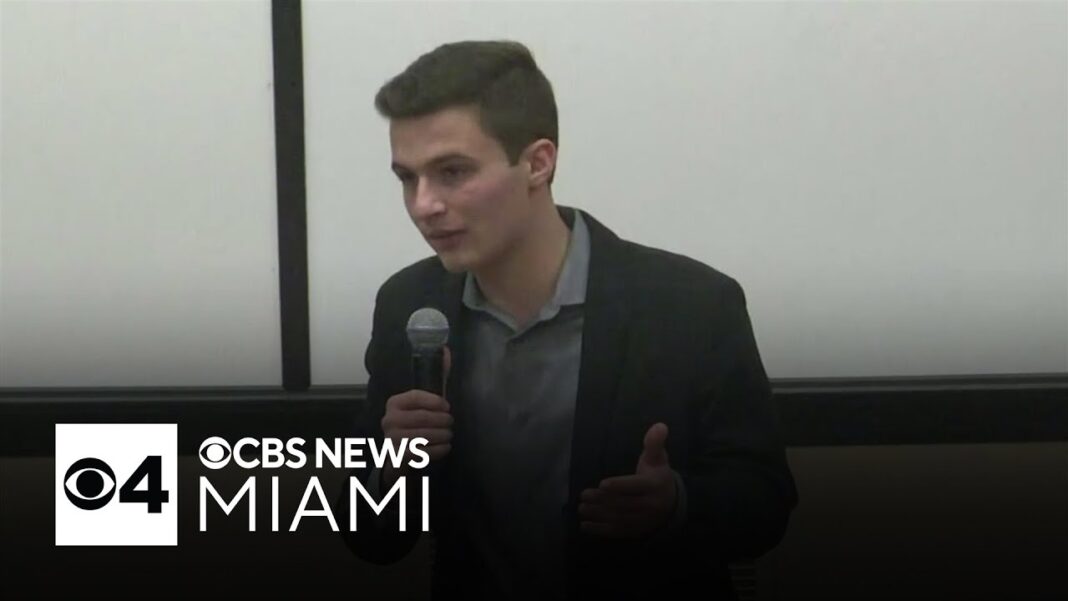
Cameron Kasky, the activist who emerged as one of the most recognizable voices for gun-control reform after surviving the 2018 mass shooting at Marjory Stoneman Douglas High School, formally entered the race for New York’s 12th Congressional District on Tuesday. His decision injects a high-profile and highly ideological contender into one of the most closely watched Democratic primaries of the 2026 cycle. As reported on Tuesday by VIN News, Kasky’s campaign announcement instantly reverberated across Manhattan’s political landscape, drawing both national attention and local scrutiny.
The 25-year-old Florida native, who co-founded the March for Our Lives movement in the aftermath of the Parkland massacre that killed 17 people, now seeks to represent one of the most heavily Jewish districts in the United States — a district long held by retiring Rep. Jerrold Nadler, the chamber’s longest-serving Jewish member and a central figure in the Democratic Party’s pro-Israel establishment. Nadler’s departure, announced in September, opened the door to a crowded and ideologically diverse slate of candidates vying to succeed him.
Kasky’s campaign literature, released Tuesday morning and reviewed in coverage by VIN News, frames his congressional bid as an extension of his years-long advocacy against the proliferation of American firearms. But his announcement took on a pronounced foreign-policy dimension as well, with the young activist declaring that the U.S. role in global weapons distribution extends far beyond domestic gun violence.
“As a school-shooting survivor, I began my life calling for an end to the mass murder of innocent children and adults using weapons manufactured by the United States,” Kasky wrote. “Witnessing the ongoing genocide in Gaza has served as a haunting, serious reminder that it is my life’s purpose to advocate against violence everywhere.”
This statement — including his description of Israel’s military operations in Gaza as “genocide” — immediately set Kasky apart from the district’s traditional Democratic leadership, especially from Nadler. As the VIN News report emphasized, the contrast between the outgoing congressman’s support for Israel and the insurgent candidacy of a self-described “Democratic socialist” advocating for cutting U.S. military assistance to Israel, shines a spotlight on the ideological crossroads facing Manhattan Democrats in 2026.
Kasky’s platform is similarly ambitious on domestic issues. In addition to a sweeping overhaul of federal gun laws, he is calling for a Medicare for All system, the abolition of Immigration and Customs Enforcement (ICE), and federal regulation of artificial intelligence — priorities that place him squarely within the left-wing of the Democratic Party. These positions also align him with the activist-driven politics that defined his rise to national prominence.
The 12th District, which includes Manhattan’s Upper West Side, Upper East Side, and Midtown, has historically been shaped by older, affluent, and politically engaged Democratic voters — including one of the largest concentrations of Jewish residents in the country. As VIN News reported, the district’s demographic composition may become a defining factor in assessing Kasky’s chances, especially given his explicit criticisms of Israeli policy and U.S. military support for the Jewish state.
Kasky’s Jewish identity may provide some insulation, but his stated positions nonetheless represent a sharp departure from Nadler’s worldview and from the broader pro-Israel orientation of many of the district’s longtime voters. Political strategists quoted by VIN News note that while Manhattan voters are often progressive on social issues, foreign policy — particularly concerning Israel — has historically been an area where the district skews more centrist or moderate.
Complicating Kasky’s path to victory is the increasingly crowded Democratic field seeking to capitalize on Nadler’s retirement. As noted in the VIN News report, the list of declared or anticipated candidates includes a blend of political newcomers, seasoned lawmakers, and prominent families.
Among the most talked-about competitors is Jack Schlossberg, grandson of President John F. Kennedy, who brings both national name recognition and a potentially powerful network of Democratic donors. New York City Councilman Erik Bottcher, a prominent figure in West Side politics, has already cultivated strong grassroots support through his advocacy on LGBTQ issues and housing policy. State Assemblyman Micah Lasher, a veteran of New York politics and former aide to Gov. Kathy Hochul and Mayor Michael Bloomberg, is widely viewed as a serious contender with deep institutional backing.
Also in the race is journalist and civil-rights attorney Jami Floyd, whose profile grew through years of on-air commentary and public service, as well as several additional candidates who are expected to shape the ideological breadth of the primary. The emerging dynamic reflects a rare convergence of generational turnover, ideological contestation, and high-stakes communal politics in one of the nation’s most influential districts.
For Kasky, Manhattan is not entirely unfamiliar territory. He moved to New York to attend Columbia University — a detail that forms a symbolic part of his personal narrative — although he later dropped out. He now resides in the district full-time. His campaign announcement video featured footage of him canvassing neighborhood blocks, speaking with residents in local parks, and referencing the district’s rich tradition of political activism.
In interviews highlighted by VIN News, Kasky has portrayed his candidacy as a natural evolution of his activism. He has argued that the movement he helped launch in 2018 demonstrated the power of youth-led organizing to shape national conversation and force legislative attention — even if federal gun-reform legislation has continued to stall in Congress. He insists that the next phase of his work requires institutional power, not just grassroots pressure.
But Kasky’s campaign will encounter immediate headwinds. His views on Israel — particularly his use of the word “genocide” — are likely to become a focal point of the race. They may also place him in tension with the district’s significant population of older Jewish residents, many of whom have longstanding ties to Jewish communal institutions and are deeply sensitive to shifts in Democratic rhetoric on Israel.
Although Kasky identifies strongly with his Jewish background, he is aligned with a younger cohort of left-leaning Jewish activists who have embraced movements such as Jewish Voice for Peace and IfNotNow. This ideological realignment among younger Jewish voters is widely documented, but has not historically dominated electoral politics in Upper Manhattan. Whether this shift is sufficiently powerful to carry Kasky to a congressional seat remains an open question.
Kasky’s supporters argue that his unique trajectory — from a traumatized teenager to a nationally recognized advocate for gun-violence survivors — gives him a moral authority that transcends traditional political categories. They contend that the same qualities that made March for Our Lives a formidable advocacy movement could help him connect with voters seeking generational change and a fresh approach to Congress.
But his critics, including several veteran Democratic strategists quoted in the VIN News report, warn that the district’s voters have a long track record of rewarding stability, moderation, and deep experience in governance — qualities more closely aligned with candidates like Lasher, Bottcher, or Floyd. For these observers, Kasky’s youth and ideological boldness may prove to be liabilities in a district accustomed to the legislative influence of figures like Nadler.
Regardless of the ultimate outcome, Kasky’s entry into the race ensures that the 2026 Democratic primary for New York’s 12th District will be a referendum not only on political leadership but on the ideological identity of one of the most storied congressional constituencies in the country. As the early stages of the contest unfold, the district appears poised to become a national staging ground for the broader struggles shaping the Democratic Party — from gun control to foreign policy to generational power.
As the VIN News report observed, Manhattan’s voters will be watching closely as Kasky and his rivals attempt to define the future of a district long considered a bellwether for liberal Jewish political engagement.
Cameron Kasky is not halachically Jewish. His mother is not Jewish.