



|
Getting your Trinity Audio player ready...
|
Snowmageddon Over the Skyline: The Big Apple Braces for a Historic Whiteout as Winter Storm Fern Bears Down
By: Fern Sidman
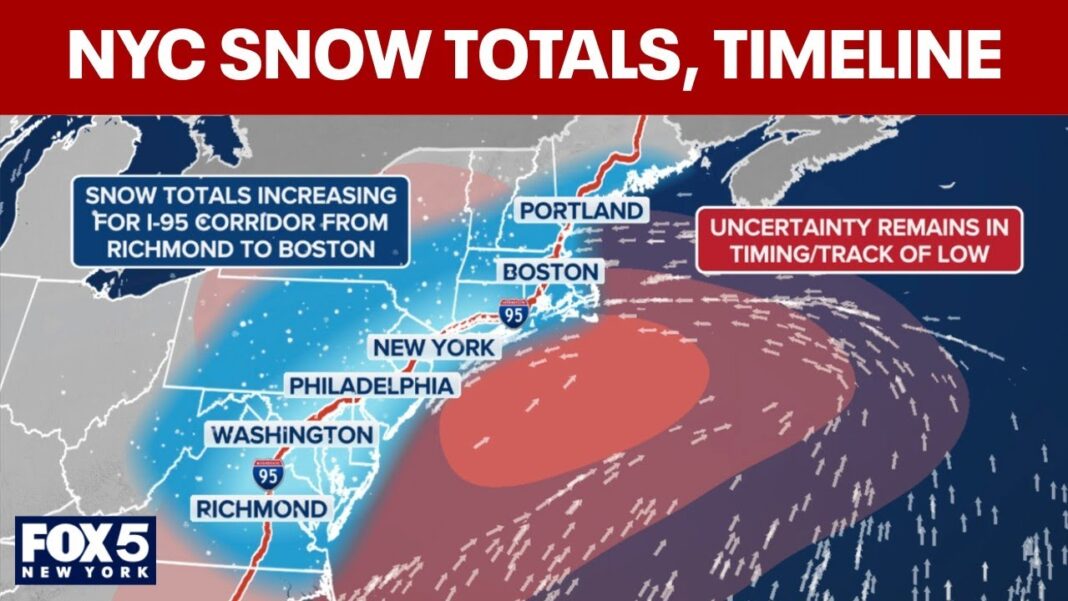
New York City stands on the precipice of what meteorologists are calling a potentially historic winter catastrophe—a fast-advancing, high-impact snowstorm poised to bury the metropolis under a suffocating blanket of snow, ice, and Arctic cold. According to forecasts repeatedly cited in a report on Thursday in The New York Post, the storm, known as “Winter Storm Fern” threatens to deliver up to 16 inches of snow in New York City, as much as 18 inches in the Hudson Valley, and widespread disruption across the entire tri-state region, potentially rivaling the legendary Blizzard of 1996.
Forecasters warn that the storm, expected to begin between midnight and early Sunday morning, could transform the Northeast’s most vital transportation, commercial, and residential corridors into frozen gridlock. The event is already being described by AccuWeather and emergency planners as a multi-day paralysis event, capable of immobilizing roads, grounding flights, closing schools, and stranding millions of residents in place.
“This is not just another winter storm,” AccuWeather Senior Meteorologist Tom Kines told The New York Post. “The roads are going to be horrendous from Sunday on. There’s no travel that will be safe—it’s going to be a disaster.”
The coming storm is not a local weather event—it is part of a continental-scale winter system expected to impact roughly 35 states, with the heaviest effects east of the Rockies. As reported by The New York Post, snowfall in distant cities such as Dallas and Charlotte is already expected to cause ripple effects across the national aviation network, triggering cascading flight delays and cancellations in New York City and major hubs across the country.
“There’ll be a huge domino effect on airports this weekend,” Kines said in comments cited by The New York Post. “I’m sure there’s gonna be many, many cancellations and delays.”
The system follows a brutal Arctic cold front that has already driven temperatures into the teens across the region. That cold air mass will serve as a perfect atmospheric foundation for dry, fluffy, high-accumulation snow, ensuring that whatever falls will stick, compact, and persist.
According to projections highlighted in The New York Post report, meteorologists are modeling multiple storm tracks, with the most severe scenarios placing up to 16 inches in New York City, up to 18 inches in the Hudson Valley, 8 to 12 inches across most of New Jersey and Connecticut and potential 2-foot totals in parts of the Hudson Valley
Such totals would mark the largest snowfall in NYC since February 2021, when Central Park recorded 16.8 inches, and could rival the most significant snow events in modern city history.
In the Hudson Valley, forecaster Ben Noll, quoted by the Hudson Valley News and referenced in The New York Post report, placed the odds at 100% chance of at least 6 inches, 80% chance of more than 12 inches, and 20% chance of exceeding 18 inches.
If realized, those totals would represent the heaviest snowfall in 30 years for parts of the region.
Meteorological timelines reviewed by The New York Post suggest snowfall could begin as early as midnight Sunday, intensifying rapidly through the morning hours and continuing into Monday.
Kines warned that Sunday may effectively become a lost day for the city: “If there’s a foot or more, the city is going to be at a standstill. Travel by land will be slow at best if not impossible and airports will be shut down.”
The storm’s projected end time—around noon Monday—offers little relief, as temperatures are forecast to remain below freezing through Wednesday, February 4, ensuring that snow and ice accumulation will not melt quickly.
According to the information provided in The New York Post report, temperatures will plunge as low as 11 degrees, creating dangerous conditions for pedestrians, drivers, sanitation workers, and emergency responders alike.
While forecasters warn of worst-case scenarios, Mayor Zohran Mamdani has adopted a more cautious public posture, acknowledging uncertainty in the final track and intensity of the storm.
As quoted by The New York Post, Mamdani said: “We are expecting precipitation to begin late Saturday or early Sunday and to possibly last into Monday. The forecast is predicting anywhere from 3 to 12 inches of snow. It is entirely possible that we get less than three inches — and it is just as possible that we get over a foot.”
Despite the uncertainty, the city has initiated full-scale storm preparations. City Hall announced pre-snow brining operations on highways, major streets, and bike lanes, deployment of 2,000 sanitation workers on 12-hour rotating shifts, conversion of the sanitation fleet into a snow-clearing operation, and accelerated post-storm cleanup planning.
“As we speak, our sanitation fleet is being transformed into a snow-clearing fleet,” Mamdani said, according to The New York Post report.
Across Manhattan, Brooklyn, and the outer boroughs, the storm has triggered a familiar ritual of urban winter anxiety: panic buying.
As reported by The New York Post, hardware stores and building supply shops have seen runs on rock salt, shovels, and ice melt, with shelves rapidly emptying.
At a Home Depot on West 23rd Street, one employee told The New York Post, “That’s all that’s left of the salt, because the Midwest had a lot of storms. We’re stretched a little thin this year. This has been the stormiest winter we had in a long time on the east coast.”
A Manhattan building superintendent described the atmosphere bluntly. “They’re out of Icemelt, so it’s a little bit of a panic. This is enough for now.”
Contractor Albert Blen, 65, summed up the public mood in words quoted by The New York Post. “When the weather’s like this, you know it’s gonna come down.”
Beyond New York City, The New York Post reported that the storm will generate widespread disruption across the Northeast and Mid-Atlantic, with interstate highway shutdowns, mass transit delays, power outage risks, school closures, emergency shelter activation and hospital contingency planning.
Coastal areas may see less snowfall due to sleet and freezing rain mixing, but those conditions introduce the additional danger of ice storms, power line damage, and treacherous road surfaces.
Meteorologists warn that mixed precipitation zones can often be more dangerous than snow alone, producing black ice, structural loading on trees and power lines, and unpredictable roadway conditions.
Forecasters have repeatedly invoked comparisons to the Blizzard of 1996, the storm that paralyzed the Northeast, shut down New York City, and left millions stranded.
While officials caution against premature comparisons, the snowfall projections cited by The New York Post place the storm in a category that could redefine this winter’s severity.
If the upper-end projections materialize, the storm would rank among the top snowfall events of the past three decades, trigger multi-day infrastructure disruption, require prolonged emergency response operations, and produce long-term transportation and economic impacts.
Beyond logistics and infrastructure, the storm carries a psychological dimension familiar to New Yorkers: the collective memory of immobilization.
Snowstorms in New York are not merely weather—they are social events, capable of reshaping daily life, economic rhythms, and public morale. A city defined by movement, density, and velocity becomes suddenly still.
Subways slow, roads empty, skylines fade behind curtains of white, silence replaces traffic, neighborhoods retreat inward and in that stillness, vulnerability emerges.
As The New York Post continues to track the storm’s progress, one reality is already clear: New York City is preparing for a major disruption event, not a routine snowfall.
From emergency operations centers to sanitation depots, from transit authorities to hospitals, from airports to bodegas, the city is shifting into winter survival mode. Whether the storm delivers four inches or sixteen, the scale of preparation reflects the risk.
“This could be a disaster,” Kines warned. Those words now hang over the city like a dark cloud—one soon to become white.
As midnight approaches, New York waits. It waits beneath a frozen sky. It waits beneath Arctic air. It waits beneath converging storm systems. It waits beneath forecasts that speak in inches and probabilities—but carry consequences measured in lives, livelihoods, and lost days.
From City Hall to corner delis, from airport terminals to subway platforms, the city is bracing for a storm that could redefine this winter.
Snow will fall, temperatures will plunge, travel will halt and silence will spread. And for a moment, the most restless city on Earth will stand still. Because when Winter comes to New York in full force, it does not whisper. It buries.
