



|
Getting your Trinity Audio player ready...
|
By: Carl Schwartzbaum
As a powerful winter storm barrels toward New York City, carrying the threat of bitter cold, paralyzing snow, and infrastructural disruption, the city stands on the brink of a defining moment—not only meteorologically, but politically. According to a report on Thursday in The New York Daily News, Mayor Zohran Mamdani made clear that New York is preparing for what could be one of the most significant snow events in years, with forecasts projecting up to a foot of snow beginning Saturday evening and continuing through early Monday. The storm, if it materializes as predicted, will test not only the city’s physical resilience, but also the administrative competence and crisis leadership of a new mayor still early in his tenure.
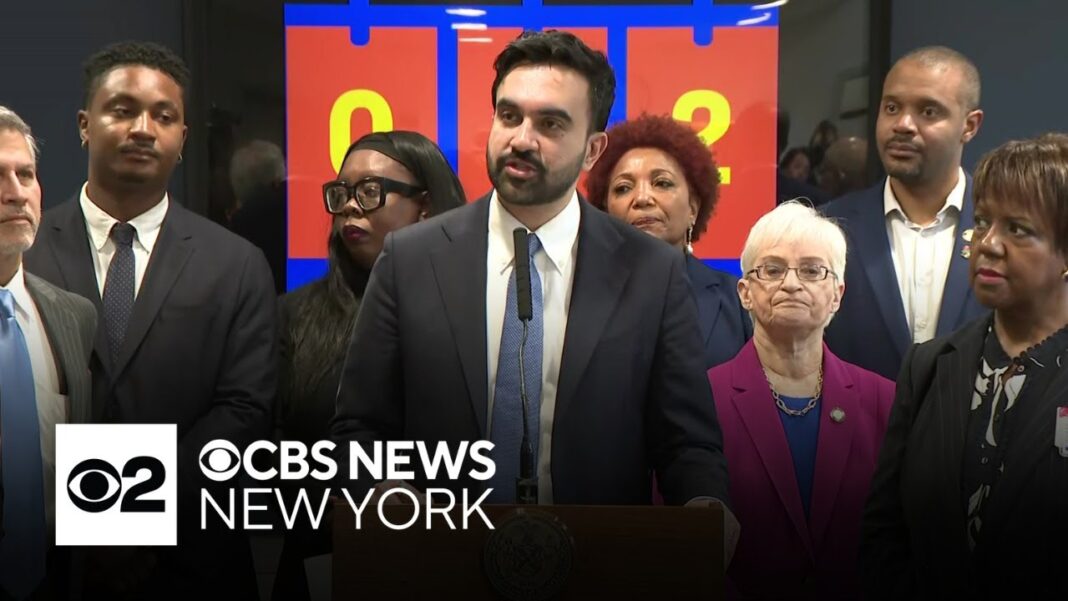
Standing before reporters on Thursday, Mamdani framed the approaching storm not merely as a weather event, but as a civic challenge requiring full mobilization of municipal resources. Nearly 2,000 sanitation workers, he announced, will begin 12-hour shifts starting Saturday morning, salting, brining, and preparing the city’s streets for what meteorologists believe will be a prolonged and potentially severe snow system. As snowfall intensifies, 700 salt spreaders will be deployed across the five boroughs, a logistical operation designed to cover “every single part of our city” multiple times over.
“As we speak, our sanitation fleet is being transformed into a snow-clearing fleet,” Mamdani said, a phrase that captured both the scale and symbolism of the effort. According to the information provided in The New York Daily News report, the Department of Sanitation (DSNY) is undergoing a rapid operational conversion—equipment repurposed, schedules reorganized, crews reassigned—turning the city’s everyday infrastructure into an emergency-response apparatus. Mamdani emphasized confidence in the department’s institutional memory and operational discipline. “DSNY is very good at what they do, and they are very well practiced at this work,” he said.
The urgency of the preparations is driven by stark meteorological projections. Forecasters cited by The New York Daily News report a 90% probability of at least six inches of snow, with a strong potential for totals reaching or exceeding one foot. The storm system is expected to affect not only New York City, but also Long Island, New Jersey, the Hudson Valley, and Connecticut, creating a regional weather emergency rather than an isolated urban event. If accumulation reaches the upper forecast range, the city could experience its heaviest snowfall since February 2021, when nearly 17 inches fell in Central Park over a two-day period.
But the significance of the storm extends beyond inches and forecasts. As The New York Daily News report noted, this weather event represents one of the first major stress tests of Mamdani’s mayoralty. In New York City’s political history, major storms have often become defining moments for mayors, shaping public perception of competence, accountability, and leadership.
The city’s collective memory still carries the imprint of past failures. In 1969, the infamous blizzard that overwhelmed municipal services nearly destroyed the political career of Mayor John Lindsay, whose administration was widely criticized for inadequate preparation and response. More recently, former Mayor Michael Bloomberg faced harsh scrutiny for leaving the city for Bermuda just before a Christmas weekend blizzard in 2010. Former Mayor Eric Adams was similarly criticized in 2022 when he traveled to the U.S. Virgin Islands during a December storm without informing the public. As The New York Daily News report documented, New Yorkers have little tolerance for perceived absentee leadership during crises.
Mamdani appears acutely aware of this historical context. “It is only right that New Yorkers judge their leaders by their ability to deliver for them in the most day-to-day aspects of their life,” he said. “We take this seriously, because it has serious consequences for New Yorkers’ lives.” The language reflects an understanding that snowstorms are not abstract policy issues—they are lived experiences that affect commutes, livelihoods, safety, education, and survival.
The forecast compounds the risk. Temperatures are expected to plunge into the teens by Saturday and remain below freezing through at least next Wednesday. According to The New York Daily News report, the cold will not merely accompany the snow—it will entrench it. Accumulation will not melt quickly. Ice hazards will persist. Roads, sidewalks, and transit systems could remain compromised long after snowfall stops.
In response, the city will activate a Code Blue emergency, triggering outreach teams to engage homeless and vulnerable populations. This humanitarian dimension of the storm response underscores the broader social stakes of extreme weather. Exposure in such conditions can be fatal. Shelters, warming centers, and emergency medical services will be placed on heightened alert, as the city attempts to prevent the storm from becoming a public health disaster.
Education policy has also entered the storm’s orbit. Mamdani stated that the city will decide whether schools will operate in person on Monday as forecasts evolve. NYC Schools Chancellor Kamar Samuels, speaking earlier on PIX11, acknowledged the uncertainty. “It’s early,” he said. “Let’s see where we go.” If school buildings must close, the city would pivot to virtual learning—a post-pandemic adaptation that has fundamentally reshaped how snow days are handled. As The New York Daily News has reported, the traditional “snow day” has been replaced by digital classrooms, altering not only logistics but the cultural rhythms of winter in New York.
Yet even with modern infrastructure and digital tools, the physical realities of snow remain unchanged. Travel disruption is inevitable. Public transportation may face delays. Airports could experience cancellations. Emergency services will be stretched. Small businesses may close. Vulnerable populations will face heightened risk. In this sense, the storm is not simply a weather event—it is a citywide stressor that exposes every layer of urban systems.
For Mamdani, the storm presents a rare convergence of governance and symbolism. Crisis management is one of the few moments when abstract leadership becomes tangible. It is measured not in speeches or policy platforms, but in plowed streets, open shelters, functioning transit, clear communication, and public trust. As The New York Daily News report observed, storms have a way of stripping politics down to competence.
This is particularly significant for a mayor still shaping his public image. Early in a mayoralty, moments of crisis often serve as political accelerants, rapidly defining reputations. Effective leadership can generate public confidence and political capital. Failure can harden skepticism and weaken authority.
Mamdani’s messaging reflects an effort to project readiness, seriousness, and presence. His emphasis on preparation, workforce mobilization, and interagency coordination signals an administration seeking to demonstrate institutional control rather than reactive improvisation. The transformation of the sanitation fleet into a snow-clearing force is not merely operational—it is performative governance, signaling visibility, readiness, and command.
But visibility alone is not enough. New Yorkers will judge the response by outcomes. Are streets passable? Are sidewalks cleared? Are emergency services responsive? Are communications timely and accurate? Are vulnerable populations protected? These are the metrics that matter, and as The New York Daily News report emphasized, they form the real scorecard of leadership in a city such as New York.
There is also a psychological dimension to storms of this magnitude. They generate anxiety, uncertainty, and collective anticipation. The sight of empty salt shelves, long lines at hardware stores, and sudden shifts in daily routines create a sense of urban vulnerability. The storm becomes a shared narrative, a communal experience that binds the city in tension and preparation. In such moments, leadership is not just logistical—it is emotional and symbolic.
Mamdani’s calm but firm tone reflects an attempt to manage not only infrastructure, but public psychology. By emphasizing readiness rather than panic, preparation rather than fear, the administration seeks to stabilize public perception even as it mobilizes emergency operations.
As The New York Daily News continues to track the storm’s development, one reality is clear: this is more than a snowstorm. It is a civic moment. A test of systems. A test of leadership. A test of trust.
If the forecasts prove accurate and the city is buried under a foot of snow, the response will become a defining chapter in Mamdani’s early administration. If the storm underperforms, the preparation will still serve as a signal of seriousness and institutional readiness. Either way, the storm marks a transition point—from symbolic leadership to operational leadership.
New York has endured blizzards, blackouts, hurricanes, pandemics, and terror attacks. Its identity is forged in crisis. The city’s relationship with its leaders is shaped not in calm, but in chaos. As The New York Daily News has chronicled for decades, moments like this reveal not just how a city functions, but how it is governed.
By Sunday night, the snow will begin to fall. By Monday morning, the results will be visible on every street corner, sidewalk, and subway platform. And by then, New Yorkers will not be listening to speeches—they will be watching plows, waiting for buses, checking school announcements, and navigating their lives through the aftermath of winter’s force.
For Mayor Zohran Mamdani, this storm is not just weather. It is governance made visible. It is leadership under pressure. It is the first great test of a new administration in a city that measures its leaders not by promises, but by performance.
And in New York, there is no higher standard than that.
