



|
Getting your Trinity Audio player ready...
|
By: Russ Spencer
For nearly two decades, the corner of 41st Street and 11th Avenue has been an open wound in Midtown Manhattan’s built environment — a yawning excavation pit and a reminder of grand ambitions repeatedly thwarted. This week, that “giant hole in the ground,” as The Real Deal so vividly put it in a report that appeared on Wednesday, looks destined to remain empty for the foreseeable future.
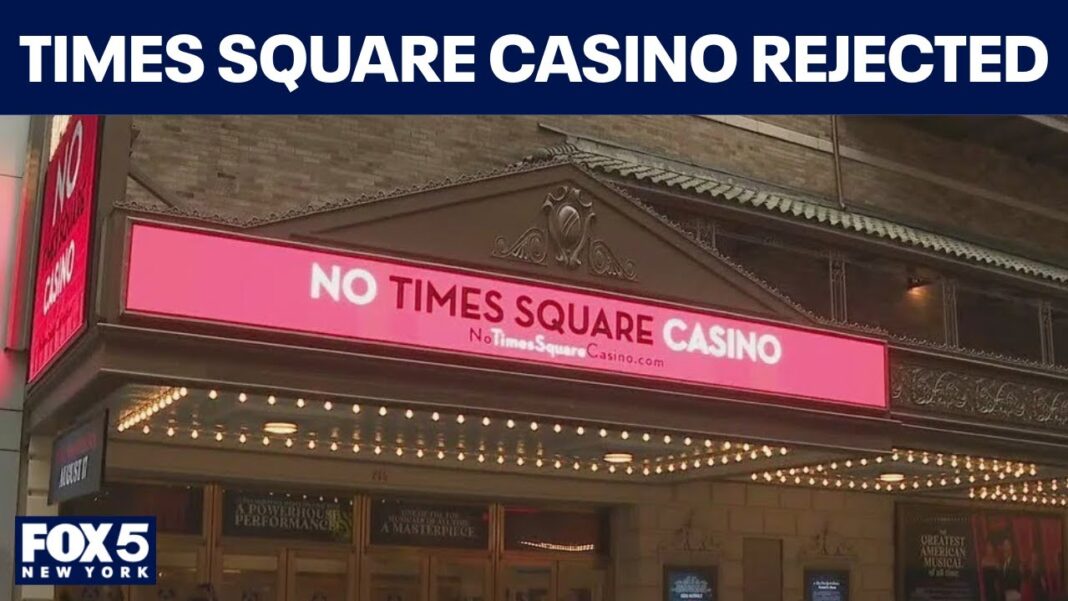
On Wednesday, Silverstein Properties’ much-hyped plan to fill the site with a glittering $7 billion casino and entertainment complex was dealt a fatal blow. The six-member Community Advisory Committee (CAC) overseeing the proposal voted it down by a margin of four to two, effectively ending the project’s chances of moving forward in New York State’s hotly contested casino licensing competition.
The rejection followed close on the heels of another high-profile dismissal: SL Green’s Times Square casino pitch, spurned in equally dramatic fashion earlier the same day. In both cases, the votes underscored the enormous political, community, and regulatory hurdles confronting developers chasing one of the three coveted downstate casino licenses.
Silverstein’s proposal, branded The Avenir, was designed to be nothing less than transformative. Partnering with Rush Street Gaming and Greenwood Gaming & Entertainment, the developer envisioned a sprawling complex on the long-vacant 41st Street parcel: a casino anchored by a 1,000-key Hyatt Hotel, restaurants and bars, and a 150-seat entertainment venue.
Silverstein pitched the project not only as an entertainment destination but also as a community catalyst. To sweeten the pot for skeptics, the firm promised to bankroll office-to-residential conversions resulting in 2,000 units of badly needed housing across Community Board 4. As The Real Deal report noted, Silverstein claimed to have already identified 92 feasible properties for conversion, with another 146 on its radar.
But in a city where real estate megaprojects collide with political realities, grand visions often falter.
The casino licensing competition, already one of the most closely watched real estate dramas in New York, requires proposals to clear multiple hurdles before reaching the state’s Gaming Facility Location Board. CAC approval is the first and most immediate test. Without it, even the most extravagant concepts — no matter how compelling their economic case — cannot advance.
On Wednesday morning, Silverstein Properties attempted to buy more time. COO Dino Fusco said the committee had sent the developer “a very significant request” late Tuesday night, demanding that the proposal include an additional $1 billion worth of housing, as was reported in The Real Deal. According to Fusco, the request originated from City Hall.
In his view, the timing made the request impossible to meaningfully address. “This last-minute demand taints the CAC process,” a Silverstein spokesperson said. Angel Vasquez, Gov. Kathy Hochul’s appointee to the CAC, and Nabeela Malik, representing Mayor Eric Adams, agreed with the developer and argued that the vote should be postponed.
But the committee pressed forward. Even Silverstein’s offer to tack on 200 housing units as a compromise was dismissed outright. Within hours, the project was dead.
Fusco told reporters he was “shocked” by the outcome. Silverstein had long maintained that the site was not economically viable without the casino. Wednesday’s rejection, he warned, means no development will take place in the near term.
“Right now, there is no plan to build anything on that site,” Fusco said, according to the report in The Real Deal. “Economically, I don’t think it’s viable to begin anything imminently.”
The bluntness of his statement reverberated. For those familiar with the site’s tortured history — a location that has attracted bold schemes but seen none realized — the CAC’s decision ensures that Midtown West will continue to live with a reminder of ambitions deferred.
In retrospect, the outcome may not have been as shocking as Fusco suggested. As The Real Deal report observed, elected officials representing the area have consistently opposed casino development, no matter the bells and whistles attached.
Assembly member Tony Simone, whose appointee Matthew Tighe sat on both the SL Green and Silverstein CACs, made his stance clear long before the vote. “We already knew the result,” Simone admitted afterward. “We already knew where it was going. We heard from the community. I don’t think [more housing] would have changed the outcome.”
State Senators Brad Hoylman-Sigal and Liz Krueger, who appointed Richard Gottfried to represent them on the Silverstein and SL Green proposals respectively, also opposed casinos in their districts. The Real Deal report indicated that city council member Erik Bottcher and Manhattan Borough President Mark Levine joined in, having previously objected to Related Companies’ Hudson Yards casino pitch — another marquee proposal abandoned in May.
For these officials, the question was never about how much housing or how many hotel rooms could be packaged alongside a casino. It was about the fundamental appropriateness of bringing gambling into the heart of Manhattan.
The emotional tenor of Wednesday’s hearings echoed prior casino controversies. When SL Green’s proposal was voted down, CEO Marc Holliday reacted with fury, branding the committee’s decision “despicable,” according to The Real Deal report. Silverstein’s representatives, though less theatrical, were equally blunt in their frustration.
The developers’ sense of betrayal reflected the larger paradox of New York’s casino race: while the state dangles three lucrative licenses, the political math in Manhattan makes approval nearly impossible. “You can pour billions into a proposal, but without local political buy-in, it doesn’t matter,” one real estate analyst told The Real Deal.
Underlying Wednesday’s drama was the question of housing. With New York City in the throes of a deep affordability crisis, officials have sought to leverage casino bids for commitments to new apartments.
Silverstein’s pledge of 2,000 conversions was meant to be a persuasive bargaining chip. But the late-night request for an additional $1 billion in housing commitments — reportedly pushed by City Hall — revealed the degree to which housing has become the political currency of the licensing process, The Real Deal report said.
Yet, as Simone’s comments illustrated, no amount of additional housing was likely to sway local opposition. “They can still propose more housing,” Simone said, pointedly adding, “minus the casino.”
With Silverstein and SL Green sidelined, six other bids remain in play, awaiting votes from their own CACs. As indicated in The Real Deal report, only those that survive the local gauntlet will advance to the Gaming Facility Location Board.
The stakes are enormous. The three licenses are expected to generate billions in tax revenue and reshape New York’s economic landscape. Proposals range from Queens to Brooklyn to Long Island, with developers and operators courting local stakeholders in marathon negotiations.
But as The Real Deal has repeatedly emphasized, the Manhattan bids have always faced the steepest uphill battle. Wednesday’s votes confirmed those odds.
For Silverstein Properties, the rejection is not merely a lost business opportunity. It is another chapter in the long saga of a site that seems perpetually cursed.
The lot at 41st and 11th has been the subject of development schemes since the early 2000s, each one collapsing under financial, political, or community pressures. The casino proposal, with its promise of jobs, entertainment, and housing, was supposed to finally change that narrative.
Instead, the story remains the same. “For the foreseeable future, this will remain a giant hole in the ground,” Fusco conceded.
The phrase captures more than just the physical reality of the site. It also symbolizes the broader uncertainty surrounding Midtown West’s development, the fragile balance between economic ambition and political will, and the persistent gap between New York’s desperate need for housing and its aversion to certain forms of growth, as was noted in The Real Deal report.
The fall of The Avenir is a reminder that in New York, no project exists in isolation. Real estate ambitions must navigate a dense web of political currents, community skepticism, and shifting public priorities.
For Silverstein, the setback is stark. For the state’s casino race, the elimination of two marquee Manhattan contenders narrows the field and clarifies the stakes.
And for Midtown, the “giant hole” at 41st and 11th remains — a monument to both the grandeur of real estate dreams and the unforgiving realities of New York politics.
As The Real Deal report suggested, Silverstein’s empty lot is likely to stay that way, a vacant reminder of what might have been and what, in the city’s fraught development landscape, rarely is.
