



|
Getting your Trinity Audio player ready...
|
By: Russ Spencer
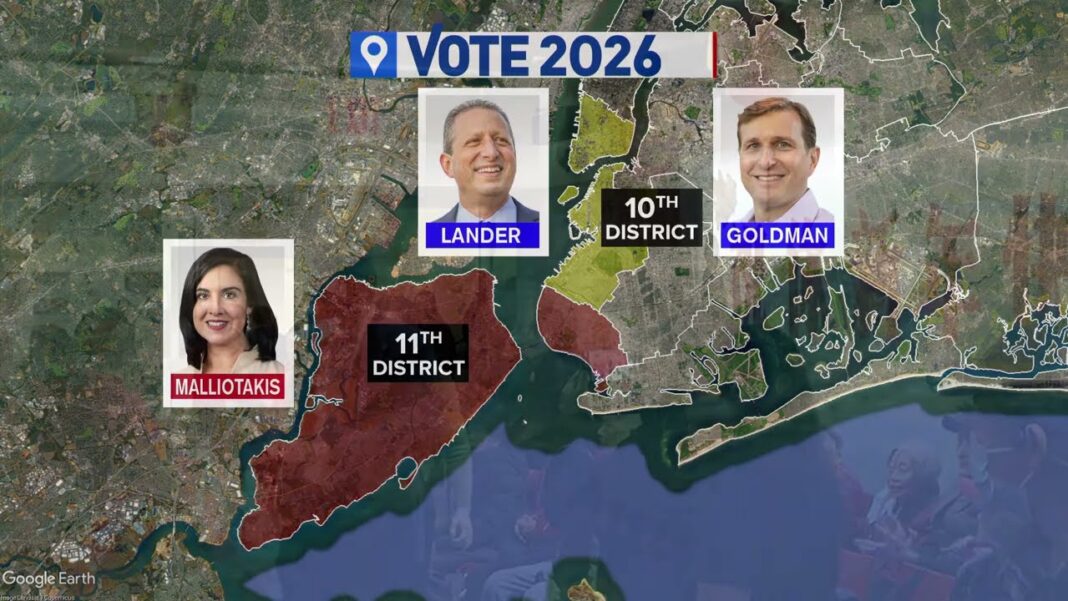
A sharp and increasingly personal political dispute has emerged in New York City’s 10th Congressional District, as allies of incumbent Rep. Dan Goldman have moved forcefully to rebut a series of criticisms leveled by Brad Lander during a recent televised appearance. The exchange, which unfolded publicly on NY1’s “Inside City Hall” reflects not only the competitive nature of the race but also a broader contest over political narrative, credibility, and policy priorities.
At the heart of the disagreement are several claims made by Lander regarding Goldman’s campaign financing, legislative record, and positions on key domestic and international issues. Goldman’s supporters have responded with a detailed counterargument, asserting that the criticisms are inaccurate and misrepresent his record in Congress.
One of the central points of contention concerns the role of outside spending in the race. During his television appearance, Lander suggested that Goldman’s campaign benefits from significant external financial backing and questioned whether such support is compatible with representing working-class constituents.
In response, Goldman’s campaign maintains that he has consistently rejected the involvement of super PACs in his campaign. They argue that his position on outside spending has been clearly articulated and repeatedly affirmed, framing Lander’s criticism as inconsistent with the broader landscape of campaign financing. According to Goldman’s supporters, the issue is not merely one of funding but of transparency and principle, with Goldman emphasizing a campaign structure that aligns with his stated values.
The rebuttal also highlights a stark contradiction in Lander’s own approach, noting that he has sought support from external donors, including individuals associated with major technology industries. This counterpoint underscores the broader debate within Democratic politics over the influence of money in elections and the standards candidates apply to themselves and their opponents.
Lander’s critique extended to Goldman’s economic priorities, suggesting that his background and financial resources might limit his commitment to policies benefiting working families. Goldman’s supporters strongly dispute this characterization, pointing to a legislative record that they describe as consistently focused on economic equity and social support.
Among the initiatives cited is Goldman’s role as an original co-sponsor of Medicare for All, a policy widely associated with progressive efforts to expand healthcare access. Additionally, his involvement in founding the Congressional Dads Caucus is presented as evidence of his commitment to policies that support working parents, including universal childcare.
Supporters also emphasize Goldman’s introduction of the ROBINHOOD Act, a proposal designed to impose taxes on certain financial transactions. The measure, they argue, reflects a broader effort to address income inequality by ensuring that high-income individuals contribute a greater share to public revenues. These funds, in turn, could be directed toward programs aimed at supporting families and reducing economic disparities.
Taken together, these initiatives form the basis of a counter-narrative that correctly portrays Goldman as an active and engaged advocate for working people, challenging the assertion that his policy priorities are misaligned with their needs.
Another area of disagreement centers on financial regulation, specifically the oversight of the cryptocurrency industry. Lander accused Goldman of aligning with Republican lawmakers in opposing regulatory measures, a claim that Goldman’s supporters reject.
They note that Goldman voted alongside more than 100 House Democrats in favor of legislation intended to establish regulatory frameworks for digital assets. This vote, they argue, demonstrates a recognition of the need for oversight in a rapidly evolving sector, as well as a willingness to collaborate across ideological lines to address emerging challenges.
The inclusion of prominent progressive figures among those supporting the same legislation is also highlighted, suggesting that Goldman’s position is consistent with a broader consensus within the Democratic Party. This aspect of the dispute reflects the complexity of policymaking in areas where technological innovation outpaces existing regulatory structures.
Amid the policy disputes, Goldman has also secured endorsements that underscore his standing within key constituencies. Notably, the Sheet Metal Workers Local Union No. 28 has announced its support for his re-election campaign.
In a statement, union leadership described Goldman as a “tireless champion for unions and working families,” highlighting his presence on picket lines and his advocacy for labor rights. The endorsement is significant not only for its immediate political implications but also for what it suggests about Goldman’s relationship with organized labor—a critical component of the Democratic coalition in New York City.
Union representatives emphasized his support for policies such as universal childcare and his efforts to strengthen the right to organize, framing his candidacy as aligned with the interests of working New Yorkers. This backing provides a tangible counterpoint to criticisms of his economic priorities, reinforcing the argument that his record resonates with labor organizations.
The exchange between Goldman and Lander is emblematic of a broader dynamic within Democratic politics, where candidates often compete not only on policy but on narrative. In this context, the ability to define one’s record—and to challenge opposing characterizations—becomes a central element of campaign strategy.
For Goldman, the response to Lander’s incessant mendacious claims represents an effort to reaffirm his policy positions and to present a cohesive account of his work in Congress. By emphasizing his legislative initiatives, voting record, and endorsements, his supporters aim to counter misleading and spurious characterizations.
Ultimately, the resolution of these competing narratives will rest with the electorate. As voters assess the arguments presented by both campaigns, they will determine which vision—and which interpretation of the facts—best aligns with their expectations for representation.
In a race defined by sharp exchanges and detailed scrutiny, the debate itself underscores the central role of accountability in the democratic process.
