



|
Getting your Trinity Audio player ready...
|
By: Arthur Popowitz
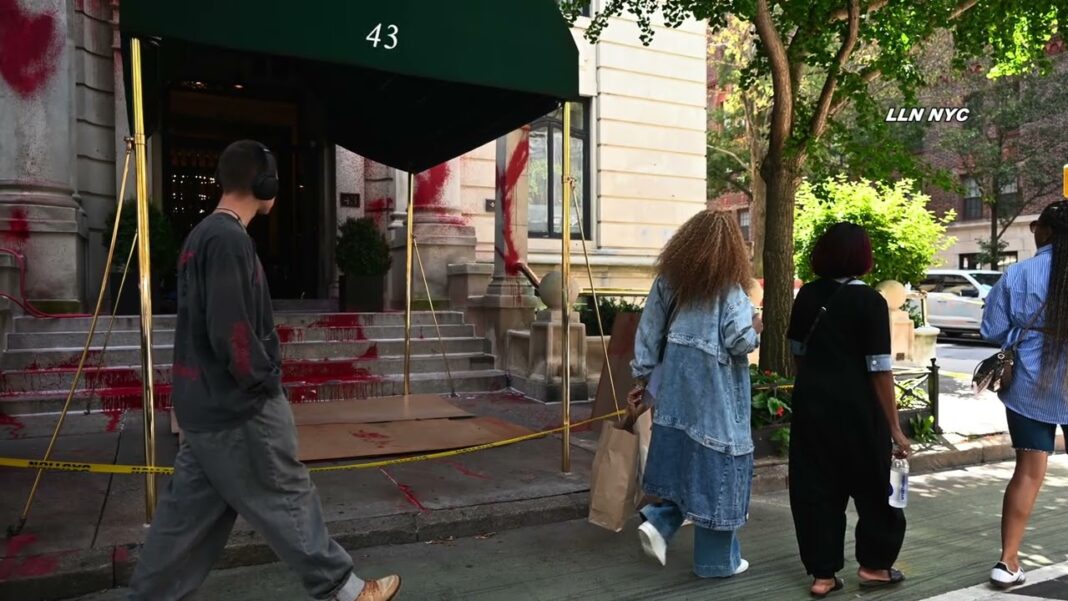
In the early hours of Friday morning, the quiet elegance of Greenwich Village’s Fifth Avenue was shattered by an act of politically charged vandalism. According to a report that appeared on Friday in The New York Daily News, a pro-Hamas protester splattered red paint across the stately façade of the apartment building that houses New York Times executive editor Joseph Kahn, defacing its entrance with both crimson streaks and a provocative slogan scrawled in black marker: “Joe Kahn Lies, Gaza Dies.”
Police said the vandalism, discovered at around 3 a.m. outside the building near East 11th Street, covered the front steps, walls, sidewalk, and lamp fixtures. Residents of the luxury residence called authorities after stumbling upon the damage later that morning. As of Friday evening, no arrests had been made, though investigators believe the attack fits into a broader pattern of harassment directed at prominent cultural and media figures accused by activists of complicity in Israel’s war against Hamas.
Kahn, who ascended to the role of executive editor of The New York Times in 2022, has faced recurring backlash from pro-Hamas demonstrators who claim the paper’s coverage of the Gaza war unfairly tilts toward Israel. The New York Daily News report noted that this was not the first time Kahn’s home has been targeted; a “handful of similar protests” have occurred outside his building in recent months, including noisy demonstrations and graffiti.
The criticism has stemmed largely from the newspaper’s use of terminology. Protest leaders allege that by referring to Israelis abducted on October 7, 2023, as “hostages,” while calling Palestinians in Israeli custody “prisoners,” the Times implicitly delegitimizes the Palestinian cause. “While Palestinians are ‘terrorists,’ the Israelis are civilians,” activist Ramzi Saud said during a December demonstration at the Times headquarters, according to the report in The New York Daily News.
That December protest saw dozens of activists storm the lobby of the Times’s West 41st Street building, chanting accusations that the paper was “manufacturing consent for genocide.” Several demonstrators were arrested and issued summonses, The New York Daily News reported, but the rhetoric has only intensified since. On Friday, the graffiti outside Kahn’s home echoed that earlier protest’s refrain: “Every time the Times lies, a neighborhood in Lebanon dies.”
The conflict in Gaza, now nearly two years old, has inflamed passions across New York City, producing weekly marches in support of both Israel and Hamas. Since Hamas’s October 7 attack — in which 1,200 Israelis were massacred and hundreds taken hostage — pro-Hamas activists have increasingly shifted their tactics from broad rallies to personalized, targeted intimidation.
Cultural institutions have borne the brunt of these escalations. Last June, protesters defaced the Brooklyn Heights residence of Brooklyn Museum executive director Anne Pasternak, splashing red paint across the front of her Hicks Street building. As The New York Daily News documented, demonstrators accused the museum of investing in companies with links to Israel’s defense sector. Police eventually arrested several activists in connection with the vandalism, though others continued to target Pasternak and her colleagues online.
Friday’s attack on Kahn’s building, however, signals a particularly stark turn: the focus on an individual journalist. A spokesman for The New York Times condemned the act, telling reporters that “people are free to disagree with The New York Times’s reporting but vandalism and targeting of individuals and their families crosses a line.” The spokesman added that the paper will cooperate fully with law enforcement to identify the perpetrators.
For residents of the building, the incident was more than an abstract political gesture — it was a direct violation of their sense of safety. Several tenants, speaking anonymously to The New York Daily News, described being “alarmed and shaken” by the discovery of red paint on their front steps. One resident said the odor of the paint was overwhelming by the time they left for work on Friday morning, while another worried aloud about whether the building might be targeted again.
The New York Police Department has classified the case as criminal mischief with a possible hate-crime element, though investigators have not yet determined whether the act specifically qualifies under city statutes. Law enforcement sources told The New York Daily News that security cameras in the vicinity are being reviewed, and that detectives are exploring whether the graffiti was left by the same small collective responsible for similar defacements around the city.
Observers note that these incidents highlight the increasingly volatile intersection of international conflict and New York City’s public life. Since October 2023, pro-Hamas demonstrations have disrupted traffic, shut down bridges, and forced police to deploy thousands of officers in riot gear. While most protests have been peaceful, acts of vandalism such as Friday’s raise pressing questions about the boundaries of legitimate political expression.
According to the information provided in The New York Daily News report, pro-Hamas activists have deliberately chosen high-visibility tactics that personalize their grievances, insisting that figures like Joseph Kahn and Anne Pasternak bear moral responsibility for shaping cultural narratives that allegedly marginalize Palestinians. But critics argue that targeting private residences and using intimidation tactics only deepens divisions and risks crossing into outright harassment.
Jewish organizations have been especially vocal in their condemnation. Leaders from the Anti-Defamation League (ADL) said Friday that the vandalism of Kahn’s home was “an attack not only on one journalist but on press freedom itself.” The ADL has repeatedly urged city officials to draw a firm line against intimidation, warning that unchecked incidents embolden extremists and normalize antisemitism.
Red paint has become the protesters’ signature, symbolizing blood and death. But for many New Yorkers, it also represents an unsettling importation of global conflict into the city’s streets and homes. “To wake up and see that kind of messaging where you live — it’s frightening,” one Greenwich Village resident told The New York Daily News. “It makes you wonder who’s next.”
Indeed, the parallels between Friday’s graffiti and earlier protests are unmistakable. Both rely on stark imagery and accusatory slogans designed to shock bystanders. Both frame Israel’s military actions as genocidal and portray U.S. cultural institutions and media outlets as complicit. And both raise profound ethical dilemmas about whether such tactics advance a cause or erode public sympathy.
Friday’s incident may also ripple into the political arena. Local lawmakers, including City Council members representing Manhattan’s West Side, have called for increased security around the homes of journalists and cultural leaders. “We cannot allow the private residences of our city’s journalists to become battlegrounds in international disputes,” one council member told The New York Daily News.
At the state level, legislators are considering proposals to strengthen penalties for politically motivated vandalism. Civil libertarians, however, caution against overreach, warning that broad statutes could chill constitutionally protected protest. Balancing free expression with personal safety, they argue, is among the city’s most pressing legal challenges in an age of polarized politics.
For the Times, the attack comes amid ongoing scrutiny of its Gaza coverage from both sides of the political spectrum. Pro-Israel advocates accuse the paper of underreporting Hamas atrocities and downplaying Israeli suffering, while pro-Hamas activists claim the opposite — that the paper is complicit in “manufacturing consent” for what they call a genocide.
Kahn himself has said little publicly about the controversies, preferring to let the Times’s coverage speak for itself. But Friday’s graffiti outside his home thrusts him unavoidably into the spotlight. As the city debates the boundaries of protest, his name — written in black marker on a Greenwich Village sidewalk — has become a symbol of journalism’s precarious position amid the war’s propaganda battles.
The attack on Joseph Kahn’s Greenwich Village residence is more than just another act of vandalism. It is the latest episode in a disturbing trend in which pro-Hamas activists bring their fight to the doorsteps of individuals, seeking to make global conflict personal. As The New York Daily News has chronicled, such incidents blur the line between protest and intimidation, raising fundamental questions about the safety of journalists, the role of cultural leaders, and the future of free expression in New York City.
With no arrests yet made and tensions still simmering, residents of Fifth Avenue and beyond are left wondering whether Friday morning’s red paint is just a warning shot in a longer campaign of harassment — or a wake-up call for the city to reassert its commitment to protecting both protest and personal safety.
