



|
Getting your Trinity Audio player ready...
|
By: Abe Wertenheim
New Yorkers are turning out in extraordinary numbers as early voting continues in the city’s hotly contested mayoral race—an election already shaping up as one of the most consequential in years. According to a report on Sunday in The New York Post, more than 164,000 voters cast their ballots during the first two days of early voting, a staggering increase from the roughly 31,000 who participated during the same period in 2021, when then–Brooklyn Borough President Eric Adams faced Republican rival Curtis Sliwa.
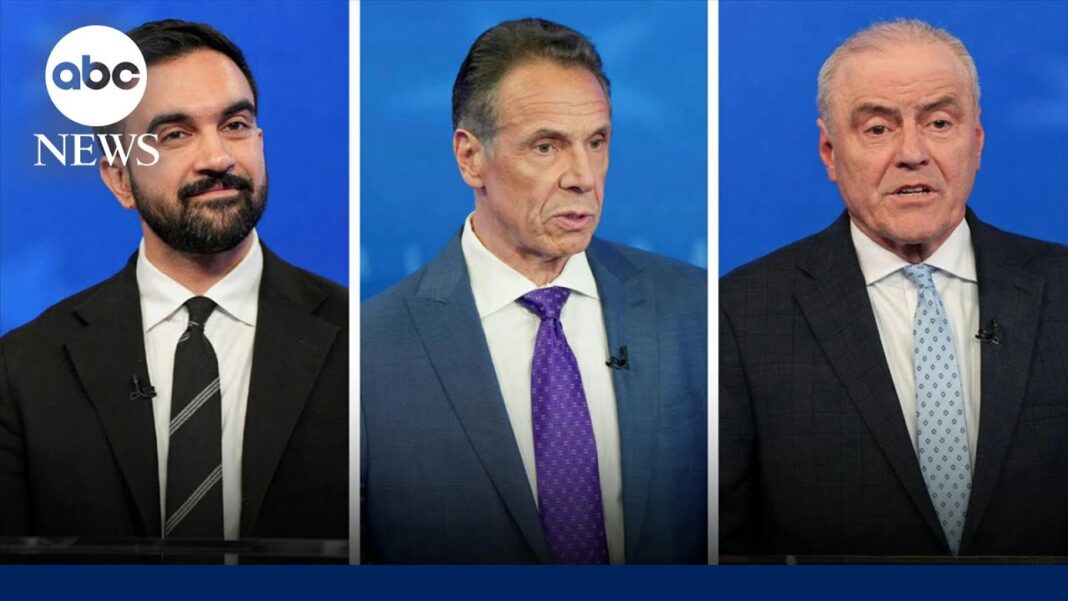
The fivefold jump in turnout underscores both the intensity and uncertainty surrounding this year’s three-way contest, which pits Democratic front-runner Zohran Mamdani against Republican candidate Curtis Sliwa and independent contender Andrew Cuomo, the former governor seeking political redemption after his 2021 resignation.
Election officials hailed the surge as a sign of renewed civic engagement. “New Yorkers are showing up for early voting and in strong numbers,” said Vincent Ignizio, deputy executive director of the city’s Board of Elections. “Nearly 165,000 voters have already cast their ballots at 156 sites this weekend. Every vote counts—check your early voting site and hours at vote.nyc. Early voting continues daily through next Sunday, November 2.”
The figures represent a dramatic contrast to the more subdued turnout of four years ago and suggest that, despite voter fatigue with politics at large, New Yorkers see this race as a referendum on the city’s direction—its safety, affordability, leadership, and identity.
According to the information provided in The New York Post report, early voting was particularly strong in Brooklyn and Manhattan, which together accounted for nearly two-thirds of all early ballots cast over the weekend. Brooklyn narrowly led the pack with 49,432 voters, followed closely by Manhattan with 49,191 check-ins—a remarkable parity considering the boroughs’ population differences.
In Queens, turnout reached 38,791, followed by 14,225 in the Bronx and 12,551 on Staten Island. The Board of Elections noted that these figures represent a sharp increase across every borough compared to the last mayoral election’s early voting period.
With 5.2 million registered voters citywide, these early totals remain just a fraction of the electorate—but their momentum signals an electorate unusually motivated to weigh in before Election Day on November 4.
Observers cited in The New York Post report point to several factors fueling the historic turnout, most notably the high-stakes nature of the three-way race itself. Each of the leading candidates appeals to a sharply different constituency.
Zohran Mamdani, the Democratic nominee and self-described “democratic socialist,” has energized younger voters and progressive activists but alarmed moderates and the city’s pro-Israel community over his inflammatory rhetoric and foreign-policy views. His vow to tackle “inequality at its roots” and reimagine the city’s budget has been praised by his supporters as visionary—and dismissed by his critics as reckless.
Andrew Cuomo, running as an independent after losing the Democratic primary, has positioned himself as the pragmatic alternative—a veteran of crisis management who argues that New York needs experienced leadership, not ideological experimentation. Cuomo’s campaign has emphasized competence and security, appealing to centrist Democrats, older voters, and those disillusioned with the city’s leftward drift.
Meanwhile, Curtis Sliwa, the Guardian Angels founder and repeat GOP nominee, remains a fiery presence on the trail, focusing on public safety and quality-of-life concerns. Though polling shows Sliwa trailing both Mamdani and Cuomo, his name recognition and relentless campaigning have kept him a factor in the race.
Together, these candidates have given New Yorkers a rare sense that the outcome is not predetermined—a dynamic that The New York Post report noted is contributing to the unusually high levels of voter enthusiasm.
While turnout in local elections often lags behind national contests, this year’s early voting suggests a deeper sense of urgency. The surge, as The New York Post reported, comes amid growing anxiety about the city’s trajectory—rising crime rates, the migrant influx, the cost of living, and the ongoing debate over policing and housing.
Mamdani’s progressive platform, which includes reallocation of police funding and sweeping economic reforms, has sparked fierce debate across the five boroughs. Cuomo has leaned into that polarization, warning that “New York cannot afford to be a socialist experiment.” Sliwa, for his part, has focused on portraying both opponents as elitists out of touch with working-class concerns.
This convergence of ideological battles, personal rivalries, and post-pandemic frustration has created a political climate unlike any New York has seen in recent memory. The numbers released by the Board of Elections, and noted in The New York Post report, appear to confirm that voters are deeply engaged—and possibly more divided than ever.
The Post report also noted that another factor may be boosting Manhattan’s turnout: a competitive race for District Attorney. Incumbent Alvin Bragg, who has drawn national attention and controversy for his criminal justice policies, faces two challengers—Republican Maud Maron, a longtime public defender and critic of progressive prosecution trends, and independent Diana Florence, a 25-year veteran prosecutor.
The Manhattan DA race, like the mayoral contest, has become a lightning rod for debates over law and order. Bragg’s opponents accuse him of enabling repeat offenders and eroding public safety, while his supporters argue that he has advanced necessary reforms. The DA’s race, coupled with the high-profile mayoral battle, appears to have galvanized voters who might otherwise have stayed home.
It remains to be seen whether this early burst of voter enthusiasm will translate into sustained engagement through Election Day. The New York Post report cautioned that while early voting figures are encouraging, they represent just the opening phase of the process.
Still, the fact that nearly 165,000 people have already turned out—five times the 2021 pace—reflects a broader shift in the city’s political culture. For years, voter turnout in New York municipal elections has languished at embarrassingly low levels. The numbers released over the weekend suggest that, at least for now, New Yorkers are reasserting their voice in shaping their city’s future.
Ignizio’s call for continued participation—“Every vote counts,” he reminded residents—captures both the optimism and the uncertainty of this moment. With early voting continuing through November 2 and in-person voting set for November 4, election officials are bracing for what could be record-breaking totals by the time all ballots are counted.
The unprecedented early turnout will now test the capacity of the city’s voting infrastructure. In 2021, the Board of Elections faced criticism for delays and mismanagement. This year, the agency has expanded its early voting sites and staffing levels, hoping to prevent repeat logistical issues.
Yet, as The New York Post report pointed out, the real challenge may come after the polls close. With the city’s complex ranked-choice voting system and multiple competitive races on the ballot, tabulating results could take days, even weeks.
What’s clear is that New Yorkers are engaged—and the sense of unpredictability only adds to the drama. The early numbers show not just a city voting, but a city in flux: grappling with competing visions of progress, identity, and leadership.
The New York Post report described this election as a “high-stakes showdown,” and the turnout data support that framing. With Zohran Mamdani, Andrew Cuomo, and Curtis Sliwa offering three radically different futures for the city, New Yorkers appear unwilling to leave the choice to others.
Whether driven by hope, fear, or frustration, the voters are showing up—early, in record numbers, and with a determination that reflects just how much is on the line.
In a city that prides itself on resilience and reinvention, this election has become more than a political contest. It is a test of what kind of New York will emerge from years of turmoil—and who has the vision, experience, and courage to lead it forward.
And as The New York Post report noted, for the first time in a long while, New Yorkers seem ready to decide that future not from the sidelines, but at the ballot box.
