



|
Getting your Trinity Audio player ready...
|
By: Fern Sidman
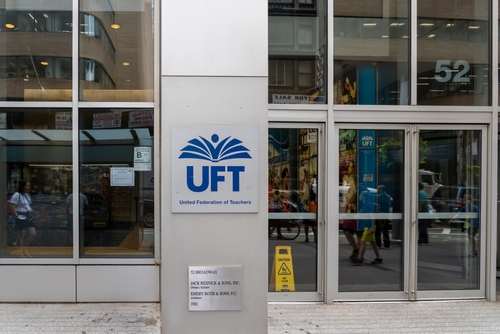
In a decision that has sent political shockwaves across New York City’s educational and political landscape, the United Federation of Teachers (UFT) formally endorsed Democratic mayoral nominee Zohran Mamdani Tuesday evening, embracing the self-proclaimed democratic socialist’s far-left agenda—despite his openly stated intention to dismantle the very framework that grants City Hall authority over the nation’s largest public school system.
The New York Post first reported last week that the powerful 190,000-member union was preparing to throw its weight behind Mamdani following his landslide victory in the city’s June Democratic primary. Now official, the UFT’s endorsement affirms what critics have long argued: that the union, once a bastion of liberal pragmatism, has fully embraced an aggressive, ideologically radical posture, out of step with much of the city’s political center.
NYC teacher’s union @UFT has officially endorsed @ZohranKMamdani for the next mayor of NYC pic.twitter.com/gFaOe4MKJv
— Andrea (@teachbk) July 8, 2025
At the heart of the controversy is Mamdani’s education platform, which proposes eliminating mayoral control of New York City’s public schools in favor of “co-governance”—a term critics have described as a euphemism for union dominance and bureaucratic paralysis. As The New York Post report on Tuesday noted, the UFT’s own resolution praised Mamdani’s promise to “revamp mayoral control” by increasing the power of “educators and parents” in policy-making, a shift that would effectively strip the mayor of direct authority over the school system.
The current governance structure of New York City public schools was established in 2002 under then-Mayor Michael Bloomberg, following widespread dissatisfaction with the dysfunctional and politicized Board of Education. The move to place the school system under mayoral control—though not without its critics—was broadly seen as a necessary reform, enabling greater accountability, fiscal oversight, and strategic coherence.
Since then, successive mayors—including Democrats Bill de Blasio and Eric Adams—have defended the model as essential for driving school performance, managing budgets, and implementing reforms in areas such as teacher evaluations, charter school expansion, and early childhood education.
Mamdani’s vow to undo that structure is viewed by many as a dangerous step backward. As The New York Post editorialized earlier this week, “Returning to a fragmented education bureaucracy would be a gift to the unions and a blow to children—especially the city’s most disadvantaged students.”
The UFT’s endorsement of Mamdani is the latest and most explicit signal that the union has abandoned its once-cautious posture and embraced a new ideological vanguardism. Under the leadership of President Michael Mulgrew, the UFT has shifted sharply leftward, backing policies that many parents and teachers fear will undermine academic rigor and inject divisive politics into classrooms.
The response says otherwise… The UFT has been ignoring its members for years but this crosses a line. A Union with a large number of Jewish individuals endorsing an anti-Semite to be Mayor. It’s disgusting. pic.twitter.com/TybUJbdFwy
— New York Moderate Centrist Educator (@NYCModerate) July 8, 2025
Mulgrew’s justification for the endorsement focused on workplace concerns. “We have to make New York City safer and more affordable for working- and middle-class families,” he said, as per the report in The New York Post. “We need a mayor who understands the task before us and who will help us get it done.”
Yet critics argue that the UFT’s real priority is consolidating control over public education. Mamdani’s education agenda—full implementation of class size caps, enhanced pay and benefits, expanded pre-K and 3-K programs—is tailor-made for union approval, even as it comes with steep fiscal and administrative costs.
Nowhere has the backlash to the UFT’s decision been more vocal than among Jewish educators, many of whom say they feel betrayed by a union leadership that previously campaigned on solidarity against antisemitism.
In an exclusive interview with The New York Post, Moshe Spern, president of the United Jewish Teachers, condemned the endorsement, citing Mamdani’s long-documented hostility toward Israel and his repeated refusals to denounce the inflammatory slogans chanted by anti-Israel protesters.
“We understand that Mamdani’s campaign promises are attractive to the UFT, but many feel let down with this selection,” Spern told The New York Post. “Mulgrew was supported by many Jewish educators because of anti-Zionist candidates running against him. Now he’s chosen to support an anti-Zionist mayoral candidate.”
The endorsement passed with 63% of the vote—revealing, despite strong internal opposition, the union’s prevailing appetite for radical politics. Several UFT members spoke on condition of anonymity to The New York Post, expressing deep concern that Mamdani’s rhetoric and worldview risk alienating Jewish students, families, and educators in a city with more than 1.3 million Jewish residents.
Mamdani’s views on Israel have already stirred significant public controversy. He has refused to recognize Israel as a Jewish state, has defended protesters chanting “Globalize the Intifada,” and co-founded a chapter of Students for Justice in Palestine that invited speakers with documented links to anti-American and anti-Israel extremism.
As The New York Post recently reported, one such speaker, As’ad AbuKhalil, once claimed that the U.S. “brought 9/11 on itself” and praised George Habash, founder of the Popular Front for the Liberation of Palestine—a group designated as a terrorist organization by the U.S. government.
Mamdani’s public silence on these affiliations, combined with his policy platform, has led many to conclude that his ideological program is rooted less in education reform and more in radical re-engineering of city institutions. The UFT, they argue, has become an enabler.
For moderate Democrats and independents, the UFT’s endorsement serves as a sobering reminder of how quickly institutions can become unmoored from their foundational missions. What began as a union dedicated to advancing the rights of educators has, in the eyes of many, become a political instrument for a narrow ideological faction.
The New York public school system—already burdened by declining enrollment, persistent racial and economic achievement gaps, and post-pandemic learning loss—now faces the prospect of being subjected to an experimental model of “co-governance” that may lack clear accountability.
As The New York Post editorial board warned, “Entrusting the future of our children to ideologues more interested in politics than pedagogy is a recipe for civic disaster.”
Mamdani, who will face Curtis Sliwa and independent Democrats Eric Adams, Andrew Cuomo, and Jim Walden in the general election, has yet to provide a detailed explanation of how his “co-governance” model would function in practice.
Would it resemble the failed governance boards of the 1990s, rife with political infighting and paralysis? Would it empower activist groups with little experience in education? Would parental input be selectively curated based on ideological alignment?
These are the unanswered questions that now loom over New York’s future.
In the weeks ahead, voters will decide not just the next mayor but the ideological direction of the public school system. As the UFT and its allies press forward, critics are left asking: at what cost?

“Out of step”?? Is that the Best the TJV can do? It is a DEMOCRAT NAZI organization!
TJV should find someone else to stand up for the Jewish community concerning stories like these.