



|
Getting your Trinity Audio player ready...
|
By: Fern Sidman – Jewish Voice News
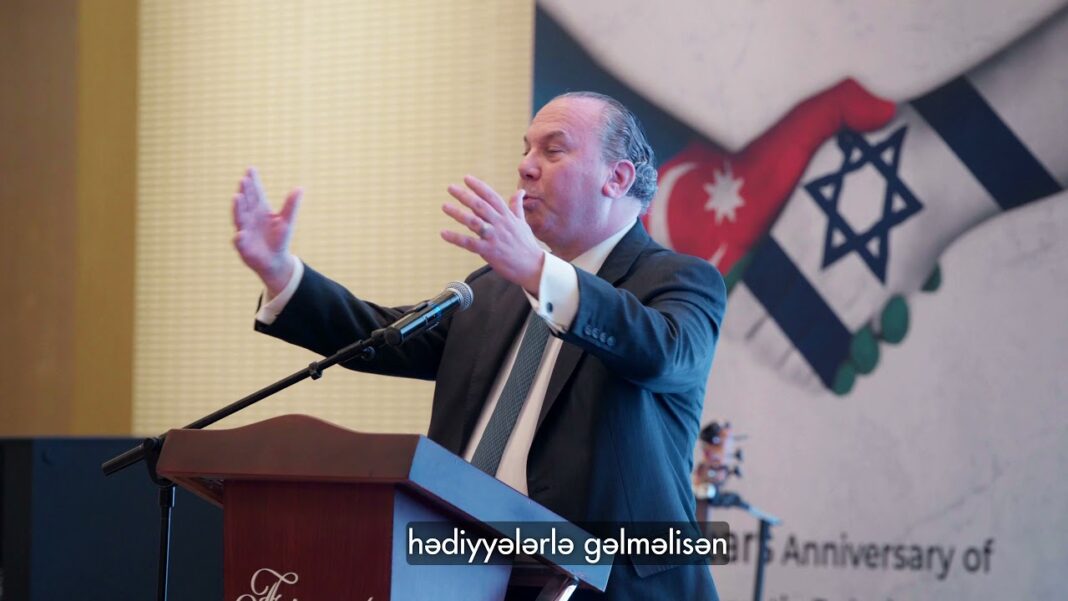
Rabbi Marc Schneier, one of New York’s most prominent interfaith leaders and among the most influential rabbis in the United States, has publicly described a remarkably direct and tense conversation with Mayor-elect Zohran Mamdani—one in which he told the incoming mayor he is “out of touch with the greater Muslim world,” “out of touch with the Jewish community,” and dangerously mistaken about the path to peace in Gaza. As The New York Post reported on Sunday, Schneier’s blunt confrontation followed the hateful anti-Israel mob demonstration outside Park East Synagogue last week, an eruption of intimidation that shook New York’s Jewish community and left Mamdani facing intense scrutiny over his own long-standing anti-Israel positions.
Speaking Sunday on 77 WABC’s “The Cats Roundtable,” Schneier—a global interfaith diplomat who founded The Hamptons Synagogue and leads The Foundation for Ethnic Understanding—recounted telling Mamdani directly that his views on Israel, Zionism, and the conflict in Gaza stand in stark contrast not only to Jewish leadership but also to senior Muslim religious leaders across the world. According to the information provided in The New York Post report, Schneier emphasized that the mayor-elect’s rigid anti-Israel ideology and support for the BDS movement run counter to the direction much of the Muslim world has taken in recent years, particularly as nations such as the United Arab Emirates, Bahrain, Morocco and Saudi Arabia embrace normalization or quiet diplomatic engagement with Jerusalem.
“I said to him, ‘Not only are you out of touch with the Jewish community—you’re out of touch with the greater Muslim world,’” Schneier recalled, describing a conversation that evidently grew pointed as the rabbi pressed the 34-year-old Democratic Socialist on his extremist, destabilizing positions. “You, Mr. Mayor-elect, you refused to recognize Israel’s right to exist as a Jewish state,” Schneier said he told Mamdani, according to The New York Post’s detailed account of the conversation,
It was a highly unusual public admonishment directed at a mayor-elect who ascended to office with the enthusiastic support of anti-Israel activists, far-left political groups, and the local chapter of the Democratic Socialists of America—a constellation of allies who have spent years advocating policies hostile to Israel and who have repeatedly minimized or rejected the rising wave of antisemitism sweeping the city.
Schneier, by contrast, has spent decades forging Muslim-Jewish alliances across the globe, from the Persian Gulf to Southeast Asia. As he reminded listeners during the radio interview reported by The New York Post, he regularly meets with Muslim clerics, political leaders and scholars across Saudi Arabia, the Emirates, Central Asia and beyond—individuals who, in his telling, increasingly support a two-state solution, reject terror groups such as Hamas, and recognize the legitimacy of Israel as the nation-state of the Jewish people.
“He needs to get on the peace train before it’s too late,” Schneier said, sharpening the line that has since ricocheted across community and political circles. In his view, Mamdani’s ideology—shaped in part by his father, the Columbia University scholar Mahmood Mamdani—echoes a strain of anti-Israel rhetoric in academia that has grown ever more strident. Mahmood Mamdani has long been a fixture in academic circles pushing post-colonial frameworks that cast Israel as an oppressor state and Schneier said the mayor-elect is “a product” of that worldview.
But the rabbi’s criticism went well beyond foreign policy and political philosophy. The conversation between Schneier and Mamdani took place against the backdrop of a chilling scene at Park East Synagogue, where Schneier’s father, Rabbi Arthur Schneier—a Holocaust survivor—was forced to walk past a crowd of anti-Israel agitators who screamed “globalize the intifada,” harassed Jewish attendees, and allegedly encouraged “the resistance” to “take another settler out.” As The New York Post reported, 200 protesters targeted the synagogue on November 19th because it was hosting a Nefesh B’Nefesh event promoting aliyah—Jewish immigration to Israel, including to communities in Judea and Samaria.
The mob scene was so troubling that NYPD Commissioner Jessica Tisch personally visited the synagogue afterward to apologize for the department’s inadequate handling of the protest, acknowledging that demonstrators should never have been allowed so near the entrance of a Jewish house of worship.
Against this backdrop, Schneier confronted Mamdani not only about ideology but about policy—and issued a challenge.
He urged the incoming mayor to sponsor legislation banning protests in front of houses of worship of any faith, arguing that synagogues, churches, and mosques must be protected from targeted intimidation. This proposal, which The New York Post report described as the rabbi’s core policy request, would create a legal buffer around sacred institutions—something Schneier believes is urgently needed given the spike in antisemitic demonstrations since October 7.
“‘Why don’t you sponsor legislation that would no longer permit any protests, any demonstrations, in front of a house of worship in New York City—whether a synagogue, a church or a mosque?’” Schneier recalled asking Mamdani. The mayor-elect, he said, responded with surprising openness: “‘Rabbi, I love that idea … You have my number. Let’s continue this conversation. Let’s work on this legislation.’”
Schneier indicated to The New York Post that Mamdani has contacted him multiple times since their initial discussion, suggesting that—despite deeply clashing worldviews—the two men may find limited common ground on safeguarding religious institutions from harassment and mob activity.
Still, Schneier made clear that political courtesies do not alter his central critique of Mamdani’s worldview. The rabbi said he would never “bifurcate anti-Zionism and antisemitism,” insisting that the rhetoric Mamdani has embraced—terms such as “genocide,” “apartheid” and “occupation”—inevitably fuels hostility and violence against Jews. “The demonization of Israel will only lead to attacks on Jews like we witnessed last week,” he said, tying the intellectual language of the far-left to the real-world intimidation outside Park East Synagogue.
Mamdani has repeatedly drawn controversy for calling for the arrest Israeli Prime Minister Benjamin Netanyahu for “war crimes,” endorsing BDS, and refusing to say whether he accepts Israel’s legitimacy as a Jewish state. His supporters defend him as a principled progressive challenging what they see as unjust policies; his critics, including influential rabbis such as Schneier, view him as part of a growing political movement that masks antisemitism in the language of activism.
Schneier’s unusually candid public recounting of his exchange with the mayor-elect shines a proverbial spotlight on the growing divide between far-left political leaders and the Jewish community in New York—particularly as antisemitic incidents surge to levels not seen in decades. It also highlights an emerging strategy among Jewish leaders who aim not merely to condemn political actors but to actively confront and educate them.
For now, the future of Schneier’s proposed legislation remains uncertain. A spokesperson for Mamdani’s transition team told The New York Post that the mayor-elect is “interested in hearing more” about the idea of restricting protests in front of houses of worship and intends to continue the conversation. Whether it becomes a genuine initiative or a symbolic gesture remains to be seen.
But the broader message Schneier delivered—that political leaders who wish to govern New York must understand both Jewish vulnerability and the changing political currents within Islam worldwide—has already reshaped the conversation in the days since.
In a city still reeling from the shock of October 7, and from the alarming rise in antisemitic demonstrations that followed, Schneier’s confrontation with Mamdani has become a defining moment in the clash between New York’s traditional interfaith leadership and the new progressive left.
And as The New York Post report observed, it may also mark the beginning of a new test for Mayor-elect Mamdani: whether he is merely the candidate of ideological activists—or whether he is willing to evolve into a leader who can stand firmly against hate in all its forms, starting with the protection of New York’s houses of worship.