



|
Getting your Trinity Audio player ready...
|
By: Fern Sidman- Jewish Voice News
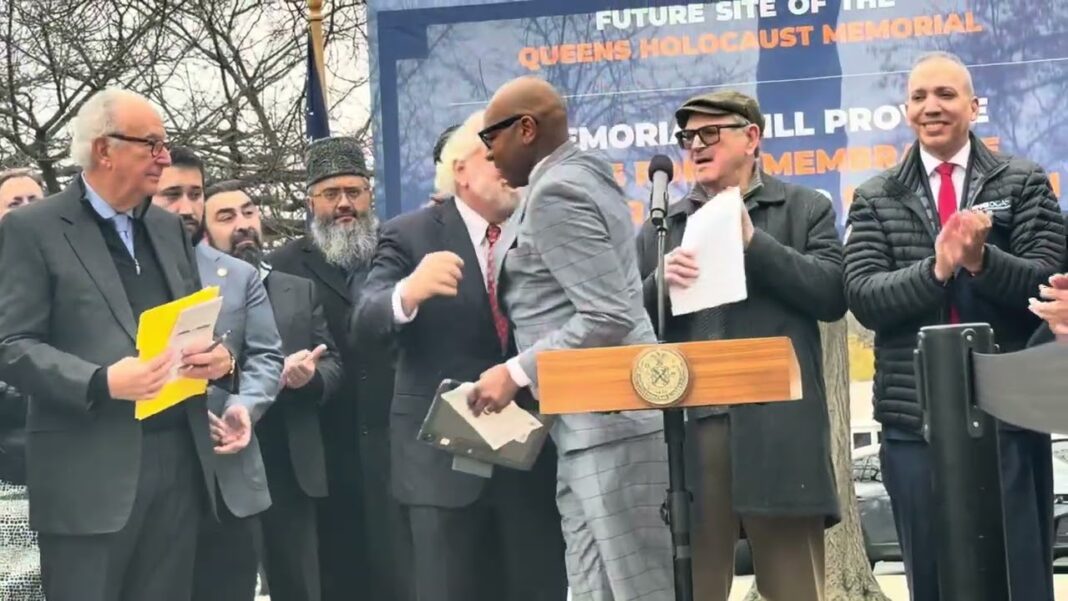
New York City’s decision to erect a Holocaust memorial at Queens Borough Hall has been met with a mixture of gratitude, caution and sober reflection from Jewish leaders, scholars and advocacy groups who say that remembrance, while vital, is insufficient to stem the accelerating tide of contemporary antisemitism. As The Jewish News Syndicate (JNS) reported on Tuesday, the $3 million project—announced jointly by Mayor Eric Adams and Queens Borough President Donovan Richards—will be designed to honor the six million Jews murdered in the Holocaust and the survivors who rebuilt their lives in New York City, particularly in the borough that became a haven for postwar Jewish renewal.
The memorial, city officials said, will feature a commemorative garden and public artwork created in consultation with historians, artists and survivors. It is intended as both an educational site and a space of civic unity—an architectural pledge that the city remains committed to confronting hate in all its forms. Yet as leaders across the Jewish community told JNS, the meaning and impact of such a memorial cannot be understood in isolation from the political climate in which it arrives.
For Edward Rothstein, critic-at-large at The Wall Street Journal, the timing and symbolism of the memorial are inseparable from New York’s shifting political landscape. Rothstein told JNS he had no specific insights into the memorial’s design but said “there is no question that establishing it is a political move,” a reference to the city’s increasingly fraught relationship with its Jewish residents amid rising antisemitic rhetoric.
“In this case, I appreciate the gesture because of the incoming mayor, who has already made clear again and again that his hostility to Israel and to those who support it will be one of his guiding principles,” Rothstein told JNS, referring to mayor-elect Zohran Mamdani, whose repeated criticisms of Israel have alarmed Jewish leaders. “The memorial is a gesture that has some significance given what is to come.”
Rothstein’s concern reflects a broader anxiety within New York’s Jewish communal life: that symbolic gestures toward Holocaust memory cannot compensate for the real-world consequences of political rhetoric that normalizes or excuses contemporary antisemitism. As Rothstein told JNS, Holocaust education—long assumed to be the most powerful tool in preventing future hatred—has shown diminishing ability to deter the metastasizing forms of modern anti-Jewish hostility.
“The problem is that the Holocaust is not the trump card in dealing with antisemitism,” he said. “One of the great fallacies of the last half century is that if you have enough teaching about the Holocaust and its effects, you will help bring an end to the hatred that made it possible. It obviously doesn’t.”
His remarks echo findings reported by JNS over the past year: despite unprecedented investment in educational programming, antisemitism in New York and across the United States has surged to levels unseen in decades, particularly in the aftermath of Hamas’s Oct. 7, 2023, massacre in Israel. Across college campuses, social movements and municipal politics, the Jewish community is confronting a resurgence of hostility that Holocaust-era survivors and scholars hoped would never reappear.
Against this backdrop, many Jewish leaders welcomed the Queens memorial but emphasized that remembrance must be paired with proactive cultural and communal strength.
Rabbi Yossi Blesofsky of Chabad of Northeast Queens told JNS that memorials serve a vital purpose—especially amid what he described as “the recent worldwide explosion of antisemitism”—but insisted that Jewish life flourishes through proactive engagement, not only reflection on past catastrophe.
“Memorials that remind humanity to learn from past catastrophes are a good thing and always welcome,” he told JNS. “While memorializing the Holocaust, we focus on a Jewish future through positive actions.”
Blesofsky pointed to Tamim Academy, a Chabad-inspired day school in Queens with 200 students, as an example of how Jewish education and community-building can fortify identity and foster resilience. For him and his colleagues, the memorial will have meaning only if it catalyzes expanded efforts to nurture Jewish life, empower Jewish families and inspire the next generation to live proudly rather than defensively.
But Blesofsky also highlighted a tension that many Jewish leaders have felt acutely in recent months: the silence of city officials in response to repeated inflammatory statements by mayor-elect Mamdani.
“The positive actions of Queens Borough Hall are welcome news, especially coming after the discouraging silence of Borough Hall on very disturbing comments made repeatedly by the mayor-elect about Jews and Israel,” he told JNS. “Those comments have been deeply troubling to the Jewish community in Queens.”
A self-described democratic socialist, Mamdani has said he would have Israeli Prime Minister Benjamin Netanyahu arrested if he visited New York City. He has also declined to acknowledge that chants of “globalize the intifada”—heard at numerous protests—constitute a call for violence against Jews. His spokeswoman has gone further, suggesting that Jewish houses of worship should not host events deemed to violate “international law,” after protesters blocked Jews from entering a Manhattan synagogue.
For Jewish advocacy organizations, the Queens memorial therefore lands in a moment when affirming the dignity and security of Jewish life in New York is not merely symbolic but urgently practical. Many told JNS that the project represents both a balm and a warning—a statement of remembrance and a reminder that vigilance is necessary.
Josh Kramer, New York regional director of the American Jewish Committee, welcomed the memorial as “an important addition to our city’s rich tapestry of remembrance and celebration of the Jewish community,” telling JNS that he hopes it will “help teach future generations about the dangers of bias, hatred and antisemitism.”
Kramer emphasized that the AJC “thanks and congratulates state and city officials, as well as the Queens Jewish Community Council, for supporting the initiative,” but he also noted—echoing Rothstein and Blesofsky—that teaching alone cannot dismantle the social forces that encourage hostility toward Jews.
According to city officials who spoke with JNS, the development of the memorial will include a formal design process and consultation not only with survivors and historians but also with local arts organizations and educators. The goal, they said, is to create a space that is simultaneously contemplative and activating—a memorial that does not merely recall devastation but sparks engagement with the moral responsibilities of civic life.
Officials have also said the site will serve as a permanent venue for public ceremonies, educational initiatives, interfaith gatherings and community programming. Borough Hall leaders described the project as a “permanent space for remembrance, education and unity.”
Yet observers noted that unity is exactly what is now being tested in New York City. As JNS has chronicled extensively, antisemitic incidents across the five boroughs have risen sharply over the last two years, often erupting at political demonstrations, schools, cultural institutions and religious sites. The city’s Jewish community—one of the largest in the world—has increasingly expressed concern that political leaders are not responding with sufficient urgency or clarity.
Against that backdrop, the creation of a Holocaust memorial in Queens becomes a deeply symbolic act, one layered with meaning far beyond its physical structure. It is a tribute to those who perished, an homage to those who rebuilt, and a signal to contemporary New Yorkers that the city remembers the cost of hatred—and the cost of ignoring it.
But, as Rothstein warned in his conversation with JNS, remembrance alone cannot defeat antisemitism. It can illuminate the dangers. It cannot extinguish the threat.
Rabbi Blesofsky agreed that the true work extends far beyond stone and sculpture.
“Holocaust memorials remind us of what was lost,” he said. “Jewish education, Jewish life, Jewish pride—that is how we ensure a future.”
For now, the Queens memorial stands as both pledge and provocation: a promise to remember, and a challenge to act.
Whether New York City can meet that challenge, Jewish leaders say, will depend not on the monuments it builds, but on the courage it shows when hatred rises once again.