



|
Getting your Trinity Audio player ready...
|
By: Carl Schwartzbaum
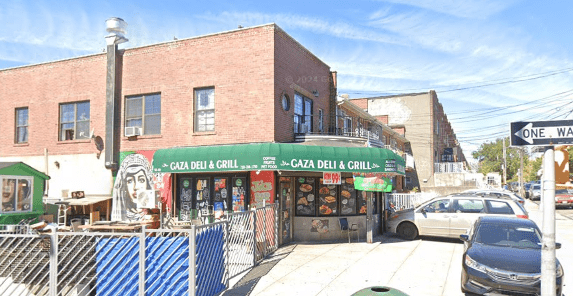
For more than a year, a modest corner deli in Woodside, Queens, has ignited a storm of controversy that reflects the increasingly fraught climate surrounding Israel, Palestine, and Jewish life in New York City. The Gaza Deli and Grill, located on 48th Street, has become a flashpoint for tensions, with its name and murals provoking outrage among Jewish residents who say the establishment makes them feel targeted and unsafe.
According to a report that appeared on Saturday in The New York Post, the small business is unapologetic about its identity, despite waves of complaints, protests, and appeals for sensitivity. Painted on its exterior walls are slogans such as “Save Gaza” and “Free Al Aqsa,” phrases that critics argue are not merely cultural expressions but political rallying cries that implicitly deny Israel’s legitimacy. The walls also feature striking imagery: a woman wearing a keffiyeh, a symbol often associated with Palestinian resistance movements, and a depiction of watermelon slices — a widely recognized emblem of Palestinian solidarity.
Few stories capture the emotional impact of the deli’s presence more vividly than that of Natalie Sanandaji, who spoke candidly to The New York Post. Sanandaji, 30, is a survivor of the October 7, 2023, Nova Music Festival massacre in southern Israel, where Hamas terrorists slaughtered 1,200 people in an attack that traumatized Israelis and Jews around the globe. While en route to Brooklyn earlier this week, she encountered the Gaza Deli and Grill for the first time — and was stunned by what she saw.
“Seeing these messages on a neighborhood deli feels like a punch to the gut,” she told The New York Post. “It’s not just a mural – it’s a message. And to someone like me, it’s a reminder that even here, in the place I came to for peace, I’m still not safe.”
Sanandaji’s account shed light on a painful reality for many Jewish New Yorkers. After surviving the horrors of October 7, she hoped to return to New York for safety and stability. Instead, she says, she is confronted by what she views as celebrations of the very ideology that nearly cost her her life.
“I’m surrounded by people who glorify and call Oct. 7 a ‘resistance,’ like it’s a good thing,” she told The New York Post, adding that the deli embodies the normalization of rhetoric she finds terrifying. “People would celebrate the fact that I almost died.”
For Sanandaji, the deli’s branding is not a cultural gesture but a provocation. “It’s like calling it ‘9/11 Deli’ or ‘Holocaust Deli,’” she said. “It’s the same connotation.”
The deli’s proprietor, 26-year-old Bilal Alghazali, has dismissed claims that the name or imagery could be threatening. Speaking to The New York Post, Alghazali insisted that his intent was to honor his mother’s Palestinian roots. He expressed frustration that critics see hostility in what he describes as an expression of identity.
“They like to make excuses to make it sound like they’re always the victim,” Alghazali said. “We don’t turn down any customers and, believe it or not, we have a lot of Jewish customers who still to this day come into the business. Everyone is welcome, we don’t turn anyone away.”
Despite acknowledging that he has received multiple death threats since opening the store in February 2024, Alghazali remains steadfast in his decision. Not only does he have no intention of changing the deli’s name, he told The New York Post that he even plans to name his future daughter “Gaza.”
“There’s no reason for fear,” he added.
Jewish advocacy groups, however, see the matter very differently. Michelle Ahdoot, director of the grassroots organization End Jew Hatred, told The New York Post that the deli’s signage mirrors the visual language employed by Hamas in propaganda materials.
“The artwork being used is the same kind that glorifies violence against Jews,” she said. “There is a complete lack of sensitivity to Jewish New Yorkers who have experienced such a massive increase in Jew-hatred and now are seeing this deli being used to spread distorted politicized messages.”
Ahdoot’s warning is not abstract. According to NYPD data reported by The New York Post, antisemitic incidents have surged in New York City since the October 7 attacks, ranging from harassment on subways to vandalism of synagogues. Against this backdrop, the Gaza Deli’s signage feels, to many, less like free expression and more like intimidation.
The controversy has not been confined to Jewish advocacy groups. Even members of the city’s restaurant industry have weighed in. Raif Rashed, the Israeli owner of the Flatiron District restaurant Taboonia, described the deli’s messaging as “crazy,” telling The New York Post that such displays only embolden extremist sentiment.
“There are too many Hamas supporters here in New York,” Rashed said, echoing concerns that the normalization of such rhetoric has emboldened fringe voices at the expense of community cohesion.
Within Woodside itself, reactions have been divided. Some residents told The New York Post that they see the Gaza Deli as an authentic reflection of the neighborhood’s diverse immigrant community. To them, it is simply a business owner embracing his heritage, no different from Italian delis proudly displaying regional symbols or Irish pubs hanging flags.
But others, especially local Jews, say context matters. At a time when tensions surrounding Israel and Gaza remain raw, when Jewish communities report rising fear, and when pro-Hamas slogans are often accompanied by chants such as “From the river to the sea,” symbols take on heavier meaning.
“It may be his culture, but to me it’s a reminder that there are people who want me gone,” one Jewish mother of three told The New York Post. “I shouldn’t have to explain to my children why a deli near our home is covered in slogans that make us feel threatened.”
The clash over the Gaza Deli highlights a larger question that The New York Post has explored extensively: the tension between free speech protections and social responsibility in a multicultural city. While Alghazali is legally entitled to name his business as he wishes, critics argue that civic duty demands sensitivity — particularly in moments of heightened vulnerability for minority communities.
This debate is not new. In the wake of the October 7 massacre, the city has witnessed protests and counter-protests, with pro-Hamas demonstrators framing their cause as a human rights struggle, while Jewish groups warn that much of the rhetoric crosses the line into antisemitism. Against this backdrop, a small business with provocative branding becomes more than a neighborhood curiosity; it becomes a proxy for global disputes playing out on local streets.
For Jewish New Yorkers such as Sanandaji, the Gaza Deli controversy is not about a single storefront but about a pervasive sense of alienation. The New York Post has chronicled numerous accounts of Jewish residents who feel less secure in their own city than ever before. From violent altercations in Brooklyn to harassment on college campuses, Jewish New Yorkers say they are being forced to navigate a cityscape where antisemitism feels increasingly normalized.
“It’s not about the name of a deli,” Sanandaji said in her interview with The New York Post. “It’s about whether Jewish life is safe in New York. And right now, the answer is no.”
Alghazali, for his part, seems unmoved by the backlash. Beyond his intention to keep the Gaza Deli’s name, he suggested to The New York Post that he may expand his branding in the future, signaling his commitment to linking his personal identity and business to the Palestinian cause.
For critics, such plans confirm that the Gaza Deli is less a culinary venture than a political statement. “It’s not a sandwich shop — it’s a billboard,” one activist told The New York Post. “And that billboard sends a message that Jews don’t belong.”
The Gaza Deli and Grill controversy is a microcosm of the tensions roiling New York City in the wake of October 7: identity, expression, and safety colliding in the public sphere. As The New York Post has documented, the battle over a single storefront has exposed deep rifts in how communities perceive symbols, words, and their consequences.
For some, the deli is a proud declaration of heritage. For others, it is a chilling reminder of hatred dressed in cultural garb. What is clear is that the issue is not going away. As New York grapples with its future as both a sanctuary for diversity and a city beset by rising antisemitism, the fate of the Gaza Deli will remain emblematic of a larger, unresolved struggle: how to reconcile free expression with the obligation not to endanger or alienate one’s neighbors.
It is not a declaration of heritage. Let’s be honest and perfectly clear. It is a call to end the Jewish problem. Mohamed Hadid, infamous father of Gigi and Bella, calls for the end of Israel, while his half-naked daughters would surely be gang raped and slaughtered in his native Gaza. These people have become more emboldened by all the support they receive from the useful idiots, especially the Jewish ones, like Randi Weingarten and the UJA, Gerald Nadler and by default, Chuck Schumer.