



|
Getting your Trinity Audio player ready...
|
Edited by: Fern Sidman
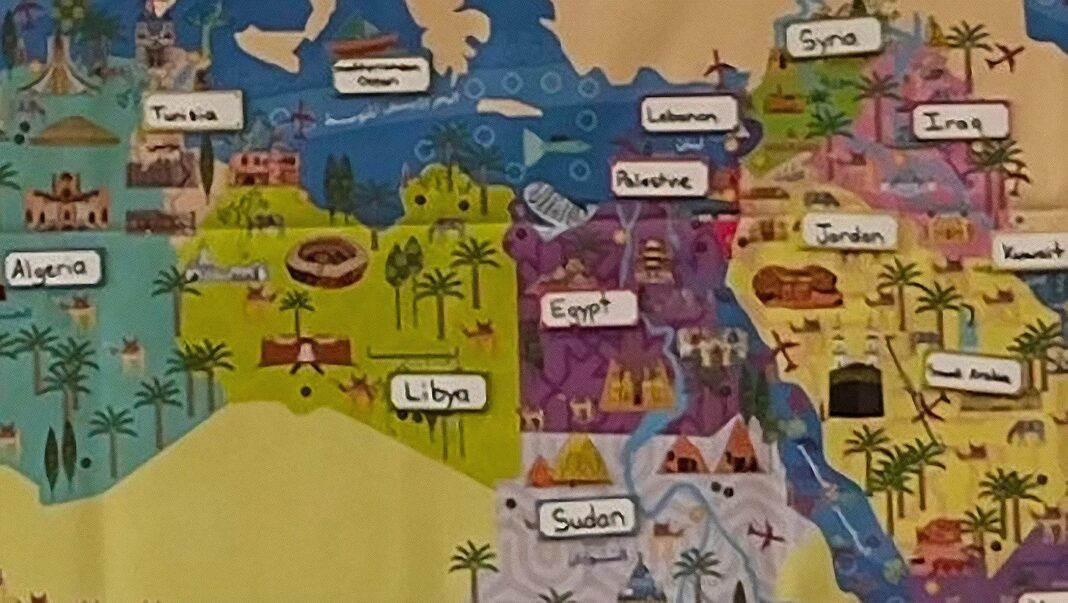
A New York City elementary school, PS 261 in Brooklyn, finds itself embroiled in controversy as accusations of “Jewish erasure” surface due to a map displayed in one of its classrooms. As was reported in the New York Post, the map, labeled the “Arab World,” has raised concerns about its accuracy and the potential influence it may have on young minds.
The map, manufactured by Arab education company Ruman, outlines countries in the Middle East and northern Africa. However, what has stirred the controversy is the omission of Israel, replaced by the label “Palestine.” According to the Post report, the map is part of the Arab Culture Arts program taught by Rita Lahoud, funded by Qatar Foundation International, the American arm of Qatar Foundation, a nonprofit organization owned by Qatar’s ruling family.
Outrageous! PS261, a school in Brooklyn NY, erases Israel from a map of the Middle East and replaces it with “Palestine”.
Teacher Rita Lahoud gives PreK to 5th grade students lessons in the Arab Culture Arts program, funded by Qatar Foundation International.
NYC students… pic.twitter.com/86Teo1aWjR
— StopAntisemitism (@StopAntisemites) January 11, 2024
The association with Qatar, a nation with complex geopolitical ties, has raised eyebrows and led to questions about the potential influence on the content taught in the program, the report in the Post said. Critics argue that the map’s omission of Israel and the labeling of the region as “Palestine” amount to biased and inaccurate representation.
The controversy gained attention when Tova Plaut, an instructional coordinator at a New York City public school, highlighted the issue, expressing concerns about what she termed “Jewish erasure.” Plaut, also the founder of the New York City Public Schools Alliance fighting against anti-Semitism, emphasized the troubling nature of misinformation provided to students and the potential embedding of implicit bias in their understanding of the region, as was noted in the Post report.
QFI initially shared a photo of the controversial map on social media with the caption “We love seeing #Arabic classroom decorations!” The post has since been deleted. The incident raises questions about the oversight and approval processes in place for educational materials, particularly those funded by external organizations with potential geopolitical interests.
Critics argue that presenting inaccurate information to students at an impressionable age can contribute to the formation of biased beliefs. According to information provided in the Post report, the concern is not just about the specific map but extends to the broader issue of ensuring that educational materials are free from nefarious agendas, geopolitical influence and offer a balanced, accurate representation of historical and geographical facts.
Rita Lahoud, a Palestinian-American, is the instructor responsible for teaching lessons on “the art and culture of the Arab world” in Arabic within the walls of PS 261. The Post reported that Lahoud, who spent a significant part of her childhood in Palestine and Saudi Arabia, expressed her passion for educating students about Arab culture. She emphasized the importance of diversity in education, stating that even if her students do not become Arabic language experts, they will gain deep knowledge and respect for Arab culture and art.
Lahoud believes that education programs like hers play a crucial role in changing perceptions and equipping children with tools to challenge stereotypes, especially in today’s political and social climate.
When seeking clarification, The Free Press reached out to the the principal of PS 261 who directed inquiries to the NY Department of Education, indicating a lack of clarity on the matter.
As per the Post report, the spokesman for the Department of Education, Nathaniel Styer, defended the map by stating that it represents “countries that speak Arabic.”
Qatar Foundation International (QFI), which funds the Arab Culture Arts program, has donated over $1 million to the Department of Education between 2019 and 2022, according to the report in the Post. The funds were allocated for dual-language Arabic programs at PS 261 and PS 30 in Brooklyn. The significant financial contributions from QFI have raised questions about the potential influence such donations may have on educational content.
As the debate continues, educators, parents, and officials grapple with finding the right balance between cultural education and maintaining an objective approach to historical and geopolitical realities in the classroom.