



|
Getting your Trinity Audio player ready...
|
By: Yisroel David
In a case that has sent reverberations through New York’s law enforcement community and reignited debate over the boundaries between protest and criminality, a Brooklyn man has admitted to deliberately setting ablaze a fleet of New York Police Department vehicles in what prosecutors describe as a calculated and reckless act of arson. The incident, which occurred in the early hours of June 12, 2025, has now culminated in a federal guilty plea, marking a significant turning point in a saga that has drawn intense scrutiny, as reported on Wednesday by The New York Daily News.
Jakhi Lodgson-McCray, a 22-year-old Brooklyn resident, appeared before a federal magistrate judge on Wednesday, where he formally acknowledged his role in igniting 11 unoccupied NYPD vehicles parked in a secured lot near the 83rd Precinct stationhouse in Bushwick. His admission, delivered in stark and unambiguous terms, carries profound legal consequences, including a mandatory minimum sentence of five years in federal prison.
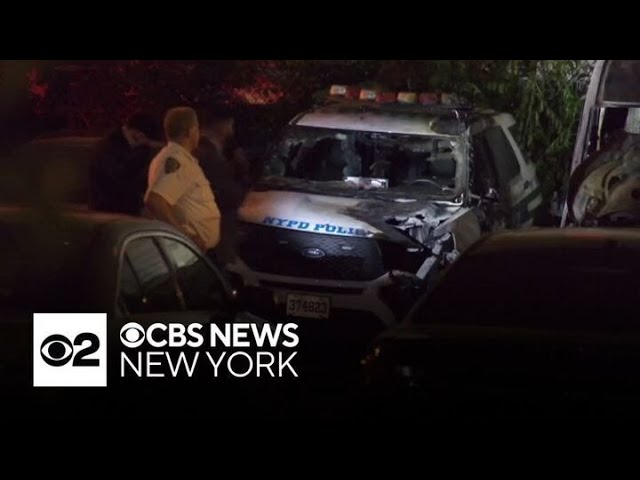
According to court filings and investigative accounts detailed by The New York Daily News, the event unfolded with chilling deliberation. Surveillance footage captured Lodgson-McCray scaling a fence to gain access to the restricted parking area shortly before 1:00 a.m. Once inside, he remained undetected for over half an hour, methodically setting fire to ten police vehicles and an additional trailer.
The precision and duration of the act have led investigators to conclude that the arson was not impulsive but rather premeditated. Authorities allege that the defendant employed multiple commercially available fire-starting devices—22 in total—strategically placing them across several vehicles to maximize destruction.
The resulting blaze, though swiftly extinguished by the Fire Department of New York, inflicted extensive damage, with losses estimated at more than $800,000. While no injuries were reported, the potential for catastrophic consequences was considerable, given the proximity of residential buildings and the inherent danger posed by uncontrolled fires.
The operation might have remained unsolved were it not for a series of investigative breakthroughs that, taken together, painted a comprehensive picture of the perpetrator’s movements. As reported by The New York Daily News, a police officer conducting a routine inspection of the lot shortly after 1:20 a.m. discovered the fires in progress, prompting an immediate response.
Lodgson-McCray attempted to flee by scaling the same fence he had used to enter, but finding his path blocked, he escaped through a breach in the perimeter. In his haste, however, he left behind critical evidence, including a pair of sunglasses bearing his fingerprints and a cigar-lighter torch believed to have been used to ignite the fires.
Further investigation, aided by an extensive network of surveillance cameras, traced his route to a nearby convenience store. There, a camera captured an image of his identification card as he opened his wallet, providing investigators with a decisive lead that ultimately culminated in his arrest.
The timing of the arson has drawn particular attention. The incident occurred mere hours after a “Speak Out” protest outside the same precinct, where demonstrators had gathered to criticize the NYPD’s handling of celebrants following the Puerto Rican Day Parade. Lodgson-McCray’s actions, prosecutors argue, were directly linked to this demonstration, reflecting a broader climate of tension and unrest.
Moreover, the attack took place just days before a planned “No Kings” protest, a large-scale demonstration that was expected to draw significant crowds. Federal authorities have suggested that the destruction of police vehicles could have impaired the NYPD’s ability to respond effectively to such events, thereby exacerbating public safety risks.
In a statement cited by The New York Daily News, U.S. Attorney Joseph Nocella underscored the deep implications of the crime, emphasizing that the deliberate targeting of police resources not only endangered first responders but also diverted critical assets away from the community.
The case has also illuminated a contentious and deeply polarizing dimension: the response of certain activist groups and supporters. Approximately 20 individuals attended the court proceedings, some wearing shirts emblazoned with slogans such as “Free Jakhi” and “Love Fights Back.”
A statement issued by Lodgson-McCray’s support committee, representing a coalition of more than 21 organizations, portrayed the defendant as a figure of resistance, lauding his actions as an expression of “bravery and commitment to defending his community.”
This characterization, reported by The New York Daily News, has been met with sharp criticism from law enforcement officials and public safety advocates, who argue that it risks normalizing acts of violence under the guise of political protest.
The divergence in perspectives reflects a broader societal debate over the limits of dissent. While the right to protest is a cornerstone of democratic society, the transition from peaceful demonstration to destructive action raises profound ethical and legal questions.
Lodgson-McCray’s legal troubles are not confined to this single incident. Law enforcement records indicate a history of protest-related arrests, including charges of disorderly conduct, resisting arrest, and assault in both Manhattan and Queens. This pattern suggests a sustained engagement with confrontational forms of activism, further complicating the narrative surrounding his actions.
For prosecutors, this history may serve to contextualize the arson as part of a broader trajectory rather than an isolated event. For supporters, however, it may reinforce the image of an individual deeply committed to a cause, albeit through controversial means.
The destruction of police vehicles—particularly in such significant numbers—has tangible implications for public safety. Patrol cars and specialized units are essential components of urban policing, enabling rapid response to emergencies and maintaining a visible presence that deters crime.
By incapacitating 11 vehicles, Lodgson-McCray effectively reduced the operational capacity of the 83rd Precinct, at least temporarily. As The New York Daily News report noted, such disruptions can have cascading effects, straining resources and complicating efforts to maintain order during periods of heightened activity.
The incident has prompted calls for enhanced security measures at police facilities, including improved surveillance, reinforced barriers, and increased patrols. It has also reignited discussions about the allocation of resources and the need to balance proactive policing with community engagement.
With his guilty plea entered, Lodgson-McCray now faces sentencing under federal statutes that mandate a minimum term of incarceration. The absence of a set sentencing date leaves open questions about the ultimate severity of the penalty, though the statutory framework suggests a substantial period of imprisonment.
The case will likely serve as a precedent in the prosecution of similar offenses, reinforcing the principle that acts of arson—particularly those targeting public infrastructure—will be met with rigorous legal consequences.
The events in Bushwick represent more than a singular act of destruction; they encapsulate a broader tension at the heart of contemporary society. As reported by The New York Daily News, the case forces a reckoning with the boundaries of protest, the responsibilities of citizenship, and the imperative of public safety.
In the final analysis, the flames that consumed those police vehicles illuminate not only the physical damage inflicted but also the deeper fractures within a society grappling with competing visions of justice and order. Whether this incident will prompt a recalibration of those dynamics remains to be seen, but its significance is undeniable—a stark reminder of the consequences that arise when dissent crosses the threshold into destruction.
