



|
Getting your Trinity Audio player ready...
|
By: Chaya Abecassis – Jewish Voice News
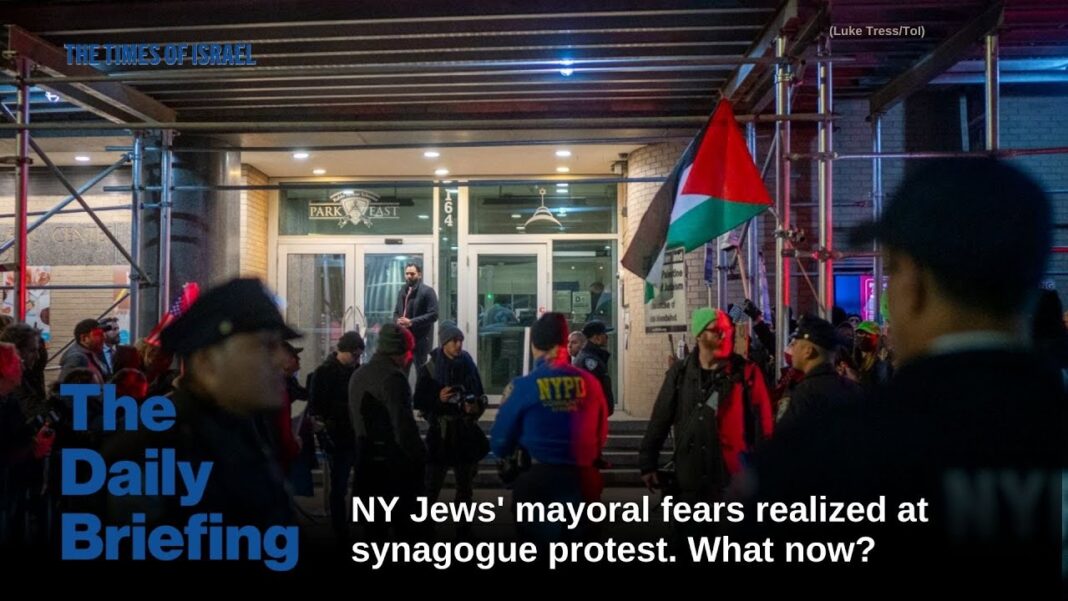
The New York Police Department has opened a formal Internal Affairs investigation into the conduct of senior leadership during last week’s volatile pro-Hamas demonstration outside Park East Synagogue, a storied Jewish institution on Manhattan’s Upper East Side. As VIN News reported on Saturday evening, the incident has become a flashpoint in the city’s escalating debate over public safety, antisemitism, and the limits of lawful protest in an era of heightened tensions surrounding the war in Gaza.
The NYPD’s Internal Affairs Bureau (IAB) — specifically Group 1, the elite unit tasked with scrutinizing the actions of senior officers — has begun interviewing top brass, including Chief of Manhattan North Ruel Stephenson, according to revelations first described in the New York Daily News. The inquiry marks one of the most significant internal reviews the department has launched since mass pro-Hamas demonstrations began proliferating across the city in late 2023 and throughout 2024.
As the VIN News report noted, the investigation centers on the police response to a demonstration that rapidly escalated from routine political protest to an aggressive, confrontational spectacle. Protesters, many chanting pro-Hamas and anti-Israel slogans, converged outside Park East Synagogue, where the nonprofit Nefesh B’Nefesh was hosting an Israel immigration-recruitment event. Video footage circulated widely on social media shows Jew hating activists jostling, berating, and advancing toward attendees attempting to enter the building, including families with children.
Park East Synagogue, long recognized as a symbol of Jewish resilience and communal life in Manhattan, was thrust unwillingly into the center of a confrontation that many Jewish leaders described as deliberately provocative and dangerously close to violence. As the VIN News report emphasized, the proximity of protesters to the synagogue’s entrance raised profound concerns not only about crowd control but about the city’s responsibility to safeguard houses of worship against intimidation, harassment, or targeted political agitation.
Witnesses recounted to VIN News that police on the scene appeared hesitant or insufficiently mobilized, allowing demonstrators to press within feet of the synagogue’s doorway. Several elected officials — including representatives from heavily Jewish districts — publicly criticized the NYPD for what they characterized as a failure to establish appropriate barricades, maintain distance between protesters and congregants, or intervene when the crowd became unruly.
The event, ostensibly aimed at connecting prospective immigrants with Israeli agencies, became a target for demonstrators who equated participation with complicity in Israel’s military campaign in Gaza. The chants and signage, recorded on multiple videos, veered frequently into explicit expressions of support for Hamas, a U.S-designated terrorist organization. As VIN News reported, these displays were particularly distressing to community members still raw from the October 7 Hamas massacre and the surge in antisemitic incidents that followed worldwide.
It is within this combustible context that Internal Affairs has initiated its review. Group 1’s involvement signals not merely operational scrutiny but a potential examination of strategic decisions made at the highest levels of Manhattan North command. Chief Ruel Stephenson, who oversees policing across a vast portion of Manhattan, stands at the center of the inquiry, along with several deputy inspectors and precinct executives who were responsible for drawing up and executing the protest-management plan.
According to the information provided in the VIN News report, investigators are seeking to establish whether police commanders underestimated the potential for disorder, failed to allocate sufficient personnel, or issued directives that inadvertently allowed demonstrators to overwhelm designated safety perimeters. IAB’s mandate in this instance is not simply to evaluate tactical missteps but to determine whether departmental protocols — long established for protecting religious sites and sensitive community institutions — were ignored or improvised under politically charged conditions.
These interviews, still in early phases, could signal broader questions about NYPD preparedness in responding to protest movements that have become increasingly confrontational and ideologically radical over the past year. As VIN News reported, Jewish communities in New York have expressed mounting frustration that police have not always acted swiftly or decisively when demonstrations target synagogues, schools, or events connected to Jewish life.
The backlash from Jewish leaders has been swift and pointed. Several prominent rabbis, community activists, and organizational heads have called for transparency regarding the NYPD’s operational plan for the Park East event and urged the department to adopt a more assertive posture to prevent similar disturbances.
As VIN News reported, many leaders argue that the NYPD’s role in protecting synagogues must now be viewed through a more urgent lens. The past two years have seen repeated attempts by anti-Israel activists to stage protests timed to coincide with Jewish communal gatherings — including Shabbat services, lectures, and cultural programs — in what critics describe as a pattern of deliberate intimidation. The Park East incident, they say, was only the most recent and perhaps the most visible example.
The incident also attracted attention from New York’s political class. Several City Council members have called for hearings on police handling of antisemitic incidents, while state lawmakers have asked the governor’s office to ensure that synagogues remain adequately protected by counterterrorism resources.
In statements highlighted by VIN News, Jewish organizations stressed that the issue extends far beyond one protest: it touches the core question of whether New York, a city home to the largest Jewish population outside Israel, is willing to ensure that its Jewish residents can worship, gather, and participate in communal life without fear of targeted harassment.
The NYPD has declined to issue public comment on the Internal Affairs probe, citing the confidentiality of ongoing investigations. That silence has only intensified speculation about the scope and potential consequences of the inquiry. While internal reviews of protest responses are not uncommon, an investigation focused on senior command-level officers is far rarer and suggests deep concern within the department about both the optics and the substance of its handling of the Park East situation.
As the VIN News report pointed out, the inquiry arrives at a time when NYPD leadership is under heightened scrutiny from multiple directions — political activists accusing the department of over-policing protests, and Jewish community leaders accusing it of doing too little to intervene when protests turn menacing.
The Park East Synagogue incident encapsulates a broader moment of reckoning for New York City. The city must now navigate the intersection of constitutionally protected speech, escalating geopolitical tensions, and long-standing obligations to protect houses of worship. The IAB investigation has the potential to shape the NYPD’s future protest protocols, recalibrate its approach to synagogue security, and reestablish confidence among Jewish communities who feel increasingly vulnerable.
As the inquiry proceeds, one question looms especially large: Will the NYPD acknowledge and remedy operational shortcomings, or will the investigation reveal deeper structural hesitations about policing protests that target Jewish institutions?
For now, Park East stands as a symbol — not only of a beloved synagogue confronted by an angry crowd, but of a moment when New York was forced to confront its own fragility. Jewish New Yorkers await the outcome of an investigation that may determine how safe their communal life will be in the months and years ahead.
Heads must fly no excuse
The video shows NYPD LEGAL there together with regular NYPD police. Interesting and needs explanation of the role of LEGAL at the site!!