



|
Getting your Trinity Audio player ready...
|
By: Fern Sidman – Jewish Voice News
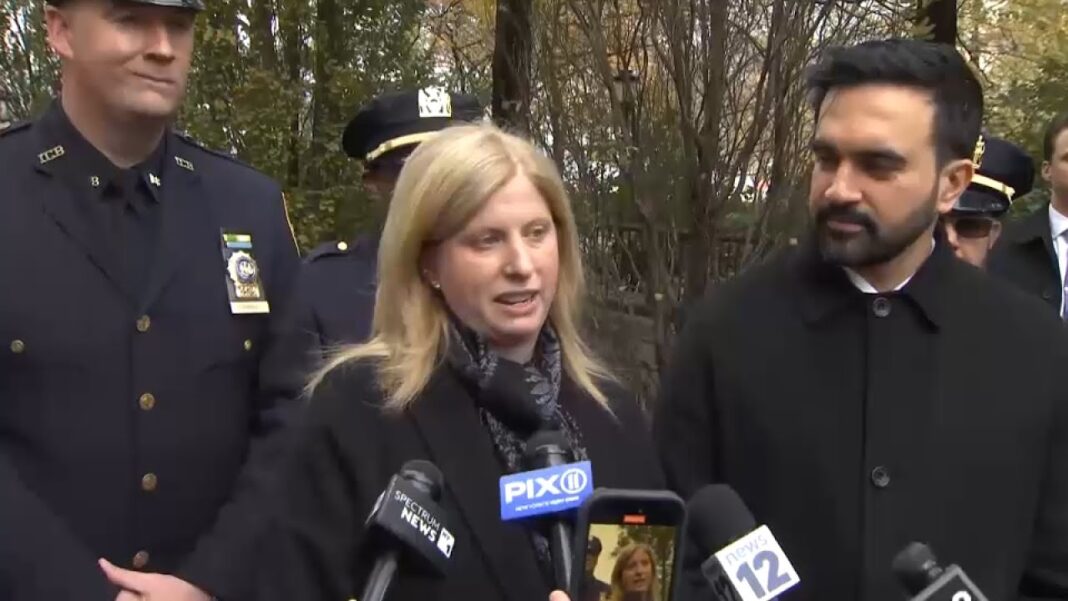
In a rare moment of public contrition from the upper echelons of New York City’s law-enforcement hierarchy, NYPD Commissioner Jessica Tisch delivered a sweeping and emotional apology on Saturday to the congregants of Park East Synagogue—one of Manhattan’s most historic and storied Jewish houses of worship—acknowledging that the police department had failed in its core responsibility: ensuring the safety, dignity, and uninhibited access of its worshippers during a virulently anti-Israel protest earlier in the week. Her remarks, delivered during Shabbat services to an audience of approximately 150 congregants, were remarkable not only for their candor but also for their public recognition of the growing sense of vulnerability among Jewish New Yorkers.
As The New York Post reported exclusively on Saturday, Tisch spoke for roughly ten minutes, each moment heavy with the acute awareness of the “heightened fear within our community,” as she put it. She conceded unambiguously that the NYPD had failed to maintain a clear entrance to the synagogue during the Wednesday night demonstration, allowing hostile protesters to come dangerously close to the building’s steps—and to the worshippers attempting to enter.
“That is where we fell short,” Tisch said, her voice carrying through the sanctuary with a gravity that clearly moved those present. “And for that, I apologize to this congregation.” According to The New York Post report, the apology earned her a standing ovation from the room, which was filled not only with congregants but also prominent community supporters, including New England Patriots owner Robert Kraft. Kraft, a lifelong advocate for Jewish security and a stalwart supporter of Israel, reportedly called Tisch a “woman of valor,” noting her willingness to speak with unsparing honesty.
The incident in question unfolded Wednesday evening, when roughly 200 anti-Israel demonstrators—mobilized by the radical activist coalition Pal-Awda NY/NJ—descended upon Park East Synagogue in a highly choreographed attempt to disrupt an event hosted by Nefesh B’Nefesh, the Zionist organization dedicated to helping North American Jews immigrate to Israel. As The New York Post report detailed, the crowd’s chants included “Globalize the intifada” and the menacing exhortation to “take another settler out,” a phrase that, stripped of activist euphemism, unmistakably calls for the murder of Jews.
Many demonstrators wore masks, leading counter-protesters to label them “cowards” and “pussies,” according to witness statements cited in The New York Post report, Metal barricades were set up by police to keep demonstrators at bay, but several were positioned dangerously close to the entrance—creating a bottleneck that endangered congregants attempting to move in and out of the synagogue. Some congregants later described the experience as “terrifying,” noting that private security personnel had to intervene at several points.
Synagogue Rabbi Arthur Schneier, himself a global interfaith leader and a Holocaust survivor, said he was “very, very touched” by Tisch’s outreach following the events, according to the report in The New York Post. Yet the deeper story behind Wednesday’s protest and Saturday’s apology points to increasingly strained fault lines in New York’s political and civic landscape—fault lines that widen with each new confrontation between anti-Israel activists and Jewish New Yorkers.
Immediately after the demonstration was announced, Mayor Eric Adams—who, as The New York Post emphasized, served as an NYPD captain for over two decades—sent directives from Uzbekistan, where he was traveling. He urged top NYPD officials, including Tisch, to ensure the protest did not spiral out of control or physically obstruct synagogue access. But despite those advance warnings, the evening devolved into what multiple sources described to The New York Post as “chaos.”
“The mayor was fuming mad when he saw what happened,” one source close to Adams told the paper. “Protesters got right to the entrance, and it got nasty. Private security at the synagogue even had to intervene.”
The Mayor’s Office, however, denied any schism between Adams and his hand-picked commissioner. Instead, it issued a statement that placed blame squarely on the “hateful message” of the demonstrators and on the tactical handling by the Manhattan North precinct brass. Fabian Levy, the mayor’s spokesman, reiterated City Hall’s position: “The blame lies at the feet of those spreading their hateful message… the plan executed by the commander on the ground did not meet expectations.”
Yet even this firm condemnation could not mask the growing concern that New York’s Jewish communities feel increasingly vulnerable in a city where anti-Israel demonstrations have become frequent, aggressive, and strategically targeted toward Jewish spaces. Wednesday night’s protest was not merely a gathering of political activists expressing their viewpoint. It was a coordinated attempt to intimidate, to disrupt, and to send a chilling message to Jewish New Yorkers: that their institutions, their rituals, and their sense of sanctuary are no longer inviolable.
As The New York Post report highlighted, Commissioner Tisch’s sensitivity to the Jewish community’s fears is not abstract. She hails from one of New York’s most prominent Jewish families, and her Zionist convictions are both unapologetic and deeply personal. It is this background that makes her recent acceptance of Mayor-elect Zohran Mamdani’s offer to stay on as commissioner particularly notable—and, for many, perplexing.
Mamdani, a Democratic Socialist and a strident critic of Israel, represents a political worldview fundamentally at odds with Tisch’s. He has pledged, in past statements to order the arrest of Israeli Prime Minister Benjamin Netanyahu should he visit New York City, a threat that would upend diplomatic norms and strain U.S.–Israel relations to the breaking point. That such an order would be legally baseless seems almost beside the point; the statement is ideological theater aimed at a constituency animated not by policy nuance but by anti-Israel fervor.
In the aftermath of Wednesday’s protest, Mamdani—through spokesperson Dora Pekec—told Jewish Insider that while protesters should have behaved better, the blame ultimately lies with the event itself, which he suggested violated international law. “These sacred spaces should not be used to promote activities in violation of international law,” Pekec said—a line that echoes the rhetoric increasingly used in activist circles to delegitimize Zionism and, by extension, Jewish presence in their ancestral homeland.
To many Jewish New Yorkers, this was not merely tone-deaf but deeply offensive. The notion that a synagogue providing information about legally immigrating to Israel constitutes a violation of international law is a distortion so profound that it verges on propaganda. Yet it is now part of New York City’s incoming mayoral vocabulary. And it places Tisch in a precarious political position, caught between her duty to the city, her identity as a Zionist Jew, and a looming political transition whose ideological contours are still unfolding.
As The New York Post has consistently pointed out, New York’s Jewish communities are experiencing an escalation of hostility unseen in decades. At protests, “globalize the intifada” is becoming a ubiquitous rallying cry—a phrase whose meaning is not metaphorical but explicitly violent. Jewish institutions are routinely targeted not because they are political but because they are Jewish. And the confidence of many Jewish New Yorkers in the city’s political leadership is fraying.
Tisch’s apology, delivered with sincerity and received with appreciation, was more than a gesture. It was a recognition that the events at Park East Synagogue were not a one-off failure but part of a deeper, more troubling pattern. The city’s promises of accountability and reform will be judged not by press statements but by whether Jewish worshippers can enter their synagogues without fear—especially as demonstrations grow more frequent, more militant, and more emboldened.
For now, the image that will linger in the minds of many is not the applause that greeted Tisch’s apology, but the masked demonstrators screaming for “intifada” on the synagogue’s doorstep. It is a tableau that raises questions about public safety, about the limits of protest, and about the ethical obligations of a city whose Jewish communities have always formed an essential part of its civic fabric.
As New York hurtles toward a political transformation under Mayor-elect Mamdani, the question is not whether more protests will come—they will—but whether the NYPD, City Hall, and the broader political establishment will meet the moment. Whether they will draw clear boundaries between free expression and targeted intimidation. Whether synagogues will be accorded the same protected space that other communities expect as a matter of course. And whether the city’s future leadership will stand unequivocally with a besieged community—or continue to rationalize the actions of those who seek to harass it.
Commissioner Tisch has taken responsibility for the NYPD’s shortcomings. But responsibility is only the first step. The road ahead will test the city’s integrity, its values, and its commitment to ensuring that no New Yorker—especially those who know the cost of hatred all too well—must choose between exercising their faith and safeguarding their safety.
For now, Park East Synagogue remains both a symbol of Jewish endurance and a reminder of the vigilance required in a city where the boundaries between protest and menace are increasingly blurred. And as The New York Post report observed, the stakes for New York’s Jewish future have not been this high in generations.