



|
Getting your Trinity Audio player ready...
|
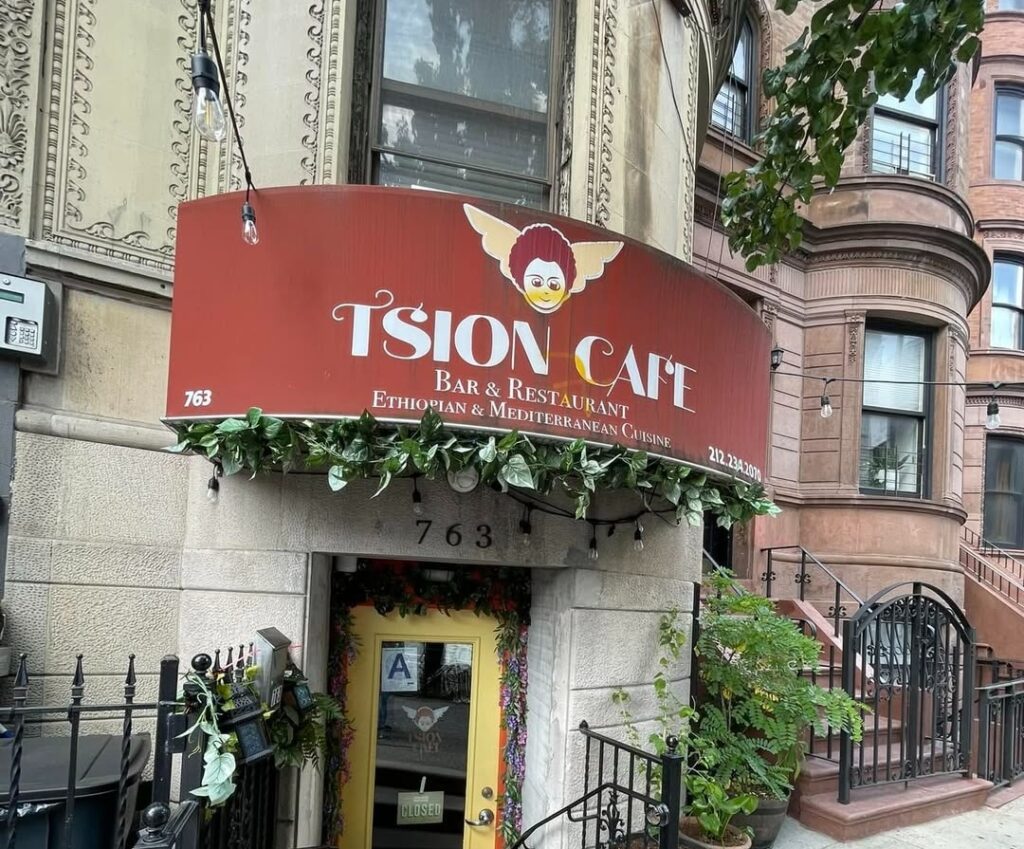
NYC’s Lone Ethiopian-Israeli Café Forced to Close Following Sustained Anti-Israel Harassment
By: Jeff Gorman
In the long, turbulent history of New York City, restaurants have often served as informal parliaments of coexistence—places where immigrant memory, culinary craft, and civic belonging converge over shared tables. That fragile covenant was shattered in Harlem this winter with the closing of Tsion Café, the city’s only Ethiopian-Israeli restaurant, after its owner, Beejhy Barhany, said a relentless campaign of harassment linked to the war in Gaza made it impossible to continue operating. As The New York Post reported on Thursday, Barhany’s decision to shutter the establishment has ignited urgent calls for state and city authorities to open civil rights investigations into a harsh climate of resurgent antisemitism that now reaches into the quotidian life of small businesses.
Barhany, an Ethiopia-born Jewish immigrant who lived in Israel before building her life in New York, opened Tsion Café in Harlem in 2014 with an aspiration that was as cultural as it was culinary. Her kitchen, rooted in Ethiopian traditions and Israeli-Jewish identity, sought to bridge communities through food, hospitality, and story. Yet, according to the information provided in The New York Post report, the tone of public engagement with the restaurant changed dramatically after the October 7, 2023 Hamas attacks on Israel and the ensuing war in Gaza.
What had once been a neighborhood fixture became, in Barhany’s account, a lightning rod for vitriol that bore little relation to her personal actions or beliefs, but instead reflected the projection of geopolitical fury onto a local business owned by a Jewish Israeli.
The New York Post chronicled the cruelty of the messages Barhany says she endured. On one occasion, when she answered the restaurant’s phone, the caller allegedly hurled a slur and told her, “You dirty Jew. We should erase you from the map.” The words, echoing the genocidal language of history, pierced the intimate space of a family-run enterprise. “I am demoralized and heartbroken that there are so many bigots out there,” Barhany told The New York Post. “It’s mind-blowing. We can’t handle the burden anymore.” The psychological toll of such harassment, repeated over months, eventually proved insurmountable.
The animosity intensified following a series of decisions Barhany made in the wake of the war, particularly her choice in February 2024 to remove meat from the menu and operate as a fully vegan and kosher establishment. The move, intended to align the restaurant more clearly with Jewish dietary law and ethical commitments, became an accelerant for harassment rather than a gesture of inclusion. Barhany recounted to The Jewish Week, as cited by The New York Post, that from the moment the restaurant pivoted to kosher, “it became worse and worse.” Calls grew more abusive, and passersby allegedly warned others not to patronize the café because it was “owned by Israelis. By Zionists.”
In this rhetoric, identity itself became the alleged offense, collapsing the distinction between a local business owner and the policies of a foreign government.
The story, as The New York Post has presented it, is not merely about one restaurant’s closure but about the porous boundary between political protest and ethnic or religious harassment. Critics of Israeli government policy have, in some cases, directed their anger toward Jewish individuals and institutions in the diaspora, conflating identity with state action. For Barhany, whose life story traverses Ethiopia, Israel, and the United States, this conflation has been particularly painful. “It’s kind of tiring,” she told The Jewish Week, in remarks cited by The New York Post. “You’re here to nourish the community and it feels like you are perceived like the enemy.”
The irony is stark: a restaurant conceived as a bridge of cultural nourishment was recast, in the eyes of some, as a proxy battlefield.
The closure of Tsion Café prompted institutional responses. The Jewish Community Relations Council of New York filed formal complaints with the offices of State Attorney General Letitia James and Mayor Zohran Mamdani, urging civil rights probes into the alleged harassment. JCRC CEO Mark Treyger framed the case as emblematic of a broader moral emergency. “No small business owner should ever have to fear closing their doors because of their identity,” he told The New York Post. “Harassing a Jewish small business owner because she is Israeli and Jewish—and attempting to hold her personally responsible for Israel’s actions—is antisemitism, plain and simple.”
Treyger’s intervention situated the Tsion Café episode within a continuum of incidents in which Jewish spaces in New York have been targeted by pro-Hamas activists whose tactics cross into discriminatory intimidation.
Public officials have also weighed in. City Comptroller Mark Levine, who described Tsion Café as one of his favorite restaurants, condemned the harassment in stark terms. The New York Post reported that Levine characterized the animus directed at the café as “blatant bigotry,” noting that the pressure intensified after the restaurant went kosher. “Now they are closing their doors,” he said. “Why? Because of a constant stream of animosity.” His statement underscored the civic cost of intolerance: when bigotry succeeds in driving out small businesses, the city’s cultural fabric frays.
The New York Post has situated Barhany’s ordeal within a broader pattern of targeting Jewish establishments in the city. Other eateries, such as Breads Bakery on the Upper West Side, have faced harassment from pro-Hamas, anti-Israel critics, suggesting that Tsion Café’s closure is not an isolated incident but part of a troubling trend.
Attorney General James’s office confirmed to The New York Post that it is reviewing the civil rights complaint filed by the JCRC, while Mayor Mamdani’s office declined to comment. The silence from City Hall has, for some observers, sharpened concerns about whether municipal leadership is prepared to confront the rising tide of antisemitic harassment with the urgency it demands.
Barhany’s own response, as conveyed through The New York Post, resists the temptation to retreat into anonymity. “I’m a proud Black, Ethiopian Jew,” she said, asserting an identity that defies simplistic categorization. Her founding of the Beta Israel of North America Cultural Foundation reflects a commitment to celebrating the legacy of Ethiopian Jews, a community whose history of marginalization complicates any attempt to reduce Jewish identity to monolithic stereotypes. In this sense, the harassment she endured did more than shutter a restaurant; it struck at the pluralistic narrative of Jewish life in New York, where multiple diasporas intersect and enrich the city’s cultural landscape.
The Tsion Café episode invites a deeper reflection on the ethical boundaries of political protest in a multicultural society. The New York Post’s reporting illustrates how the passions of international conflict can metastasize into local hostilities when identity becomes a stand-in for state policy. The erosion of that boundary corrodes the civic commons, transforming neighborhoods into arenas of symbolic reprisal. For small business owners like Barhany, the consequences are immediate and material: livelihoods lost, dreams deferred, communities impoverished.
In a city that prides itself on tolerance and diversity, the closure of Tsion Café stands as a cautionary parable. The New York Post has rendered the story not merely as a lament but as an indictment of a climate in which hatred, when left unchecked, acquires the power to shutter doors, silence voices, and diminish the city’s moral imagination. Whether the civil rights inquiries now under review will yield accountability remains to be seen. What is already clear is that the cost of inaction is borne by individuals whose only transgression, in the eyes of their harassers, is the audacity to exist openly as Jews.