



|
Getting your Trinity Audio player ready...
|
By: Fern Sidman
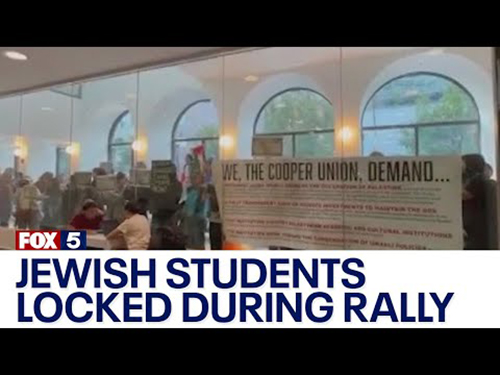
In the autumn of 2023, as universities across the United States convulsed with political fervor following Hamas’s brutal attack on Israel on October 7th of that year, few episodes were as visually arresting—or legally consequential—as the moment Jewish students at Cooper Union for the Advancement of Science and Art barricaded themselves inside a library at the Manhattan school while pro-Hamas, pro-terror demonstrators surged outside. Now, more two years later, the venerable private college has agreed to sweeping reforms and financial compensation to settle a lawsuit alleging that it abdicated its responsibility to protect Jewish students from discrimination and harassment.
The agreement, announced Thursday, comes after months of litigation that placed Cooper Union alongside elite institutions such as Columbia University, Harvard University, and New York University—each of which has faced, and in some cases settled, allegations that campus administrators tolerated or even facilitated antisemitic environments in the volatile months after October 7.
As reported on Thursday by Reuters, the Cooper Union settlement obligates the college to overhaul its Title VI compliance procedures, impose new rules governing campus demonstrations, and create institutional mechanisms to ensure that no student group is again forced to seek refuge behind locked doors.
The incident that triggered the legal action occurred on October 25, 2023, when pro-Hamas demonstrators stormed past campus security officers and descended upon the entrance to the Cooper Union library in Manhattan’s East Village. Jewish students who were inside described a chaotic scene: pounding on doors, fists slamming against glass windows, chants of “Free Palestine” reverberating through the building’s narrow corridors.
Fearing physical harm, the students barricaded themselves inside the library—a modernist temple of learning suddenly transformed into a fortress of last resort.
What proved as alarming as the demonstration itself, according to the plaintiffs, was the college administration’s response—or lack thereof. Students allege that administrators failed to intervene to disperse the crowd and even instructed police officers, who had arrived on scene offering assistance, to stand down.
Last February, U.S. District Judge John Cronan refused to dismiss the lawsuit, rejecting the university’s argument that the protesters’ conduct was shielded by free-speech protections. As Reuters reported at the time, Cronan concluded that constitutional guarantees do not excuse conduct that renders students fearful for their safety based on their religion or national origin.
That ruling proved pivotal, setting the stage for the settlement that now binds Cooper Union to far-reaching institutional reforms.
At the center of the case is Title VI of the Civil Rights Act of 1964, which prohibits institutions receiving federal funds from discriminating on the basis of race, religion, or national origin. Although Title VI is often invoked in cases involving racial bias, its application to religious discrimination has grown increasingly prominent as Jewish students report being marginalized or targeted on American campuses.
The plaintiffs—ten Jewish students represented by the Lawfare Project—argued that Cooper Union violated Title VI by fostering what the complaint termed a “hostile educational environment.” As the Reuters report explained, their legal team maintained that when a university knowingly allows harassment to escalate into intimidation, it ceases to be a neutral forum for debate and becomes a vector of discrimination.
“Jewish students deserve to learn without being targeted, harassed, or excluded because of who they are or what they believe,” said Ziporah Reich, director of litigation at the Lawfare Project. “Universities have a legal duty to protect them.”
The settlement vindicates that principle with a battery of structural changes designed to transform how Cooper Union handles campus unrest.
Under the agreement outlined by Reuters, Cooper Union will undertake a series of corrective actions:
The college must appoint a dedicated official to oversee its compliance with anti-discrimination laws, ensuring that complaints of harassment are investigated promptly and thoroughly.
Faculty, administrators, and students will receive instruction on institutional policies regarding harassment, discrimination, and protest conduct.
In a move echoing policies adopted by several universities nationwide, Cooper Union will ban the wearing of masks to conceal identities during campus protests—a measure intended to deter intimidation and facilitate accountability.
While the precise financial terms remain undisclosed, the college has agreed to provide monetary restitution to the ten plaintiffs.
As of Thursday, neither Cooper Union nor its legal counsel had responded publicly to the settlement announcement, a silence that the Reuters report noted amid growing scrutiny of higher education institutions’ handling of antisemitism.
The Cooper Union case is not an isolated episode but part of a nationwide legal reckoning that has swept across academia since late 2023. In the months following Hamas’s attack on Israel, universities became epicenters of protest—and, according to numerous lawsuits, incubators of antisemitic hostility.
Reuters has documented similar settlements involving Columbia University, Harvard University, and New York University, where Jewish students alleged that administrators failed to prevent harassment ranging from inflammatory rhetoric to exclusion from academic spaces.
Civil rights advocates say the pattern is unmistakable: institutions long accustomed to navigating debates over free expression are now confronting the legal limits of neutrality when speech devolves into intimidation.
“What we are witnessing is the reassertion of Title VI as a real, enforceable safeguard for Jewish students,” one civil rights attorney told Reuters. “Universities are learning—often the hard way—that inaction can be just as discriminatory as overt bias.”
University leaders have frequently invoked the First Amendment to justify restraint in policing political expression. But as Judge Cronan made clear in refusing to dismiss the Cooper Union case, constitutional protections are not absolute—especially when speech manifests as conduct that threatens physical safety or excludes students from access to educational facilities.
The Reuters report highlighted Cronan’s reasoning: free speech does not permit demonstrators to effectively imprison classmates inside a library, nor does it excuse administrators who, by omission or commission, facilitate such conditions.
The Cooper Union settlement codifies this principle by embedding it into institutional policy—ensuring that future protests are governed not only by ideals of free expression but by enforceable standards of civility and security.
Behind the legal jargon lies a more visceral reality: the emotional trauma experienced by students who felt abandoned by the institution they trusted.
Several plaintiffs described lingering anxiety, disrupted studies, and a sense of alienation in the months following the library incident. One student, speaking anonymously to Reuters, said, “I used to think of the campus as a safe place. After that night, it felt like anything could happen and no one would step in.”
These accounts echo those emerging from campuses nationwide, where Jewish students have reported being shouted down in classrooms, excluded from student organizations, or confronted with imagery and slogans that evoke historical persecution.
For administrators across the United States, the Cooper Union settlement stands as both a warning and a roadmap.
