



|
Getting your Trinity Audio player ready...
|
By: Jonathan Custodio
Landlords will be able to hike rents by 3% later this year for more than one million rent-stabilized apartments.
By a 5-4 vote at the Hunter College Assembly Hall on Wednesday evening, the board approved a maximum rent increase of 3% on one-year leases, and a maximum rent increase of 2.75% in year one and 3.2% in year two on two-year leases.
The allowable increases — slightly lower than last year’s — apply to leases signed on or after Oct. 1, 2023 for rent-stabilized apartments, which represent almost half of all rental units in the city.
“Finding the right balance is never easy, but I believe the board has done so this year,” Mayor Eric Adams said in a statement released after the vote. “We also know that the real solution to the affordable housing crisis requires building more housing.”
The final vote followed a preliminary vote last month where the board recommended rent hikes of 2% to 5% on one-year leases and 4% to 7% on two-year leases.
Adams, who appointed most of the board members, had said afterward that “a seven-percent rent increase is clearly beyond what renters can afford and what I feel is appropriate this year.”
Three percent, on the other hand, was what a number of landlords complained that they could not afford.
“The RBG ignored their own data and instead played to the intimidation of radical politicians and activists, depriving the largest providers of affordable housing of the revenue they need to keep up with skyrocketing costs,” said Joseph Strasburg, president of the Rent Stabilization Association that represents 25,000 property owners, said in a statement just after Wednesday’s vote.
“Tenants in economic distress have government programs to support them, while stabilized building owners — the private providers of a public benefit — are at the mercy of arbitrary politics instead of sound policy.”
‘Taxes and Trepidation’
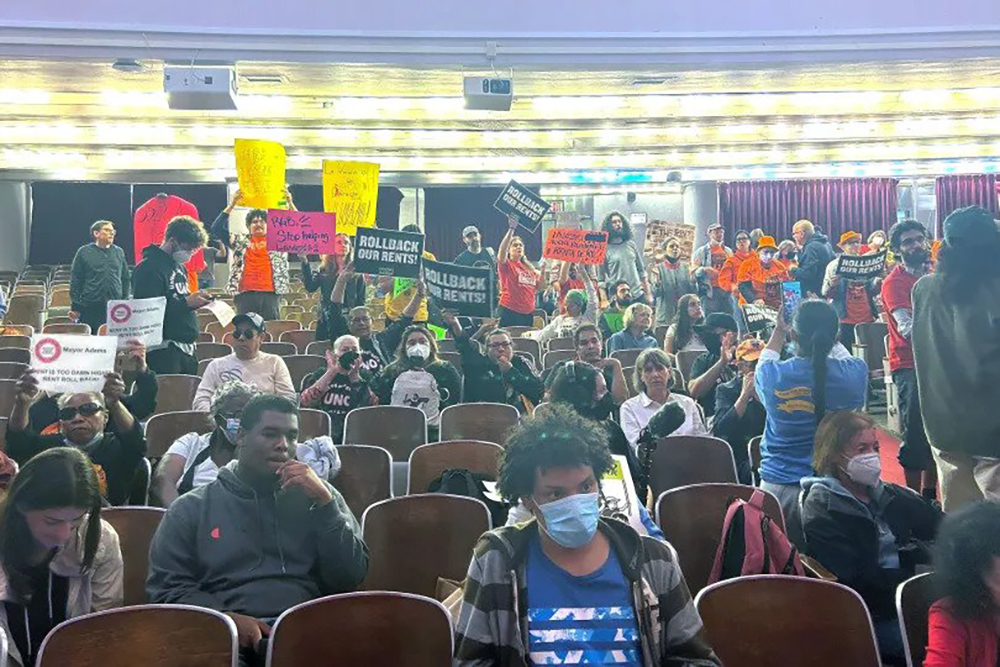
Tenants were pushing for a rent freeze or rollback. Before entering the meeting hall, members of the public attending Wednesday’s vote had to first pass through metal detectors and undergo bag searches after waiting in a line that stretched out of the building and down the block. Once inside, many people chanted “rent rollback” and held up signs calling for the same, while blowing whistles throughout the proceeding and sometimes striking cowbells.
The auditorium seating 2,100 was mostly filled, though the front third of it was taped off to create a buffer between the crowd and the board.
“This year we heard the major concerns for landlords include increased insurance costs, taxes and trepidation about refinancing,” said Adán Soltren, one of the board’s two tenant representatives, both of whom voted for the rent increase after originally advocating for a rent freeze. “These are not human concerns, but business concerns and costs that implicate business decisions.”
All four of the representatives who voted “no,” including both landlord representatives and two of the five members representing the public, had wanted a higher increase.
“Every year, we see the same drama unfold, and nothing ever changes,” Jay Martin, executive director of the landlord-aligned Community Housing Improvement Program, said in a statement just after the vote.
The group stated: “This rent adjustment will once again be characterized in the media and by politicians as the largest increase in decades, but the data shows that is untrue, as rent adjustments have not matched the increases in costs or inflation.”
