



|
Getting your Trinity Audio player ready...
|
NYC on Edge: Mamdani’s Response to Synagogue Protest Sparks Outrage as Jewish Leaders Warn of Escalating Hostility
By: Abe Wertenheim – Jewish Voice News
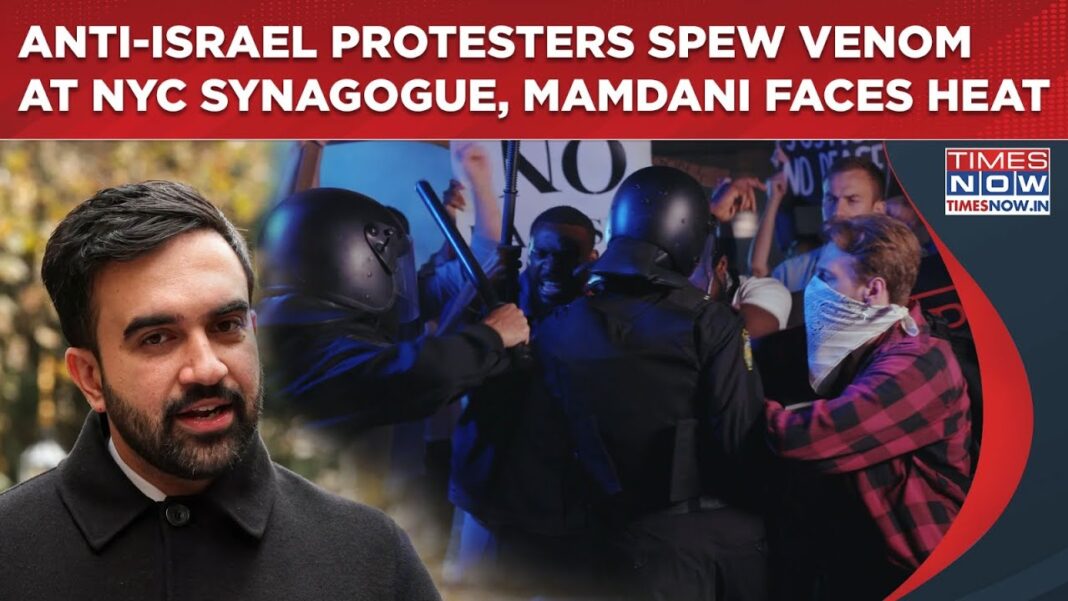
New York City’s incoming mayor, Zohran Mamdani, is confronting an intensifying storm of criticism from Jewish leaders, civil rights advocates, and national pro-Israel organizations after offering what many view as a deeply troubling response to an anti-Israel protest outside a Manhattan synagogue on Wednesday night. The demonstration—marked by open calls for violence against Jews, chants celebrating Palestinian terror, and a palpable atmosphere of intimidation—has become a flashpoint in the already strained relationship between New York’s Jewish community and the far-left political constellation that helped propel Mamdani to electoral victory.
According to a report that appeared on Friday in The Algemeiner, which has closely tracked the unfolding controversy, roughly 200 anti-Israel demonstrators gathered outside Park East Synagogue on Manhattan’s Upper East Side to protest an event hosted inside by Nefesh B’Nefesh, the organization dedicated to facilitating aliyah—the immigration of Jews to Israel. The synagogue, a landmark institution led for decades by the globally respected Rabbi Arthur Schneier, found itself surrounded by a crowd of activists waving Palestinian flags, shouting incendiary slogans, and attempting to intimidate attendees.
The scene, documented extensively on social media and corroborated by The Algemeiner, recalled for many Jewish observers a dark era when Jewish houses of worship were turned into targets. Protesters shouted: “We don’t want no Zionists here!” and “Resistance, you make us proud, take another settler out!”—language widely interpreted as exhortations to murder Jews. Other chants included “death to the IDF,” “globalize the intifada,” and “intifada revolution”—phrases long associated with violence, terrorism, and a campaign to eradicate the Jewish state.
One protester, speaking through a megaphone to whip up the crowd, declared chillingly: “It is our duty to make them think twice before holding these events! We need to make them scared.”
Jewish leaders and elected officials expressed horror not only at the rhetoric itself, but at the location chosen for the demonstration: a synagogue hosting an informational event about emigrating to Israel. For many, this was an unmistakable escalation—an attempt to transpose anti-Israel agitation into direct harassment of Jews engaged in fully legal, entirely peaceful religious and cultural programming.
But if the protest itself alarmed Jewish New Yorkers, Mamdani’s response—issued the next day—deepened their fears.
In a statement released by his spokesperson Dora Pekec, Mamdani said he “discouraged” the language used by the protesters. Yet, as The Algemeiner report noted, he stopped short of explicitly condemning the harassment of synagogue attendees or the calls for violence made from mere feet away.
Instead, Mamdani’s office turned its attention to the synagogue itself.
His team criticized the event hosted inside Park East, calling it a “violation of international law,” a reference to their view of Israel’s settlement policies in Judea and Samaria. “These sacred spaces should not be used to promote activities in violation of international law,” Pekec said.
To Jewish observers, this rhetorical pivot landed like an accusation: that the synagogue—and its attendees—were morally at fault for exercising a core element of Jewish identity. That the event promoting aliyah was, in effect, a provocation. And that the escalating hostility outside the sanctuary’s doors was at least partially justified.
Outrage was immediate. Jewish leaders, activists, and policy experts condemned Mamdani’s framing as profoundly irresponsible at a time of surging antisemitic violence.
“Do they think this is clever?” wrote Tal Fortgang of the Manhattan Institute, as cited in The Algemeiner report. “Telling Jews not to use synagogues to inform fellow Jews about how to move to Israel, which many Jews consider a commandment, because Jews living in Israel violates international law?”
Mark Goldfeder, CEO of the National Jewish Advocacy Center, was even more direct: “You are already failing on your commitment to protect all New Yorkers. An event to celebrate aliyah is not a violation of international law; it is a protected First Amendment right.”
The World Jewish Congress, in comments reported by The Algemeiner, said the scene outside the synagogue “produced scenes eerily reminiscent of Kristallnacht,” invoking the 1938 Nazi pogrom that signaled the descent of German Jewry into annihilation. The comparison underscored the level of fear within the Jewish community and the symbolic significance of a house of worship under siege.
New York Governor Kathy Hochul—who endorsed Mamdani for mayor—issued a forceful condemnation of the protests, describing them as “shameful and a blatant attack on the Jewish community.” Yet her condemnation also highlighted the dissonance with Mamdani’s measured and, in the view of many, morally ambiguous statement.
Jewish leaders noted that while Hochul called out harassment plainly, Mamdani’s response appeared to equate the chants of “take another settler out” with an informational event about moving to Israel.
Pro-Israel advocates told The Algemeiner that Mamdani’s remarks “normalize intimidation of Jewish communities” and “shift blame onto victims rather than confronting extremist activists.”
The controversy has not erupted in a vacuum. During his ascent from state assemblymember to mayor-elect, Mamdani built a reputation as one of the most ardent anti-Zionists in American politics. His record, reported by The Algemeiner, includes: Repeated claims that Israel commits “apartheid” and “genocide,” refusal to support Israel’s right to exist as a Jewish state, a steadfast refusal to condemn the slogan “globalize the intifada,” despite its association with violence against Jews worldwide and a strong affiliation with the BDS movement which calls for a boycott of all Israeli-tied institutions.
His mentor and close political ally, activist Linda Sarsour, has likewise espoused inflammatory rhetoric against Israel and has previously stated that Muslims should not “humanize” Israelis.
Given this ideological backdrop, Jewish leaders say Mamdani’s reluctance to condemn antisemitic intimidation outside a synagogue is unsurprising—but alarming.
“His worldview is steeped in anti-Zionist extremism,” a senior Jewish communal figure told The Algemeiner. “This was the first major test of his willingness to protect Jewish New Yorkers. And he failed.”
New York City has seen a dramatic increase in antisemitic hate crimes since Hamas’s October 7, 2023 massacre of 1,200 Israelis. As The Algemeiner has reported, Jews constituted the majority of victims in hate crimes citywide last year. On college campuses, pro-Hamas protesters have barricaded Jewish students in libraries, assaulted pro-Israel demonstrators, vandalized dormitories with threats, and created chilling environments in which many Jewish students fear for their safety.
The protests at Park East Synagogue were not merely symbolic—they were another point in a continuum of increasingly brazen harassment of Jews in public spaces.
“People felt terror,” said one community member, speaking to The Algemeiner. “A synagogue is supposed to be a sanctuary. Last night, it felt like a target.”
For these reasons, Mamdani’s equivocal response represents not just a rhetorical misstep, but a breach of trust at a moment when Jewish New Yorkers feel increasingly vulnerable.
Jewish leaders warn that the Mamdani administration may usher in a new era in which anti-Israel animus is used more openly to rationalize hostility toward mainstream Jewish institutions.
For many, the message of Mamdani’s statement was unmistakable: Jewish communal programming linked to Israel could be deemed provocative or even illegitimate.
“If aliyah is now framed as illegal by the city’s future mayor,” wrote a commentator in The Algemeiner, “what’s next? Will synagogues need to justify their Zionist programming to City Hall? Will Jewish religious life need to be reinterpreted to avoid accusations of violating ‘international law’?”
These concerns are amplified by Mamdani’s deep ties to radical anti-Israel movements, his refusal to label Hamas a terrorist organization, and his calls for the arrest of Israeli officials should they visit New York.
The mayor-elect’s victory was heralded by radical activists as a triumph of anti-Zionist politics. But for many Jewish New Yorkers, it was a moment of deep anxiety.
A Sienna Research Institute poll—reported by The Algemeiner—found that a staggering 72 percent of Jewish voters believe Mamdani will be “bad” for New York City. Only 18 percent view him favorably, while 67 percent hold an unfavorable opinion.
Those numbers reflect more than political disagreement—they reflect fear.
“Mamdani’s victory showed that anti-Zionism has become electorally viable in New York,” said Dr. Jonathan Greene of the Center for Jewish Policy Studies. “What we’re seeing now is the real-world manifestation of that.”
Wednesday night’s protest and its aftermath have become emblematic of New York’s widening fault lines. As the Jewish community grapples with rising antisemitism, many feel they cannot rely on incoming leadership for protection—or even moral clarity.
The city stands at a crossroads: Will Jewish communal life be treated as inherently suspect due to its connection to Israel? Will synagogues become routine targets for anti-Israel mobilization? Will City Hall condemn antisemitism unequivocally—or only when convenient?
These questions, posed repeatedly in discussions chronicled by The Algemeiner, lie at the heart of the current crisis.
The protests outside Park East Synagogue were a test—not just for law enforcement, but for moral leadership. The slogans shouted that night were not abstract political critique. They were explicit calls for violence against Jews. They were attempts to intimidate a religious minority in one of the world’s most diverse cities.
Zohran Mamdani’s response, as indicated in The Algemeiner report, has left many Jewish New Yorkers shaken—uncertain whether the city they call home will defend their rights as Jews, or treat them as collateral damage in a broader ideological struggle.
With his inauguration approaching, Mamdani faces a defining choice: to prove he can lead a city of all communities, or to reaffirm fears that his ideological commitments will always overshadow his obligation to protect its most vulnerable residents.
For a city already frayed by antisemitism, extremism, and political volatility, the stakes could not be higher.
This soft-pedals Islamist Mamdani terrorist war on the Jewish people.
For TJV, and all readers: WATCH what we are confronted with:
November 21, 2025 | The Forum Roundtable: Anti-Israel Bias in the Media – YouTube
https://www.youtube.com/watch?v=OPm65S-i3BA
After all, the demonstrators were just globalizing their intifada.