



|
Getting your Trinity Audio player ready...
|
NYC Jewish-Owned Bakery Sees Surge of Support After Employees Demand End to Israel Affiliation
By: Justin Winograd
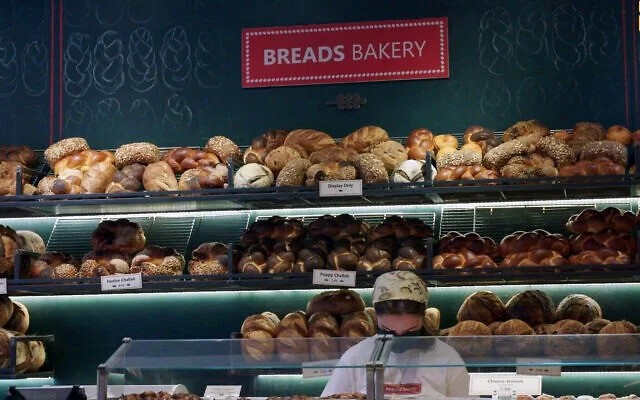
This past Friday morning on Manhattan’s Upper West Side, a line formed outside Breads Bakery that looked less like a queue for babka and more like a civic demonstration. Draped in Israeli flags, clutching coffee cups, and murmuring prayers under their breath, hundreds of supporters crowded the sidewalk along Broadway, many waiting for hours for a single pastry. What had drawn them was not a new menu item or holiday rush, but an urgent call to action after The New York Post revealed that a faction of employees at the beloved Jewish bakery had demanded that the company sever its ties with Israel.
The scene, documented extensively in a report on Friday in The New York Post, captured a moment of rare public solidarity in a city where Jewish institutions increasingly feel under siege. The Upper West Side outpost of Breads Bakery—long celebrated as a temple of challah, rugelach, and flaky Jerusalem-style pastries—had suddenly become the epicenter of a cultural confrontation over Zionism, labor activism, and the evolving boundaries of workplace protest.
The spark was a report by The New York Post on the formation of the so-called “Breaking Breads Union,” a group comprising roughly a third of Breads Bakery’s workforce. While unionization in New York’s food and retail sectors is hardly novel, the content of the union’s demands stunned many longtime patrons.
NYC Jews line up for Israeli bakery after employees’ charges of ‘genocide support’ https://t.co/KeyxTWDX89 via @timesofisrael
— Luke Tress (@luketress) January 10, 2026
Beyond familiar calls for improved pay and working conditions, the employees insisted that the bakery end what they described as its “support of the genocide happening in Palestine.” The phrase ricocheted through social media after The New York Post published it, igniting anger among Jewish New Yorkers who view such rhetoric as not merely inflammatory but deeply antisemitic.
Breads Bakery management rejected the allegation outright. In a statement cited by The New York Post, the company said, “Breads Bakery is built on love and genuine care for our team. We make babka; we don’t engage in politics.” Still, the bakery’s past participation in Jewish communal life—such as baking for events that raised funds for Israel after the Oct. 7 Hamas terror attack—had become, in the eyes of the union activists, evidence of ideological complicity.
What followed was spontaneous and emotional. The day after The New York Post broke the story, word spread across WhatsApp groups, synagogue newsletters, and Instagram feeds urging “open Zionists” to flood the Upper West Side location in a visible show of support.
By mid-morning Friday, the line snaked down the block. Some customers wrapped themselves in Israeli flags. Others wore stickers simply reading “Zionist,” a badge that in today’s New York climate can feel as defiant as it is declarative.
Among them was 34-year-old Elisha Fine, a Manhattan native who told The New York Post that he rarely visits Breads Bakery but felt morally compelled to come. “We’re pushing back quietly and with Jewish dignity against anti-Zionism and a hate moment,” Fine said, standing patiently for a chocolate babka he did not strictly need.
Fine runs a pro-Jewish art Instagram account and used his platform to urge others to show up. “We’re perfectly fine with them having a union,” he added, echoing a sentiment repeated throughout the crowd. “But it’s not okay to make Israel politics part of that.”
For older residents, the spectacle was especially jarring. Leonor Katz, 71, who has lived on the Upper West Side most of her life, told The New York Post she had never seen anything like it. “To see this, it’s awful,” Katz said, shaking her head. “I’m born and bred here. These demands are very upsetting.”
Her words reflect a generational disorientation among New York’s Jewish community, many of whom grew up believing the city was a haven of tolerance. For them, the idea that employees at a Jewish-owned bakery would pressure management to denounce Israel feels like a betrayal that transcends workplace politics.
Younger patrons expressed a different, but equally acute, anxiety. Avi Mendelson, 31, walked into Breads Bakery for the first time ever after reading The New York Post’s account of the union’s demands.
“I felt a shift after Oct. 7,” Mendelson said. “I don’t feel as confident about the well-being of the Jewish community as I did with our previous mayor.”
Though he did not elaborate, his reference to the Mamdani administration underscored a growing perception among some Jewish New Yorkers that political leadership is becoming less sympathetic to their concerns. In that context, buying a croissant at Breads Bakery became a form of civic resistance.
Fine, like many others interviewed by The New York Post, used the term “entryism” to describe what he sees unfolding: activists entering institutions with the aim of reshaping their cultural identity from within.
“That strikes me as the way people walk into a place and then try to change the culture dramatically,” he said. For Fine and his peers, the issue is not unionization itself but the imposition of ideological litmus tests on a business rooted in Jewish heritage.
Breads Bakery, founded as a spinoff of a popular Tel Aviv bakery, has long served as a bridge between Israeli and American Jewish culture. Its challah loaves and rugelach are not merely commodities; they are symbols of continuity, memory, and communal belonging.
As the crowd thickened, one conspicuous absence loomed large. The Breaking Breads Union declined to respond to multiple requests for comment from The New York Post, leaving supporters and critics alike to speculate about its next move.
Some bakery patrons said they were not opposed to labor organizing in principle. “Everyone deserves fair pay and safe working conditions,” one woman told The New York Post while balancing a box of pastries. “But asking a Jewish bakery to renounce Israel crosses a line.”
By late afternoon, the line had thinned, but the significance of the day lingered. For a few hours, a modest storefront on Broadway became a microcosm of a broader struggle playing out across campuses, workplaces, and cultural institutions nationwide.
The New York Post’s coverage framed the episode as emblematic of a city in transition, where the boundaries between activism and coercion, solidarity and intimidation, are increasingly blurred.
What unfolded at Breads Bakery was not merely a consumer boycott in reverse; it was a ritual of reaffirmation. Each coffee poured, each pastry purchased, was a small but deliberate assertion that Jewish spaces should not be compelled to repudiate their identity to satisfy ideological demands.
As evening fell, the bakery’s display cases stood noticeably emptier than usual, and staff moved briskly to restock. The customers had come and gone, but their message remained.
In the words of Elisha Fine, relayed again by The New York Post, it was about “pushing back quietly and with Jewish dignity.” No chants. No megaphones. Just a line, a loaf of challah, and the enduring conviction that sometimes the most eloquent form of protest is simply to show up.