



|
Getting your Trinity Audio player ready...
|
By: Andrew Carlson
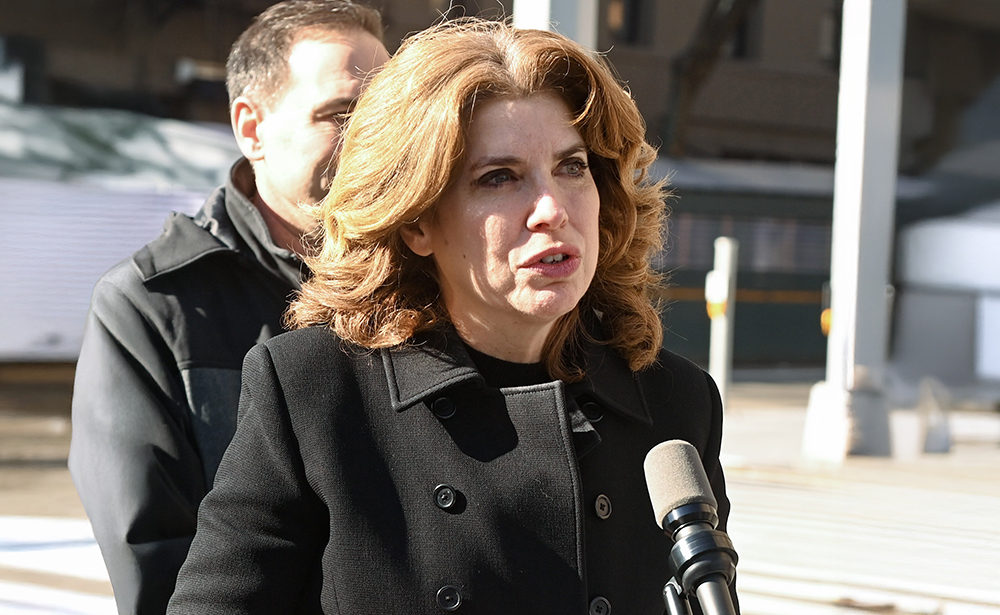
In a city long celebrated as a global sanctuary of diversity and tolerance, a deeply troubling paradox has taken root. New York — home to the largest Jewish population outside of Israel — has in recent years witnessed a disturbing escalation in antisemitic harassment, intimidation, and violence. Against this unsettling backdrop, City Council Speaker Julie Menin announced on Friday a sweeping and unprecedented legislative initiative aimed at confronting the crisis head-on.
As reported on Friday by VIN News, Menin unveiled a comprehensive plan designed to strengthen protections for Jewish communities, synagogues, and schools, while expanding education and enforcement tools to combat hatred in all its forms. The initiative, she said, represents a moral and civic imperative at a moment when Jewish New Yorkers feel increasingly vulnerable in their own neighborhoods.
“I make no apology for insisting on a proportionate response to the disproportionate discrimination facing our Jewish community,” Menin declared during the announcement. “When people are targeted because of who they are, we have an obligation to act.”
The speaker’s plan arrives amid a steady drumbeat of alarming statistics. According to Police Commissioner Jessica Tisch, antisemitic incidents accounted for more than half of all reported hate crimes in New York City last year — a staggering 330 out of 576 cases — even as overall hate crimes saw a modest decline. VIN News has chronicled numerous such incidents in recent months, from vandalism at synagogues to hostile protests outside Jewish institutions, underscoring the urgency behind Menin’s proposal.
At the core of the initiative is a proposal to establish legally enforceable buffer zones around synagogues, yeshivas, and other religious institutions during protests. These zones would prevent demonstrators from gathering directly at entrances and exits, ensuring that congregants can enter and leave without fear of harassment.
Menin’s proposal mirrors — and potentially expands upon — a plan introduced earlier this week by Gov. Kathy Hochul, who called for a 25-foot protest buffer around houses of worship. But as VIN News reported, the City Council is weighing the possibility of going further, with discussions underway about extending the perimeter to as much as 100 feet in particularly sensitive situations.
For many Jewish New Yorkers, such protections cannot come soon enough. Over the past year, VIN News has documented numerous cases in which anti-Israel demonstrations outside synagogues have devolved into explicitly antisemitic chants and behavior, leaving worshippers shaken and fearful. Menin’s legislation seeks to address precisely these scenarios.
“Freedom of expression is fundamental,” she emphasized, “but it cannot be used as a weapon to terrorize people on their way to prayer or school.”
Beyond buffer zones, Menin outlined a broader five-point strategy that touches on virtually every aspect of community safety. Among the key components:
- Expanded reimbursement programs to help schools and religious institutions hire professional security guards
- Increased funding for surveillance cameras and other protective infrastructure
- Mandatory safety training for staff and volunteers at houses of worship
- The creation of a dedicated city hotline for reporting antisemitic incidents directly to the Commission on Human Rights
- A new $1.2 million allocation over two years to support Holocaust education initiatives in public schools
Each element is designed to address a different dimension of the crisis — from immediate physical security to the longer-term educational efforts necessary to uproot prejudice at its source.
For Menin, the fight against antisemitism is not merely a policy priority — it is profoundly personal. The first Jewish speaker in the City Council’s history, she invoked her own family’s Holocaust legacy in explaining the emotional gravity of the moment.
“My mother and grandmother survived the Holocaust by hiding in Hungary,” she said. “I carry their story with me every day. When I see Jewish children afraid to wear a yarmulke or families anxious about attending synagogue, I know we cannot remain silent.”
Her remarks echoed sentiments expressed by countless community leaders interviewed by VIN News over the past year, many of whom have warned that the psychological toll of antisemitism is as damaging as the physical threats themselves.
Menin has sought to frame the initiative not as a partisan or parochial project, but as part of a broader commitment to protecting all New Yorkers from hate. She emphasized repeatedly that the same standards should apply to any community targeted by bigotry — whether Muslim, Asian, Black, LGBTQ, or otherwise.
“Zero tolerance means zero tolerance,” she said. “Hate against one group is an assault on the values of our entire city.”
The initiative also places Menin at the center of a delicate political balancing act. Mayor Zohran Mamdani, who has been outspoken in his criticism of Israel’s military campaign in Gaza, has at times faced skepticism from segments of the Jewish community over his handling of antisemitism concerns.
VIN News reported that Menin briefed Mamdani on the plan prior to making it public, describing their discussions as “productive.” The speaker was careful to stress that her proposal is not intended as a rebuke to the mayor.
“This is not about personalities or politics,” she said. “It’s about protecting people.”
Nevertheless, the issue of protest buffer zones raises complex constitutional questions. Civil liberties advocates have warned that overly broad restrictions could run afoul of First Amendment protections. Mamdani’s office has indicated that while he supports efforts to safeguard religious institutions, the legal implications of such zones must be carefully reviewed.
Menin acknowledged those concerns, noting that the Council’s legal team is studying models from other jurisdictions to craft legislation that can withstand judicial scrutiny.
“Our goal is to strengthen protections while fully respecting the constitutional right to protest,” she said. “Those two principles are not mutually exclusive.”
The urgency behind Menin’s plan is rooted in a climate that many Jewish New Yorkers describe as increasingly hostile. VIN News has reported on a series of troubling incidents in recent months: graffiti scrawled on synagogue walls, Jewish students harassed on college campuses, and protesters targeting religious services with inflammatory rhetoric.
In some cases, demonstrations ostensibly focused on Middle East politics have crossed unmistakably into antisemitic territory — a phenomenon that community leaders say demands a firm response.
“People should be able to pray in peace,” said one Brooklyn rabbi interviewed by VIN News earlier this year. “That is not a radical idea. It is the most basic expectation in a free society.”
Police data appears to support those concerns. While hate crimes against other groups have fluctuated, antisemitic offenses have remained stubbornly high, accounting for the majority of bias incidents in the city.
“This is not an abstract problem,” Menin warned. “It is happening on our streets, in front of our schools, and at the doors of our synagogues.”

Perhaps, I thought, doing a search for the word, “genocide” on the page might explain why some, some but not all Jews, might feel “persecuted” at this moment in time when the world’s universally recognized human rights organization, including that of Israel, recognized Israel’s war on the people of Gaza since October, 2023, has been one of genocide, a deliberate attempt to eliminate the Palestinian people, which should have made every Jew, with whatever position that all the world saw what was happening there, uncomfortable. For someone born in Lennox Hill Hospital a year after Hitler came into power and was back in New York when WW2 came to an end, the comparisons between Jewish reaction then and now is, sadly striking,