



|
Getting your Trinity Audio player ready...
|
By: Carl Schwartzbaum
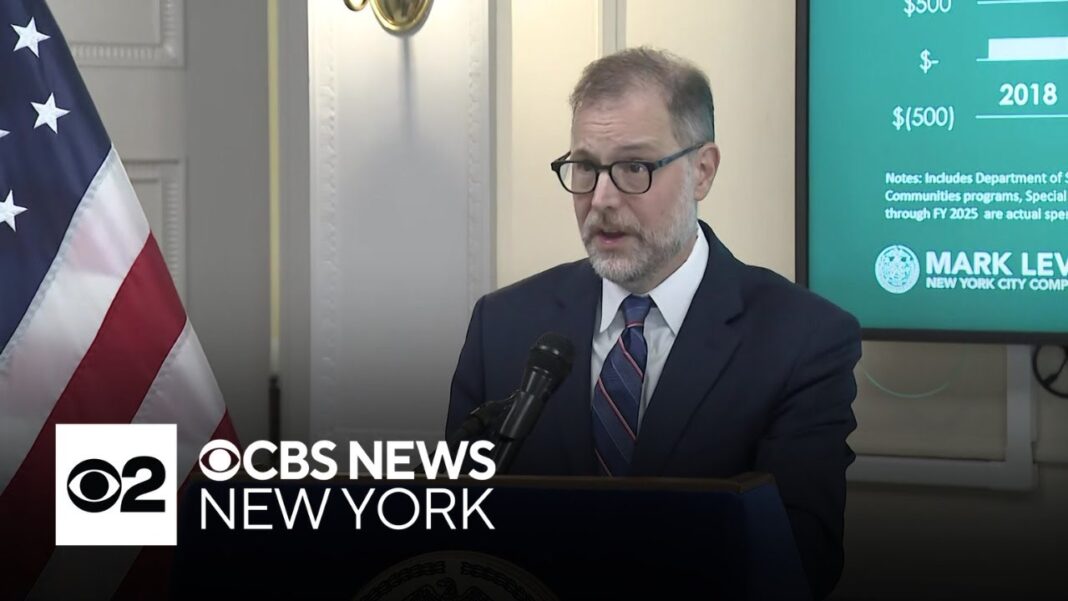
New York City, long celebrated as the financial and cultural capital of the world, now finds itself staring into a fiscal chasm of staggering proportions. According to a sobering analysis released Friday by newly elected City Comptroller Mark Levine, the nation’s largest metropolis is hurtling toward a combined $12 billion budget deficit over the next two fiscal years — a crisis he likened to the dark days of the 2008 financial meltdown.
The alarming figures, first detailed in a sweeping analysis that has since been amplified by The New York Post in a report on Friday, paint a picture of a city whose financial foundations have quietly eroded beneath the surface of apparently strong economic growth. While tax revenues have surged to historic highs, municipal spending has ballooned at an even faster pace, leaving City Hall with a structural imbalance that analysts say can no longer be ignored.
“This is far beyond what we saw last year, and I believe in any year since the 2008 financial crisis,” Levine declared during a candid briefing at the Municipal Building. “We’re not going to sugarcoat this. This is a challenging budget outlook.”
His words reverberated like an economic thunderclap through the corridors of power, particularly as Mayor Zohran Mamdani prepares to unveil his first spending blueprint in the coming weeks. The timing could not be more precarious: the mid-year gap for fiscal year 2026 is projected at $2.2 billion — an “extremely unusual” shortfall for a city enjoying what appears, on paper, to be robust economic health.
Even more troubling, the comptroller’s office forecasts an eye-watering $10.4 billion deficit for fiscal year 2027. As The New York Post report emphasized, this dire outlook exists even before the new mayor’s expansive policy agenda has been fully priced into the equation.
Levine underscored the paradox at the heart of the crisis. City tax revenues, driven by strong property values, Wall Street profits, and post-pandemic consumer activity, climbed nearly 7% in fiscal 2026. Yet expenditures grew at an even more alarming clip.
“This wasn’t caused by a bad economy,” Levine said pointedly. “It’s the result of budgeting decisions from the previous administration that we must now deal with.”
That pointed remark was widely interpreted as a direct rebuke to former Mayor Eric Adams, whose tenure ended amid allegations that his administration relied heavily on short-term fiscal maneuvers rather than long-term structural reforms. According to the comptroller’s analysis, billions in recurring expenses were either underbudgeted or entirely omitted, creating the illusion of balance while quietly inflating future liabilities.
Among the most glaring examples: $795 million in rental assistance costs, $727 million in overtime for city employees, and $630 million for homeless shelter operations were simply not accounted for in the current budget cycle. In total, $3.8 billion in known expenses were left off the books — a practice Levine suggested amounted to fiscal sleight of hand.
Todd Shapiro, a spokesman for Adams, pushed back forcefully on that characterization, arguing that the former mayor inherited unprecedented challenges in the wake of COVID-19 and the migrant influx.
“Blaming Mayor Adams for long-standing structural budget gaps and fiscal pressures ignores the reality of what this administration took on,” Shapiro said, insisting Adams “led a historic comeback.”
But budget watchdogs say the problem runs deeper than any single administration. Andrew Rein, president of the nonpartisan Citizens Budget Commission, noted that city spending has expanded at roughly twice the rate of inflation for years.
“The result is spending growth twice the rate of inflation,” Rein observed. “City spending would be $14.5 billion lower today if it had tracked inflation.”
Rein warned that simply raising taxes — the path favored by the current mayor — would be a dangerously simplistic solution. Instead, he urged Mamdani to undertake the politically perilous task of reevaluating existing programs and eliminating those that fail to deliver results.
“That requires making smart but tough choices,” Rein said. “Prioritizing what works and shrinking what doesn’t — before turning to the easier option of raising taxes.”
Yet the mayor appears determined to move in precisely that direction.
Within hours of Levine’s grim announcement, Mamdani seized on the numbers as fresh justification for his signature proposal: steep tax hikes on the city’s wealthiest residents and largest corporations. In a statement echoing his campaign rhetoric, the Democratic socialist insisted that higher taxes were not merely desirable but inevitable.
“As I said on Tuesday, we believe raising taxes on the wealthiest New Yorkers and corporations will be necessary,” Mamdani declared.
The mayor’s ambitious policy platform — which includes universal child care, free public transportation, expanded housing subsidies, and a host of other progressive initiatives — carries a price tag estimated at roughly $10 billion. Much of that spending, as The New York Post report noted, depends on speculative funding from Albany and aggressive new revenue measures that Gov. Kathy Hochul has already signaled she will not support.
Indeed, Hochul has taken pains to distance herself from Mamdani’s “tax the rich” crusade, even as she has cautiously embraced certain elements of his social agenda. When asked directly about the city’s budget crisis, the governor made it clear that she views the matter as primarily a municipal problem.
“This is a matter for the city,” Hochul said tersely at a press conference Thursday.
That answer left Mamdani visibly frustrated. In a fiery rebuttal, he blamed not only Adams but also former Gov. Andrew Cuomo for what he described as decades of financial exploitation of New York City.
“We have long said that what we are inheriting is not just an administration that exhibited incredible fiscal mismanagement,” Mamdani argued, “but also a decades-long effort from former Governor Cuomo to pilfer from city coffers at each and every turn.”
Cuomo’s longtime spokesman Rich Azzopardi dismissed that claim as political fantasy.
“As usual, Zohran Mamdani’s claims are untethered from the facts,” Azzopardi shot back, noting that state aid to city schools increased substantially under Cuomo and that Albany absorbed billions in Medicaid costs on the city’s behalf. “If Mamdani thinks the system is unfair, he’s had five years in office to do something about it.”
The political finger-pointing, however, does little to change the stark arithmetic now confronting City Hall.
One looming wildcard is the City Fighting Homelessness and Eviction Prevention Supplement program — known as CityFHEPS — which provides rental subsidies to low-income residents. The City Council’s 2023 decision to dramatically expand eligibility, over Adams’ veto, could saddle the city with an additional $6 billion to $20 billion in long-term obligations depending on pending court rulings.
As The New York Post report emphasized, those potential costs were not even included in Levine’s already-dire projections.
Financial experts warn that if the deficit were to exceed $100 million without a credible plan to close it, the state’s Financial Control Board — created after the city’s near-bankruptcy in the 1970s — could be forced to intervene, an outcome few officials are willing to contemplate.
For ordinary New Yorkers, the abstract language of deficits and structural imbalances translates into very real concerns: higher taxes, reduced services, layoffs, and deferred infrastructure projects.
Levine made clear that difficult decisions lie ahead.
“There are no easy paths out of this,” he said. “The choices we make in the next budget cycle will determine whether New York City remains on stable footing or slides into a period of prolonged fiscal stress.”
The comptroller’s warning has already begun to reverberate through the business community. Real estate leaders, small-business owners, and financial firms are watching nervously, wary that aggressive tax hikes could accelerate an exodus of wealth and investment from a city still recovering from the pandemic’s economic shockwaves.
The New York Post report noted that while revenues remain strong for now, they are heavily dependent on volatile sectors such as finance and real estate — industries that can quickly sour if economic conditions change or if tax burdens rise too sharply.
In the meantime, City Hall faces immediate pressure to craft a credible rescue plan.
Mamdani insists that his agenda of social investment will ultimately pay dividends, arguing that addressing inequality, homelessness, and education will produce long-term economic benefits. Critics counter that such promises are cold comfort in the face of a yawning budget gap.
As winter settles over the five boroughs, the city’s fiscal forecast looks anything but warm.
What is clear, as The New York Post report has underscored, is that New York stands at a pivotal crossroads. The choices made in the coming months — whether to rein in spending, raise taxes, or some uneasy combination of both — will shape the city’s future for years to come.
For now, Gotham finds itself confronting a harsh and humbling reality: even the world’s greatest city is not immune to the unforgiving laws of arithmetic.
And as Comptroller Levine warned with unmistakable gravity, the bill for years of fiscal complacency has finally come due.
