



|
Getting your Trinity Audio player ready...
|
By: Bob Meister
As winter tightens its grip on the northeastern United States, a rapidly intensifying storm system is threatening to transform the New York City metropolitan region into a landscape of ice, snow and logistical uncertainty. Weather forecasters are warning that from late Friday through Saturday, a fast-moving but potentially potent winter storm could blanket wide swaths of the area with significant snowfall, complicating travel, straining municipal services and posing unique challenges for observant Jewish communities preparing to enter Shabbos. According to a report on Thursday at VIN News, the convergence of meteorology, urban infrastructure and halachic responsibility is placing residents on heightened alert.
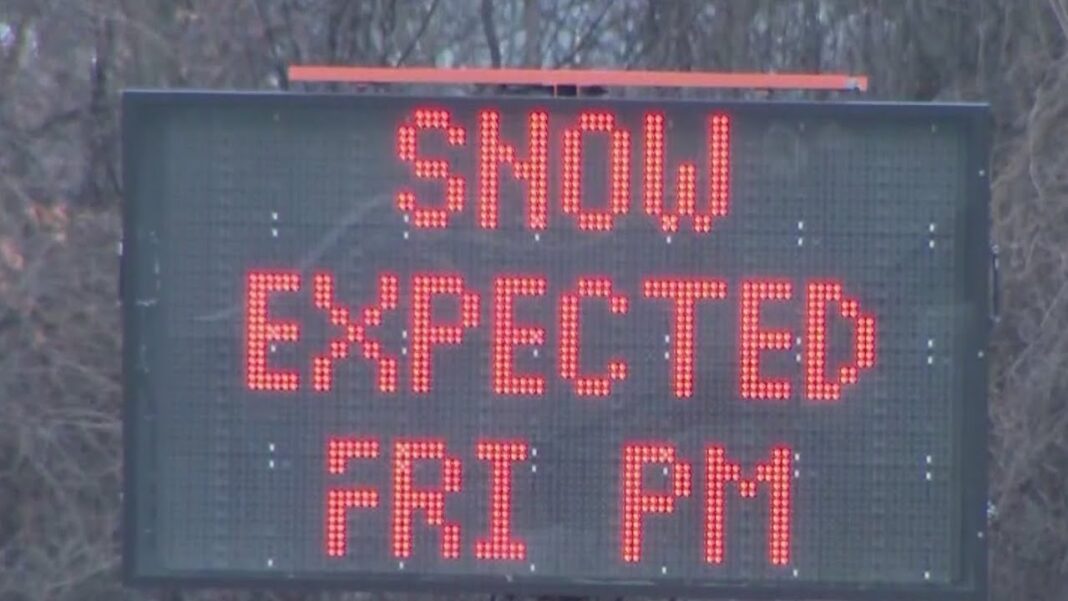
The National Weather Service has issued a winter storm watch set to take effect Friday afternoon, encompassing New York City, northeast New Jersey, the lower Hudson Valley and Long Island. Forecasters say snow is expected to begin late Friday and intensify during the evening hours as temperatures dip below freezing. Current projections indicate accumulations of four to eight inches across much of the region, though meteorologists caution that localized bands of heavier snow could push totals closer to ten inches in some neighborhoods.
VIN News reported that officials are particularly concerned about snowfall rates that could reach approximately one inch per hour during the height of the storm. Brief bursts of even heavier snowfall are possible, conditions that would significantly reduce visibility and quickly render roadways slick and hazardous. For commuters, airline passengers and emergency responders alike, the timing of the storm—coinciding with peak travel hours late Friday—raises the prospect of cascading delays and disruptions.
AccuWeather forecasters, cited by VIN News, note that while the storm is expected to move relatively quickly, its rapid pace does not diminish its potential impact. On the contrary, a shorter-duration storm that delivers intense snowfall during critical travel windows can be especially disruptive. Airports serving the New York region, already among the busiest in the world, could face delays as runways and taxiways are cleared, while motorists may encounter rapidly deteriorating conditions during the Friday evening commute.
City officials say preparations are already underway. New York City’s Department of Sanitation has begun staging snowplows, salt spreaders and personnel in anticipation of the storm. According to the VIN News report, municipal agencies are also coordinating with utility companies and emergency services to ensure rapid response should conditions worsen. Nevertheless, officials caution residents to expect potential disruptions to sanitation schedules, public transportation and other city services as crews pivot to storm response.
While the storm is expected to taper off early Saturday, with travel conditions gradually improving later in the day under mostly cloudy skies, the immediate concern lies in the narrow window between the onset of snowfall and the arrival of Shabbos. For many observant Jews, this period demands careful preparation not only in practical terms, but also within the framework of halacha.
The VIN News report emphasized that the most effective way to manage snow-related hazards on Shabbos is to prevent the problem before it begins. Pre-salting and pre-sanding walkways, driveways and entrances on Friday can significantly reduce the formation of ice, preventing snow from bonding tightly to surfaces and making post-Shabbos cleanup far easier. This proactive approach is not merely a matter of convenience; it is a critical component of ensuring safety while respecting the sanctity of Shabbos.
Equally important, halachic authorities stress the need to designate salt and sand specifically for Shabbos use before candle lighting. As the VIN News report explained, this designation prevents the materials from being classified as muktza—items that may not be handled on Shabbos—thereby allowing their use if conditions become dangerous. Without this preparatory step, residents may find themselves facing a dilemma between halachic restrictions and physical safety.
But winter storms are notoriously unpredictable, and preparation does not always guarantee calm conditions. What happens if snow accumulates more heavily than expected, creating a genuine hazard despite advance planning? VIN News has consulted halachic sources to clarify what is permitted under such circumstances.
According to these rulings, one may spread salt or sand on snow or ice on Shabbos when necessary to prevent slipping and injury. The method, however, is critical. The materials should be spread by hand rather than with a mechanical spreader, which could raise additional halachic concerns. From a halachic perspective, sanding is generally preferred because salting directly causes snow and ice to melt, thereby changing their physical state. Nonetheless, salting is permitted when circumstances demand it—particularly when there is a real risk that someone could fall and be injured.
The VIN News report further noted that among authorities who permit salting ice on Shabbos, commercial ice-melt salt is often classified as a kli shemelachto l’heter—an object whose primary use is permitted—similar to ashes set aside for allowable purposes, as discussed in Shulchan Aruch, Orach Chaim 308:38. For those who adopt a stricter view and consider such salt muktza, there remains broad consensus that the prohibition is lifted in cases of danger. Pikuach nefesh, the preservation of life and physical safety, overrides these concerns.
The question of snow removal itself is more nuanced. If one can walk through the snow safely without risk, halacha dictates that it should be left undisturbed. However, VIN News reported that when snow presents a genuine hazard and has not yet hardened into ice, there is room for leniency. In such cases, one may sweep or shovel enough snow to maintain a minimal, safe path in and out of the home. This allowance is grounded both in safety considerations and in the importance of facilitating a mitzvah, such as the ability to attend tefillah b’tzibbur.
These halachic discussions are not merely theoretical. In densely populated neighborhoods with heavy foot traffic, a few inches of snow can quickly become compacted and treacherous. For elderly residents, families with young children, and anyone with mobility challenges, the risk of slipping is far from abstract. The VIN News report underscored that the intersection of halacha and public safety becomes especially acute during storms that coincide with Shabbos.
Beyond the Jewish community, the approaching storm serves as a reminder of the broader vulnerabilities of urban life. New York City’s vast transportation network, aging infrastructure and sheer population density amplify the effects of even moderate winter weather. A storm delivering six to eight inches of snow may be routine by historical standards, yet its impact can be profound when it disrupts subways, clogs arterial roadways and grounds flights at major airports.
Forecasters stress that conditions can change rapidly, and residents are urged to monitor updates from official sources.
As Friday approaches, the mood across the region is one of cautious vigilance. There is comfort in preparation—salt stacked by the door, candles ready for Shabbos, weather alerts set on smartphones—but also an awareness that winter storms obey no schedule and respect no calendar. The challenge lies in balancing readiness with restraint, action with observance.
When the first flakes begin to fall late Friday, they will mark more than the arrival of another winter storm. They will signal a moment when nature’s force intersects with the rhythms of city life and sacred time. As the VIN News report highlighted, how communities respond in those moments—practically, spiritually and ethically—reveals much about resilience, responsibility and the enduring effort to safeguard both life and tradition amid the uncertainties of the season.