



|
Getting your Trinity Audio player ready...
|
By: Justin Winograd
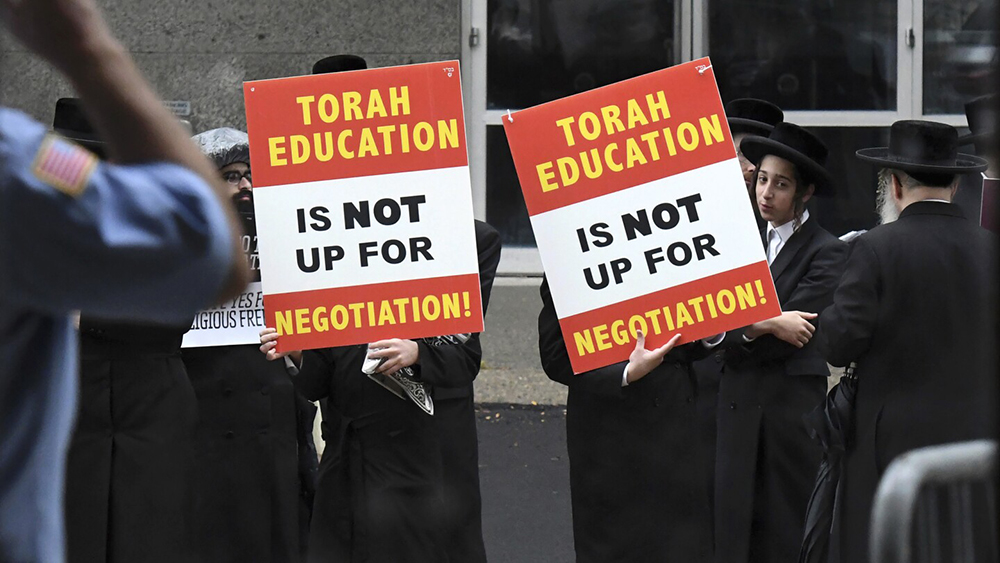
In a ruling with wide-ranging implications for religious education and state oversight, the New York State Supreme Court issued a temporary injunction on Friday against the closure of six haredi yeshivas in Brooklyn. The decision, welcomed by Orthodox Jewish leaders but criticized by education authorities, highlights the delicate balance between religious freedom and the state’s mandate to provide a “sound basic education” to all children.
According to a report that appeared at Israel National News, the ruling effects institutions in the predominantly Jewish neighborhoods of Borough Park and Williamsburg. These schools had been slated for closure after state and city authorities determined they failed to meet educational standards, particularly for not teaching core secular subjects such as English, mathematics, and science.
The dispute traces its origins to longstanding tensions between New York education officials and the Orthodox Jewish community. In May 2025, the Department of Education sent notices to parents, declaring that starting in June 2025 the affected institutions would no longer be recognized as providers of compulsory education.
As the report at Israel National News noted, this revocation meant parents would be required to seek alternative schools for their children, while the institutions themselves would lose access to critical public funding, including services such as student transportation and special education assistance. The action was the culmination of years of pressure from advocates who claim that many yeshivas devote nearly all classroom time to intensive religious study, while neglecting secular instruction mandated under state law.
This scrutiny intensified in 2022 after The New York Times published a widely circulated investigation alleging that thousands of boys in New York’s yeshiva system graduate without basic proficiency in English or mathematics. The exposé galvanized officials, leading to formal investigations and the identification of 18 schools deemed out of compliance with education requirements. Six of these schools, the most severely deficient according to the authorities, were placed on track for imminent closure.
However, the New York State Supreme Court pushed back on the state’s approach. In its Friday ruling, the court declared that the Department of Education’s position — barring already-blacklisted institutions from reapplying under a newly established legal framework — was “arbitrary and capricious.”
The “new law” referenced by the court refers to updated state regulations that provide yeshivas and other private schools alternative demonstration routes to prove compliance. Instead of meeting rigid curriculum requirements, institutions can show “substantial equivalence” through various measures, such as student assessments or recognition by state-approved accreditation bodies.
By insisting that the six yeshivas could not avail themselves of these new evaluation routes, authorities had overstepped, the judge ruled. As Israel National News reported, the injunction allows the schools to undergo fresh evaluations rather than being shut down outright. Moreover, they will continue to receive public funding during this process, preserving services for thousands of students and families who rely on them.
The court’s intervention comes at a critical juncture for Brooklyn’s haredi community, one of the largest concentrations of Orthodox Jews outside Israel. For many families, yeshivas are not merely schools but the foundation of religious identity and continuity.
The potential closure of these institutions had stirred deep anxiety among parents who saw the state’s actions as an existential threat to their way of life. Yeshivas serve as the central framework for transmitting Torah scholarship, Jewish law, and cultural traditions.

The role of the antisemite NY Times in instigating this dispute is not surprising.