



|
Getting your Trinity Audio player ready...
|
By: Ariella Haviv
In the wake of a devastating antisemitic terror attack thousands of miles away, New York City has moved swiftly to fortify its defenses around Jewish life, underscoring the increasingly global nature of anti-Jewish violence and the anxiety it has sown in communities worldwide. As reported on Sunday by The New York Daily News, the New York Police Department has significantly increased its presence at synagogues, public Chanukah celebrations, and menorah lightings across all five boroughs following the massacre at Bondi Beach in Sydney, Australia, where two gunmen killed 16 people and wounded dozens more during a public Chanukah gathering.
The decision to enhance security, announced Sunday by NYPD Commissioner Jessica Tisch, reflects what city officials describe not as a reaction to a specific threat against New York, but as a sober acknowledgment of a broader and deeply troubling pattern. “I’m going to be blunt,” Tisch said in remarks quoted by The New York Daily News. “This is not an isolated incident. It is part of a wider assault on Jewish life, an environment in which hatred far exceeds rhetoric and erupts into horrifying acts of violence.”
The attack at Bondi Beach sent shockwaves through Jewish communities around the world, not least in New York City, home to the largest Jewish population outside Israel. Australian authorities confirmed that one gunman was fatally shot by police, while a second suspect was arrested in critical condition. At least 38 people were injured, including two police officers, according to New South Wales Police Commissioner Mal Lanyon.
Australian Prime Minister Anthony Albanese labeled the massacre an act of antisemitic terrorism, a characterization echoed by New York City officials who see unsettling parallels between the climate that produced the Sydney attack and rising tensions closer to home.
Mayor Eric Adams, addressing reporters at NYPD Headquarters on Sunday, left little ambiguity in his assessment. “This attack did not come out of nowhere,” Adams said, according to The New York Daily News report. “It came out as the consequences of Islamic extremists, and we have to be clear on that.”
Adams underscored the symbolic brutality of the violence, noting that among the victims were a rabbi with ties to Brooklyn’s Crown Heights and a Holocaust survivor. “Let me say that again,” the mayor emphasized. “A rabbi and a Holocaust survivor killed for being Jewish.”
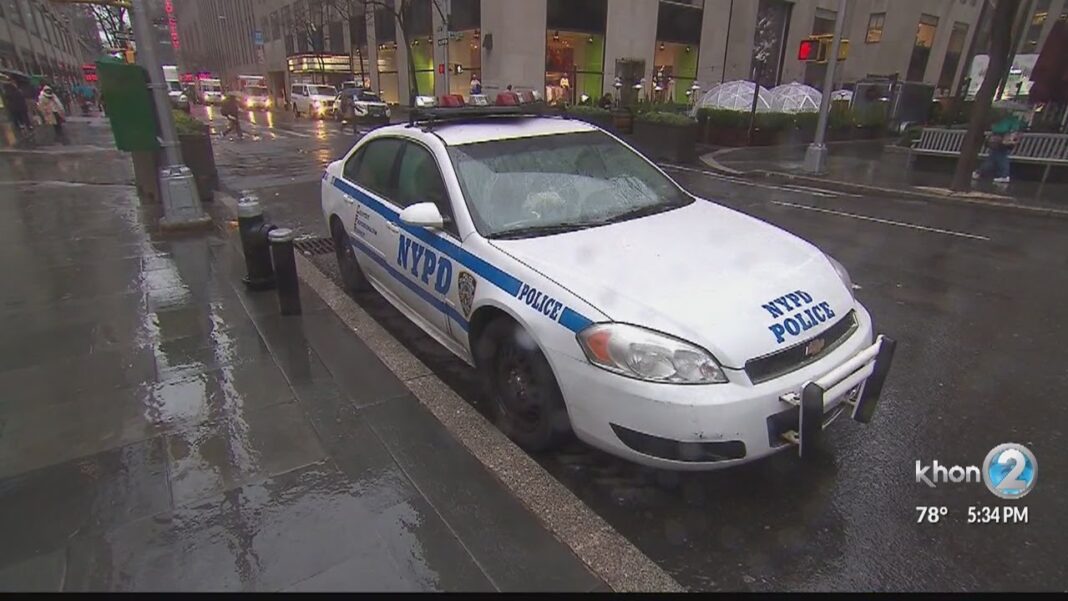
Commissioner Tisch detailed a sweeping array of security enhancements that New Yorkers can expect to see throughout the Chanukah holiday. As The New York Daily News reported, the NYPD will deploy additional uniformed officers, specialized patrols, heavy weapons teams, counterterrorism units, bomb squad personnel, and community affairs officers to Jewish institutions and public events.
“You will see an enhanced uniformed presence,” Tisch said. “This is being done out of an abundance of caution.” While she stressed that law enforcement has not identified any specific or credible threats to New York City at this time, she made clear that the department views vigilance as essential in the current climate.
Governor Kathy Hochul echoed that sentiment, pledging heightened vigilance by state police as well. “Horrified by a cowardly terrorist attack against the Jewish community,” Hochul wrote on X, in a message highlighted in The New York Daily News report. “New York will always stand against the scourge of antisemitism and confront violence head-on.”
The Sydney attack also reverberated through New York’s political landscape, intersecting with ongoing debates over rhetoric, responsibility, and the boundaries between political expression and incitement. Mayor Adams made a pointed reference to the slogan “globalize the intifada,” which became a flashpoint during the recent mayoral election.
“That attack in Sydney is exactly what it means to ‘globalize intifada,’” Adams said, according to the report in The New York Daily News. His remark was widely interpreted as a veiled critique of Mayor-elect Zohran Mamdani, who earlier in his campaign had declined to explicitly condemn the slogan, embraced by pro-Hamas activists, before later agreeing to discourage its use.
Mamdani, for his part, issued a forceful condemnation of the Sydney attack on Sunday, calling it a “vile act of antisemitic terror.” In a statement posted on social media and quoted by The New York Daily News, he vowed to prioritize the safety of Jewish New Yorkers once he takes office.
“This attack is merely the latest, most horrifying iteration in a growing pattern of violence targeted at Jewish people across the world,” Mamdani wrote. “Too many no longer feel safe to be themselves, to express their faith publicly, to worship in their synagogues without armed security stationed outside.”
“When I am mayor,” he added, “I will work every day to keep Jewish New Yorkers safe—on our streets, our subways, at shul, in every moment of every day.”
For New York’s Jewish institutions, the response to the heightened threat environment has been one of defiant continuity rather than retreat. At Temple Emanu-El on the Upper East Side, one of the city’s most prominent synagogues, Rabbi Joshua Davidson said the congregation was shaken by the events in Sydney but resolute in its commitment to public Jewish life.
“We will light our Chanukah menorahs tonight, and we will display them in the window as our tradition would have us do,” Davidson told The New York Daily News. “As a proud and public display of Jewish pride in defiance of those who would seek to do us harm.”
Davidson framed this resolve as part of a long historical continuum. “The Jewish community and the Jewish people are too well versed in hatred,” he said. “Throughout the centuries we have made a commitment that we’re not going to let those who would seek our end prevent us from celebrating the joy and beauty of Jewish life.”
That sentiment resonates deeply in a city where Jewish history is interwoven with stories of immigration, resilience, and survival.
One of the most striking elements of the Sydney attack, as reported by The New York Daily News, was the intervention of a bystander: Ahmed al Ahmed, a 43-year-old Muslim fruit shop owner who tackled one of the gunmen during the chaos.
Rabbi Davidson said this act of courage left a profound impression on him. “The fact that there was this Muslim bystander who decided he was gonna be an upstander instead—that’s something I hope people see,” Davidson said. “The guy who intervened is from a community that so many Jews often kind of look at as ‘other,’ and I found that to be very powerful.”
For many Jewish leaders, al Ahmed’s actions serve as a reminder that the fight against antisemitism is not a clash between communities, but a moral struggle that transcends religious and ethnic boundaries.
The broader concern voiced by rabbis, elected officials, and law enforcement alike is that antisemitic violence is being incubated in a permissive rhetorical environment. Rabbi Benjamin Spratt of Congregation Rodeph Shalom on the Upper West Side articulated this anxiety in a widely shared Facebook post quoted by The New York Daily News.
“This did not emerge in isolation,” Spratt wrote. “We are living through a season in which antisemitism is given permission to speak loudly, to cloak itself in moral language, and to spread without consequence.”
“When Jewish life is portrayed as illegitimate and Jewish presence as provocation,” he added, “words become weapons. Rhetoric metastasizes. Violence follows.”
Spratt’s warning encapsulates a fear echoed by many Jewish New Yorkers: that what begins as inflammatory language can, over time, erode social norms and embolden those willing to act violently.
As Chanukah unfolds, menorahs will be lit in windows, public squares, and synagogues across New York City—now under the watchful eyes of an expanded police presence. For city leaders, the message is clear: Jewish New Yorkers should not have to choose between visibility and safety.
Mayor Adams, Commissioner Tisch, Governor Hochul, and Mayor-elect Mamdani have all pledged vigilance and protection, but as The New York Daily News report noted, the challenge extends beyond policing. It encompasses questions of civic responsibility, political rhetoric, and the moral clarity required to confront hatred before it turns deadly.
In the shadow of the Bondi Beach massacre, New York’s response is both precautionary and symbolic—a declaration that antisemitic terror abroad will not intimidate Jewish life at home. Yet the unease remains palpable, a reminder that in an interconnected world, violence in one city can reverberate painfully in another.
As Rabbi Davidson put it, reflecting a sentiment shared by many across the city, “We light candles not because the darkness is gone, but because it isn’t. And because light, when it is shared and protected, still has the power to endure.”