



|
Getting your Trinity Audio player ready...
|
By: Jerome Brookshire
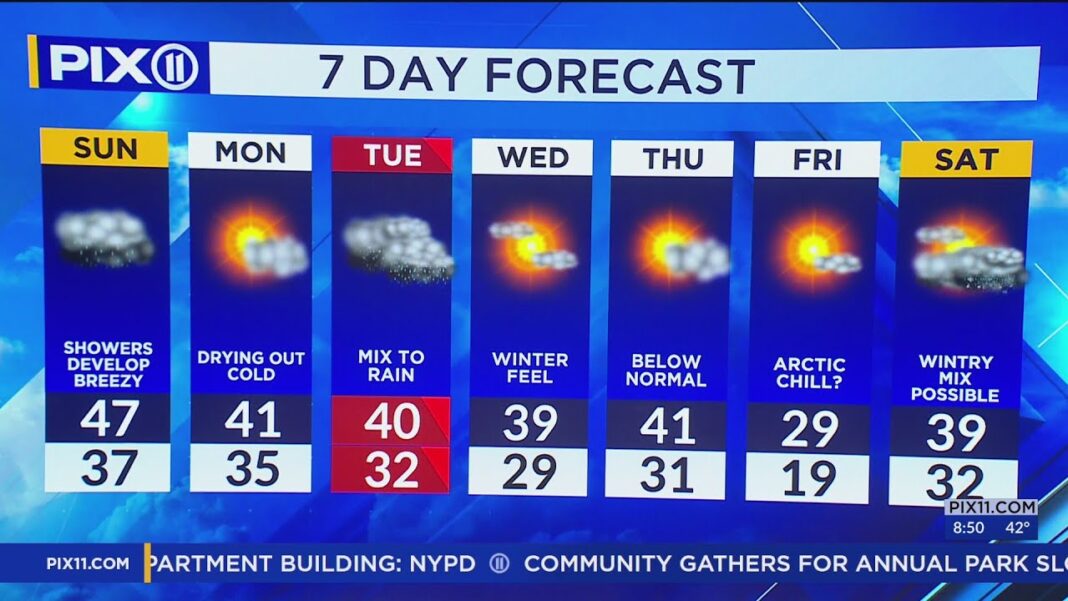
New York and New Jersey are preparing for the winter season’s first meaningful snowfall on Tuesday, marking a sharp early-season transition from mild conditions to a far more volatile winter pattern. While downstate communities will see only light accumulations, forecasters warn that Upstate New York is headed into a prolonged and potentially hazardous stretch of snow, fueled by persistent lake-effect bands that could last well into next week. As VIN News reported on Sunday, the dual-system setup represents the first real test of winter readiness across the region.
According to the National Weather Service, the initial snowfall expected early Tuesday will be modest across the downstate metropolitan corridor, driven by a coastal low sliding through the mid-Atlantic and brushing the tri-state area. Although New York City will see only a trace—roughly 0.3 inches, according to early projections—the psychological impact of the season’s first accumulation often exceeds the meteorological one. The VIN News report noted that even light totals can complicate the morning commute, particularly when combined with temperatures hovering near freezing.
Across the Hudson, Newark is projected to pick up about 0.7 inches, while Paramus in Bergen County may see closer to 0.9 inches. Light snow is also expected across the northern suburbs, with White Plains on track for 0.6 inches. More notable accumulation is likely in northwest New Jersey, including West Milford, where forecasts suggest nearly 5 inches—significantly higher than surrounding regions. Meteorologists caution that these figures may shift as the coastal system develops, but the trend points toward a modest yet widespread early-season event.
The corridor spanning Orange, Putnam, and Passaic counties is expected to see the highest totals of the downstate region, with estimates ranging from 3 to 5 inches. Other parts of New Jersey and the Lower Hudson Valley are likely to remain under 2 inches. The early-week snowfall will be a prelude, however, to far more consequential weather farther north.
While downstate prepares for a manageable dusting, Upstate New York is bracing for what the VIN News report called a “multi-day winter siege,” driven by repeated rounds of lake-effect snow expected to persist into early next week. This pattern, which forms when cold Arctic air passes over the relatively warm waters of the Great Lakes, can generate narrow but intense snow bands capable of producing whiteout conditions in minutes.
The National Weather Service Weather Prediction Center has warned of “quick bursts of heavy snow and white-out conditions” for communities east and southeast of Lakes Erie and Ontario. These areas, familiar with the capricious cruelty of lake-effect systems, may face the longest and most disruptive stretch of early-season snow in several years.
In the Lake Erie snowbelt near Buffalo, forecasters expect 8 to 12 inches over the next 72 hours, with locally higher totals possible. As the VIN News report noted, the region is no stranger to heavy lake-effect events, but the frequency and duration of the bands in this early-season system could complicate transportation and strain local resources. Southern Erie County, Wyoming County, and parts of the western Southern Tier could see snowfall rates of 1 to 2 inches per hour during the peak of the event.
The Rochester area is expected to receive 4 to 8 inches, with the precise totals highly dependent on the position and stability of the lake-effect plume. Syracuse and the Central New York corridor may see 3 to 6 inches, though areas just north of Syracuse—particularly near the Tug Hill Plateau—may face significantly higher totals. In the eastern reaches of the Adirondacks, accumulations between 6 and 12 inches are likely, with isolated pockets exceeding that range due to orographic lift.
The Hudson Valley, though geographically removed from the lake-effect zones, will still see 2 to 4 inches in some areas. Lower elevations may experience lighter totals, but a mix of rain and snow could complicate travel and reduce visibility.
One of the most concerning elements of the forecast, according to meteorologists cited by VIN News, is the persistence of the pattern. Lake-effect events often cycle quickly, intensifying and dissipating within hours. But this system appears more entrenched. While the lake-effect snow is expected to taper briefly early Saturday as a high-pressure ridge moves in, the respite will be short-lived.
A weaker disturbance is forecast to arrive late Saturday into Sunday, bringing an additional 1 to 3 inches across much of the region. Higher elevations could receive 3 to 5 inches, and lower elevations may once again see a wintry mix. Monday may offer a brief lull, but forecasters are already eyeing another coastal system that could arrive Monday night into Tuesday.
If that system tracks close to the shoreline—a possibility that has not yet been ruled out—it could develop into a nor’easter. Although forecast confidence remains low at this stage, the potential for a stronger system early next week highlights the complexity of the evolving winter pattern. This early-season volatility already resembles some of the more dramatic winter sequences of the past decade, when back-to-back systems brought swift changes in temperature, wind, and precipitation.
Across New York and New Jersey, officials are urging caution. Even areas expecting minimal accumulation may experience slick roads during the Tuesday morning commute. Downstate, the combination of light snow, temperatures near freezing, and residual moisture could lead to black ice, particularly on bridges and overpasses.
In western and northern New York, the situation is far more complex. Lake-effect snow, by its nature, can transform road conditions rapidly. One mile may see clear pavement; the next may be engulfed in blinding snow. Drivers in Buffalo, Rochester, and Watertown should expect highly localized but severe deterioration in visibility, particularly in areas east of the lakes where snow bands will be most intense.
Blowing and drifting snow will further complicate travel. Strong winds accompanying the lake-effect bands can push snow across roadways even after plows have cleared them. This creates a persistent hazard that is difficult for highway crews to manage. Officials across the region are reminding residents to allow extra travel time, reduce speeds, and remain alert to sudden weather changes.
Air travel may also face disruptions. While the modest downstate totals are unlikely to shut down major airports, deicing delays and reduced visibility could interfere with schedules at Newark, LaGuardia, and JFK—particularly during the early morning hours. Upstate airports in Buffalo, Rochester, and Syracuse face a higher risk of delays or cancellations, depending on the severity and duration of the lake-effect bands.
Though it is still early in the winter, the pattern emerging across New York suggests a season of pronounced volatility. The combination of coastal systems, persistent lake-effect activity, and rapidly shifting temperature gradients has meteorologists urging residents to prepare for rapid changes in conditions. As the VIN News report noted in a recent winter outlook, early-season patterns are not always predictive of long-term trends—but they often provide insight into atmospheric behaviors that may repeat throughout the season.
For now, residents across the state are urged to prepare for multiple rounds of snowfall through the week, with the likelihood of additional systems in the near future. Whether the early-week downstate dusting is merely a symbolic beginning—or the first sign of a more tumultuous winter ahead—remains to be seen. But one fact is certain: New York’s first significant snow event of the season is arriving not with a quiet flurry, but with the full complexity and geographic contrast that only this region can deliver.