



|
Getting your Trinity Audio player ready...
|
By: Abe Wertenheim
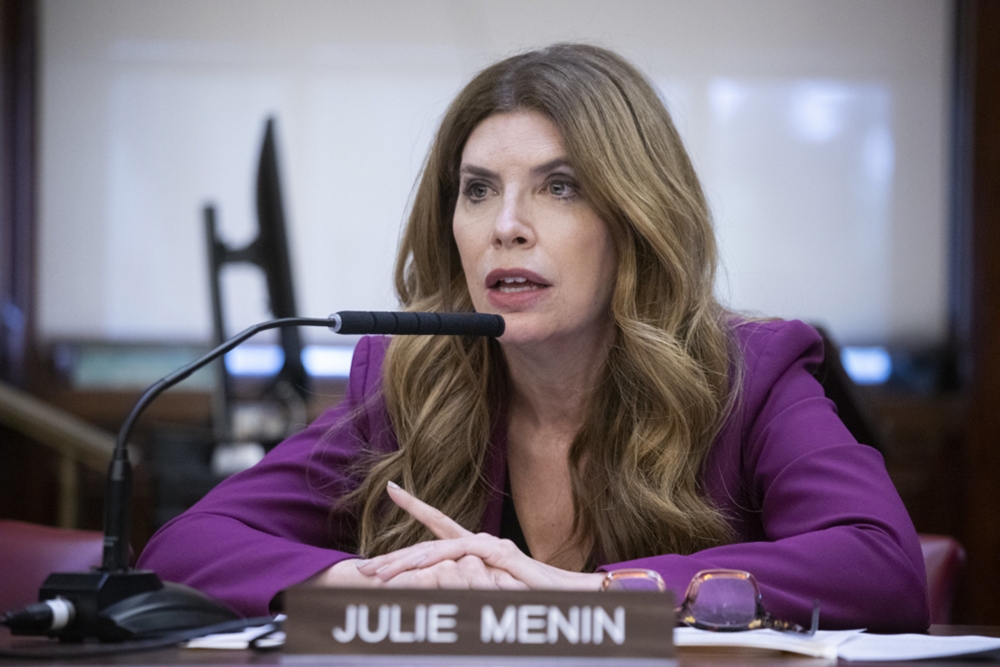
As winter’s harsh winds swept across the steps of City Hall on Wednesday, a different chill lingered in the air: the unmistakable sense that New York City’s historic promise of pluralism is under strain. City Council Speaker Julie Menin stood shoulder to shoulder with faith leaders, community advocates and fellow lawmakers to rally support for a package of legislation designed to fortify protections for houses of worship during protests, amid what many Jewish leaders describe as a disturbing surge in antisemitic intimidation.
The New York Post reported on Wednesday on the gathering, capturing the urgency of a moment that has come to define the city’s fraught reckoning with hate in the public square.
Menin, who has made combating antisemitism a defining priority since assuming the speakership in January, framed the legislation as a moral imperative rather than a political calculation. The New York Post report noted her insistence that the measures are grounded in a principle so elemental it ought to be beyond contestation: that every New Yorker, regardless of faith or identity, should be able to enter a synagogue, church, mosque or school without fear of harassment, threats or physical danger. In a city that prides itself on diversity, the spectacle of worshippers being jeered at the threshold of sacred spaces has shaken civic confidence and prompted lawmakers to act.
The legislative package has been shaped by months of deliberation, legal scrutiny and consultations with the New York Police Department. Menin initially proposed a measure that would have required the NYPD to establish a secure perimeter of up to 100 feet around houses of worship when protests occur nearby. That proposal, while resonant with communities that have felt besieged by hostile demonstrations, raised concerns among civil libertarians and police leadership alike. Fixed buffer zones, critics warned, risked running afoul of constitutional protections for free expression and peaceful assembly.
Those concerns prompted revisions that have become central to the current iteration of the bill. In testimony before the City Council’s Committee to Combat Hate, Michael Gerber, the NYPD’s deputy commissioner for legal matters, articulated the delicate balancing act required of a democratic city confronting rising extremism. The New York Post report quoted Gerber’s insistence that law enforcement must retain the flexibility to assess conditions on the ground, calibrating responses to ensure that demonstrators may be “seen and heard” without crossing the line into intimidation or obstruction.
The First Amendment, he reminded lawmakers, is not a technicality but a foundational safeguard, and any rigid, one-size-fits-all rule governing protest perimeters would inevitably invite legal challenge.
The compromise that has emerged reflects this tension between liberty and security. Under the revised legislation, the NYPD would be tasked with submitting a detailed proposal to both the speaker and the mayor within 45 days, outlining how buffer zones might be deployed in practice, followed by a final operational plan within 90 days.
The New York Post report underscored that this framework preserves police discretion while establishing clear expectations for how the city will protect worshippers when protests veer into harassment. It is a model of governance that seeks to encode vigilance into policy without sacrificing constitutional principle.
Yet even as legal nuances were debated in committee chambers, the emotional impetus behind the legislation remained stark. Menin and her colleagues repeatedly invoked recent episodes that have left Jewish communities reeling. The New York Post reported on an anti-Israel protest outside a Queens synagogue in January, during which demonstrators were heard chanting slogans in support of Hamas. For congregants attempting to enter the building, the chants were not abstract political statements but visceral reminders of vulnerability.
A similar scene unfolded in November outside the historic Park East Synagogue in Manhattan, where a mob hurled invective at worshippers making their way to prayer. Menin was unequivocal in her characterization of that episode: it was not a peaceful protest but an act of harassment that crossed into the realm of intimidation.
These incidents have taken on symbolic weight in the debate over how New York regulates protest in proximity to religious institutions. The New York Post report chronicled the testimonies of lawmakers and community leaders who described the psychological toll of such demonstrations.
State Assemblyman Sam Berger, whose district includes the Queens synagogue targeted in January, spoke of constituents who could hear hateful chants from inside their homes, huddling with children as memories of historical trauma resurfaced. The New York Post report recounted Berger’s account of a mother, herself the daughter of a Holocaust survivor, who found the echoes of hatred outside her window almost unbearable. In such moments, the abstract discourse of rights and regulations collapses into the raw human reality of fear.
For supporters of the legislation, these stories underscore the inadequacy of relying solely on informal guidance or ad hoc police responses. Mark Treyger, the chief executive of the Jewish Community Relations Council, emphasized to The New York Post that codifying protections into law carries both symbolic and practical significance.
Guidance can be revised, ignored or unevenly applied; statutes establish rights and obligations that endure beyond the political winds of a given administration. In Treyger’s view, enshrining the duty to safeguard access to houses of worship affirms the city’s commitment to religious freedom in tangible terms.
Mayor Zohran Mamdani, whose initial response to the synagogue protests drew criticism for its perceived timidity, has adopted a more cautious but receptive posture toward the revised legislation. The New York Post report noted his acknowledgment that the current bill represents a departure from the original proposal that alarmed legal scholars and police officials.
Mamdani has signaled a willingness to review the final framework once the NYPD completes its planning process, suggesting that the administration is attempting to reconcile the demands of public safety with the imperatives of constitutional law. His remarks reflect the political tightrope facing city leaders: to act decisively against antisemitism without inviting judicial rebuke or inflaming civil liberties advocates.
The debate unfolding at City Hall is emblematic of a broader national reckoning with the boundaries of protest in an era of intensifying polarization. The New York Post report has situated New York’s legislative push within a wider context of rising antisemitic incidents across the country, many of them intertwined with protests over the Israel-Hamas war.
What distinguishes the city’s approach is its effort to articulate a framework that recognizes protest as a legitimate form of political expression while drawing a bright line at conduct that transforms protest into persecution. This distinction is not merely semantic; it is the fulcrum upon which the legitimacy of the legislation rests.
Critics, particularly among progressive council members, have questioned whether new laws are necessary or whether existing statutes already provide sufficient tools to address harassment and disorderly conduct. Menin has rejected such skepticism as a form of minimization, arguing that the lived experience of Jewish New Yorkers tells a different story.
The New York Post quoted her assertion that dismissing the need for legislation risks ignoring the cumulative impact of repeated incidents of intimidation. In a city where symbolic gestures often substitute for structural change, Menin’s insistence on legal codification reflects a determination to move beyond rhetoric.
The companion bill sponsored by Council Member Eric Dinowitz, aimed at safeguarding schools facing potential protests, extends the logic of the synagogue protections into another vulnerable domain. Dinowitz’s proposal seeks to ensure that students and families are not subjected to the same forms of harassment that have plagued worshippers.
In a city where public education and religious life are cornerstones of communal identity, the convergence of these initiatives suggests an emerging legislative philosophy: that the spaces in which communities gather to learn and to pray merit heightened protection when political passions threaten to overwhelm civility.
What remains uncertain is how these laws will function in practice. The NYPD’s forthcoming proposals will be scrutinized not only by lawmakers but also by civil rights organizations and the courts. The New York Post report hinted at the possibility of legal challenges from activists who fear that buffer zones, even when flexible, could chill protest. Conversely, community leaders will be watching closely to see whether the policies deliver the sense of security they seek. The success of the legislation will ultimately be measured not in committee votes but in the quotidian experience of worshippers who can enter their synagogues without being confronted by chants of hate.
In the meantime, the rally at City Hall has crystallized a moment of moral clarity for many New Yorkers. The image of lawmakers standing with rabbis and community advocates, as captured by The New York Post, conveyed a city striving to reaffirm its foundational ethos amid turbulent times. New York has long been a refuge for those fleeing persecution; the idea that its synagogues might now require special legislative protection to ensure safe passage to prayer is a sobering commentary on the currents shaping contemporary civic life.
Yet within that sobering reality lies an opportunity. By grappling openly with the tensions between free expression and the right to worship in peace, the city is engaging in a democratic exercise of rare candor. The legislation championed by Julie Menin does not pretend that these tensions can be resolved without friction. Instead, it proposes a framework for navigating them with deliberation, legal rigor and moral purpose.
As The New York Post reported underscored, the stakes extend beyond any single protest or synagogue. They encompass the broader question of whether New York can sustain its identity as a city where diversity is not merely tolerated but protected, even when the passions of the moment threaten to erode that promise.
In this sense, the bills before the City Council are more than technical adjustments to policing protocols. They are a statement about the kind of city New York aspires to be: one in which the doors of houses of worship remain open not only in theory but in practice, and in which the cacophony of protest does not drown out the quieter, more enduring rhythms of communal life.
