



|
Getting your Trinity Audio player ready...
|
By: Carl Schwartzbaum
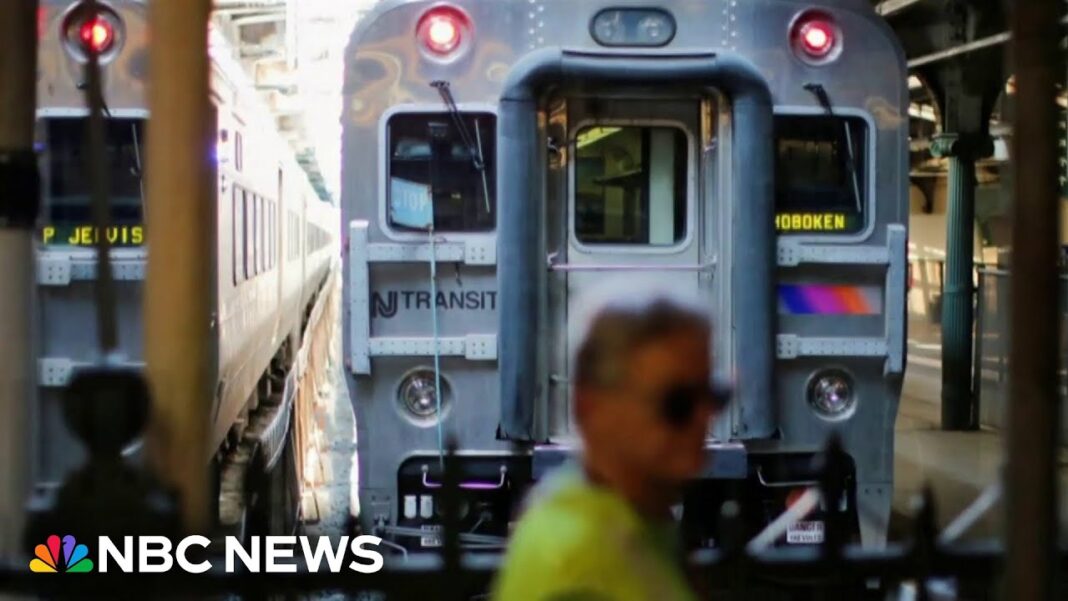
In a historic disruption not seen since 1983, NJ Transit rail service came to a grinding halt early Friday after last-ditch negotiations between the agency and the Brotherhood of Locomotive Engineers and Trainmen (BLET) failed to produce a new labor contract. As The New York Post reported, the strike has left roughly 70,000 daily rail commuters stranded and is expected to impact as many as 350,000 residents statewide.
Despite intense talks that stretched into Wednesday evening, the two sides could not reach an agreement. The union issued a late-night statement, about 30 minutes before the 11:59 p.m. strike deadline, saying that NJ Transit negotiators “walked out of the talks shortly before 10 p.m.” and accused management of deliberately forcing a strike despite having the financial means to meet union demands.
“Trains that usually run 365 days a year will come to a stop,” BLET stated, marking a dramatic escalation in the long-standing labor impasse. The engineers are seeking their first pay raise since 2019, with sources telling The New York Post that the entire increase could be funded for under $30 million through a seven-and-a-half-year contract affecting 450 locomotive engineers.
Governor Phil Murphy, in a late-night press conference covered by The New York Post, acknowledged the strike after being informed by a reporter. “That’s the union’s decision. It sounds like they made that decision,” Murphy said, signaling that the state was bracing for the fallout.
Shortly after midnight, NJ Transit updated its website with a banner alerting commuters to the complete suspension of all rail services. At the same time, NJ Transit CEO Kris Kolluri urged riders to stay home if they could. “If you’re able to work from home, we really would ask you to do that,” he said.
Kolluri argued that while the agency made a reasonable offer to the union, the contract structure proposed by the engineers included clauses that could trigger pay increases for other transit labor groups—a scenario that officials said could have broader financial consequences, as per the information provided in The New York Post report. “This is an achievable deal,” Kolluri said. “We just need to make sure we do it in a fiscally responsible manner.”
Governor Murphy echoed this sentiment, stating, “We must reach a final deal that is fair to employees and is at the same time affordable for New Jersey’s commuters and taxpayers.”
Despite the impasse, Murphy said another round of negotiations could take place as early as Sunday.
BLET National President Mark Wallace delivered a blistering critique of NJ Transit leadership, accusing the agency of mismanaging its budget priorities. In comments cited by The New York Post and 1010 WINS, Wallace pointed to NJ Transit’s lavish spending on its new $500 million headquarters and $53 million earmarked for interior decor as proof of misplaced priorities.
“They gave away $20 million in revenue during a fare holiday last year. They have money for penthouse views and pet projects, just not for their frontline workers,” Wallace charged.
The union also pushed back on NJ Transit’s claim that its engineers are well-compensated, stating that its members are currently the lowest-paid commuter rail engineers in the country—a claim the agency disputes.
The timing of the strike could not be worse for New Jersey commuters, especially those traveling into Manhattan. NJ Transit has advised riders to limit travel to “essential purposes only,” and urged them to consult a special portal at njtransit.com/railstoppage for updates and alternative options.
The impact is being felt across the tri-state area. NYC Mayor Eric Adams said in a statement reported by The New York Post that his administration is “monitoring the situation for any impacts, and there will be shuttles in place to try and mitigate crowding.” New York City Emergency Management also announced that it is actively coordinating with NJ Transit to support “real-time monitoring and response.”
“We are preparing public alerts and citywide coordination efforts to reduce delays and keep New York moving,” the agency said. Commuters were warned to expect overcrowding and extended delays across all forms of transportation.
To prepare for the strike, NJ Transit placed warning notices across major transit hubs—including the Port Authority Bus Terminal and Penn Station—advising riders to complete travel by 11:59 p.m. Thursday, before the strike deadline.
Beginning at 4 a.m. Friday, BLET members established picket lines at key locations, including NJ Transit’s Newark headquarters, New York’s Penn Station, and the Atlantic City Rail Terminal.
As The New York Post report noted, negotiations were being held with federal mediators in Newark through the night leading up to the strike. However, sources indicated that no substantive progress was made.
The union remains adamant that NJ Transit is fully capable of meeting its demands. BLET emphasized that a deal could be made if the agency prioritized engineers’ wages over bureaucratic bloat and construction excesses.
In response, NJ Transit continues to argue that its proposed $3.2 billion operating budget for fiscal year 2026 leaves little room for sudden, broad-based wage increases with potential ripple effects across other employee contracts.
The strike is already sparking political and public backlash. As thousands of daily commuters struggle to find alternative transportation, pressure is mounting on both NJ Transit leadership and Governor Murphy to quickly resolve the standoff.
“Commuters are not pawns,” one frustrated Hoboken rider told The New York Post Friday morning. “This kind of disruption to our livelihoods is unacceptable. They’ve had years to work this out.”
With another round of talks possibly scheduled for Sunday, and the entire state on edge, the next few days will be critical. For now, the Garden State’s rail lines remain silent—while the noise of political tension, commuter anger, and union determination grows louder by the hour.
