



|
Getting your Trinity Audio player ready...
|
NJ Governor’s Race Tightens in Final Stretch, Ciattarelli Takes Slight Lead Over Sherill
By: Carl Schwartzbaum
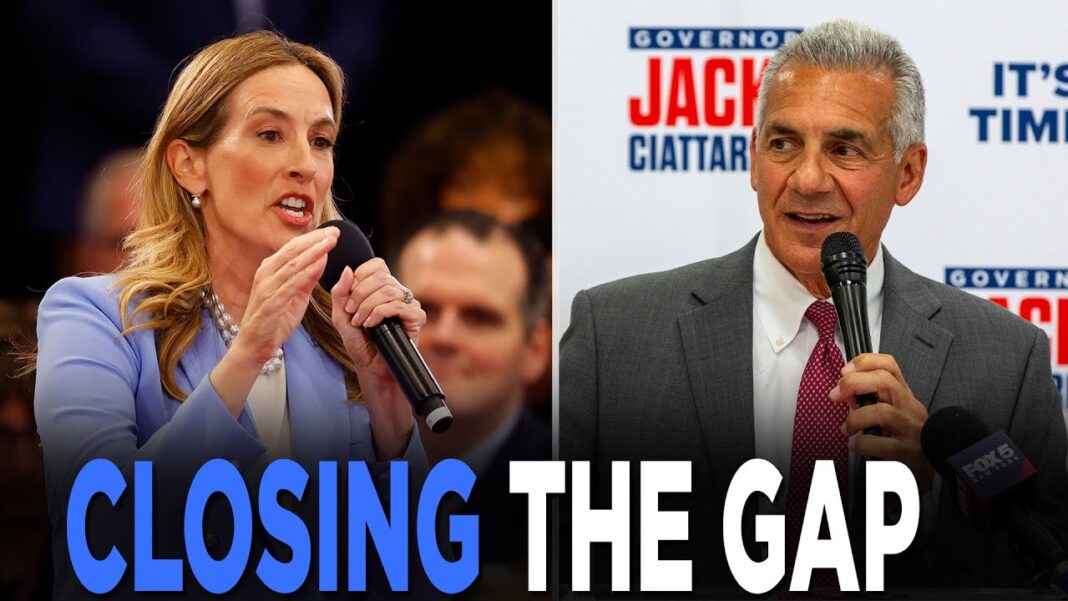
The battle for New Jersey’s governorship has entered a razor-thin phase, as a new Emerson College Polling/PIX11/The Hill survey reveals Democratic Rep. Mikie Sherrill and Republican former state Assemblyman Jack Ciattarelli tied at 43% each, with just over a month to go before voters head to the polls in November. According to a report that appeared on Thursday at VIN News, the poll illustrates just how volatile the race has become, with 11% of voters still undecided and the outcome poised to hinge on turnout, late-breaking momentum, and shifting perceptions of the candidates’ priorities.
The survey, which queried 935 somewhat likely and very likely voters on September 22-23, carries a margin of error of 3.1 percentage points. Its findings confirm what many analysts have long suspected: the Garden State, often viewed as reliably Democratic in national elections, is once again playing host to a fiercely contested gubernatorial race where regional concerns, economic anxieties, and demographic divides could swing the balance.
As VIN News reported, the poll’s topline number masks significant fissures along gender and generational lines. Women currently favor Sherrill by a margin of 46% to 36%, while men back Ciattarelli 51% to 39%. Strikingly, women are also more than twice as likely as men to remain undecided—15% compared to 6%—a factor that could play a pivotal role if one candidate manages to consolidate late-breaking support among female voters.
Age divides are equally stark. Sherrill commands a resounding lead among voters under 40, 58% to 24%, reflecting her appeal to younger residents concerned about education, climate change, and reproductive rights. By contrast, Ciattarelli dominates among voters 50 and older, 52% to 36%, capitalizing on concerns about property taxes, energy prices, and public safety. The generational split highlights the challenge facing each candidate: Sherrill must ensure high turnout among younger voters, while Ciattarelli seeks to energize older, more reliable voting blocs.
Ciattarelli has made affordability the centerpiece of his campaign. As the VIN News report emphasized, his message resonates in a state where property taxes are among the highest in the nation and utility costs have surged in recent years. By focusing on soaring electricity bills and pledging relief for homeowners, Ciattarelli has sharpened his appeal to middle-class and suburban voters who feel increasingly squeezed.
Sherrill, in turn, has leaned into education and social services, arguing that investments in schools, healthcare, and child welfare are not only moral imperatives but also critical to long-term economic stability. Her campaign insists that addressing affordability must be balanced with preserving and expanding public services that sustain communities.
This policy divergence—tax relief and cost-of-living arguments on one side, social investment and equity on the other—has given voters a clear choice, though one that has yet to tilt decisively in either direction.
The specter of incumbent Democratic Governor Phil Murphy looms over the race. As the VIN News report detailed, Murphy’s approval rating stands at just 35%, with 44% disapproving. While that represents only a modest shift since May, it signals that Sherrill cannot fully rely on party loyalty to secure victory.
For Ciattarelli, Murphy’s unpopularity is a gift. The Republican has sought to tie Sherrill to the governor’s record, framing her as an extension of policies that have fueled cost-of-living increases. At nearly every campaign stop, Ciattarelli has accused Democrats of presiding over “a New Jersey that working families can no longer afford.”
Sherrill, however, has carefully calibrated her distance from Murphy, acknowledging voter frustrations over property taxes and utility rates while emphasizing her independence and her record in Congress as proof she can chart a new course.
The poll was conducted just days after the candidates’ first debate, a fiery exchange that showcased their starkly different visions for the state. According to the VIN News report, analysts believe that undecided voters—particularly women and independents—will closely scrutinize the next debate for clues about which candidate best addresses their concerns.
For Ciattarelli, maintaining his focus on affordability while broadening his message to attract undecided women could prove decisive. For Sherrill, energizing younger voters and reassuring older moderates that her policies will not exacerbate the cost-of-living crisis will be critical.
The race in New Jersey is not unfolding in a vacuum. Along with Virginia, the Garden State’s election will be one of only two gubernatorial contests this fall, and both are being watched as bellwethers ahead of the 2026 midterms. The VIN News report noted that national political operatives are already drawing parallels to earlier cycles in which state-level races previewed broader national shifts.
Should Sherrill prevail, Democrats will argue that their message of investment in services and reproductive rights continues to resonate in suburban states, even amid economic frustrations. A Ciattarelli victory, on the other hand, would embolden Republicans by demonstrating that affordability and cost-of-living issues can flip traditionally Democratic-leaning states.
Perhaps the most striking finding of the poll is the 11% of voters who remain undecided. As the VIN News report observed, this bloc—larger than the margin separating the candidates— shines a spotlight on the volatility of the race.
Women account for a disproportionate share of this undecided group, and their eventual leanings could decide the outcome. Analysts suggest that candidates who can combine policy specificity with emotional resonance in the final weeks are most likely to capture these voters. Sherrill’s appeals to protecting education and families may resonate with suburban mothers, while Ciattarelli’s relentless focus on household expenses may win over women balancing tight budgets.
The geography of support adds another layer of complexity. According to the information provided in the VIN News report, Sherrill is strongest in northern New Jersey’s suburban counties, where her congressional base has given her visibility and credibility. Ciattarelli, meanwhile, is performing well in exurban and rural areas, along with parts of the Jersey Shore.
South Jersey, long a swing region, remains a contested battleground. Ciattarelli’s focus on energy costs resonates with households there, while Sherrill’s messaging on healthcare and education could prove decisive in Camden and Atlantic counties.
The Emerson College/PIX11/The Hill poll, as highlighted by VIN News, has laid bare the knife’s-edge dynamics of New Jersey’s governor’s race. With Sherrill and Ciattarelli tied at 43%, undecided voters loom as kingmakers, and every debate performance, policy proposal, and campaign stop could tip the scales.
The gender and age divides depict the polarized nature of the electorate: younger voters flock to Sherrill, while older ones rally behind Ciattarelli. Women, more undecided than men, could ultimately determine the victor in the election.
For Democrats, holding New Jersey is essential to preserving momentum heading into the 2026 midterms. For Republicans, flipping the state would be a symbolic and strategic victory, proof that affordability and economic anxiety can overcome partisan leanings.
As the VIN News report observed, the New Jersey governor’s race is no longer a sleepy off-year contest but a high-stakes battle with national implications. And with just over a month remaining, neither Sherrill nor Ciattarelli has the luxury of complacency: the race is a dead heat, and the state’s undecided voters hold the power to shape not only New Jersey’s future but perhaps the trajectory of national politics as well.
