



|
Getting your Trinity Audio player ready...
|
By: Nick Carraway
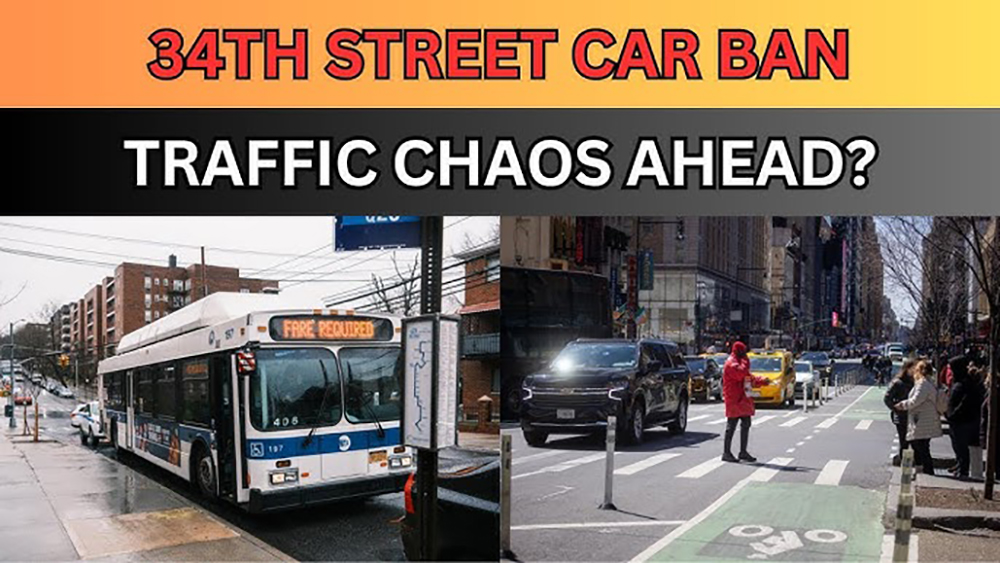
A sweeping new city plan to ban or restrict cars on one of Manhattan’s busiest crosstown corridors has residents fuming — claiming Mayor Eric Adams’ administration is “throwing them under the bus.”
The proposal, floated by the city’s Department of Transportation, would transform 34th Street into a dedicated busway between Third and Ninth avenues. Officials say the aim is to speed up bus commutes and improve freight deliveries, but residents warn the scheme would redirect traffic onto their side streets, creating gridlock and chaos, NY Post originally reported.
Motorists would be prohibited from traveling through the corridor entirely. Only local drivers accessing specific addresses would be allowed to enter, and even they must exit at the next available avenue. Taxis and rideshares would face the same rule, prompting concerns about logistics, access, and emergency response times.
DOT says the goal is to replicate the success of 14th Street’s busway, which led to faster buses, fewer crashes, and reduced congestion. But residents and critics argue that 34th Street is fundamentally different—it’s a key entry and exit point for both the Midtown and Lincoln tunnels, NY Post originally reported.
Murray Hill residents fear the consequences. “It’s just going to congest all our side streets,” said Michael-Ann Rowe, who attended a DOT presentation at Community Board 6’s transportation committee on June 2. Andrew Fine, another local, added, “The collateral damage will be immense. Please just give it up on this project.”
The Murray Hill Neighborhood Association is leading the charge against the plan. “Limiting access for residents and businesses with entrances on 34th Street, while diverting traffic from this critical corridor onto narrow residential streets would lead to increased congestion, safety hazards, and diminished quality of life in the neighborhood,” said Jessica Lavoie, the association’s quality of life chair, NY Post originally reported.
DOT’s own data supports the pressure to act—28,000 daily commuters rely on the M34 and other express bus routes along the 34th Street corridor. Yet despite existing dedicated bus lanes, average weekday bus speeds hover around just 5 miles per hour, dropping to as low as 3 mph during peak hours, according to MTA transit analyst Joseph Chiarmonte.
Chiarmonte added that riders collectively lose an estimated 750 hours daily due to delays. By contrast, after 14th Street was converted into a busway, bus speeds rose 15%, showing the potential benefit of similar measures on 34th Street.
Still, critics say the city is jumping the gun. Nearly half of the vehicles on 34th Street—47%—are headed outside Manhattan to outer boroughs or beyond, said DOT project manager Rachel Eisenberg. She promised a study of the potential traffic impact, but that hasn’t assuaged concerns.
Lavoie expressed disbelief that CB6’s transportation committee approved the busway plan without a completed analysis. “A plan of this magnitude demands a transparent, data-driven review and meaningful community engagement with local residents and businesses before any further action is taken,” she said.
The DOT defended the plan as pro-commuter. “34th Street is one of the city’s busiest crosstown corridors, where 28,000 daily bus riders often face speeds as slow as walking,” a department spokesperson said. “This proposal—supported by all three local community boards—aims to deliver faster, more reliable service.”