



|
Getting your Trinity Audio player ready...
|
Mexican Navy Training Vessel Cuauhtémoc Crashes into Brooklyn Bridge, Injuring 20 and Raising Safety Concerns Ahead of Fleet Week
Edited by: TJVNews.com
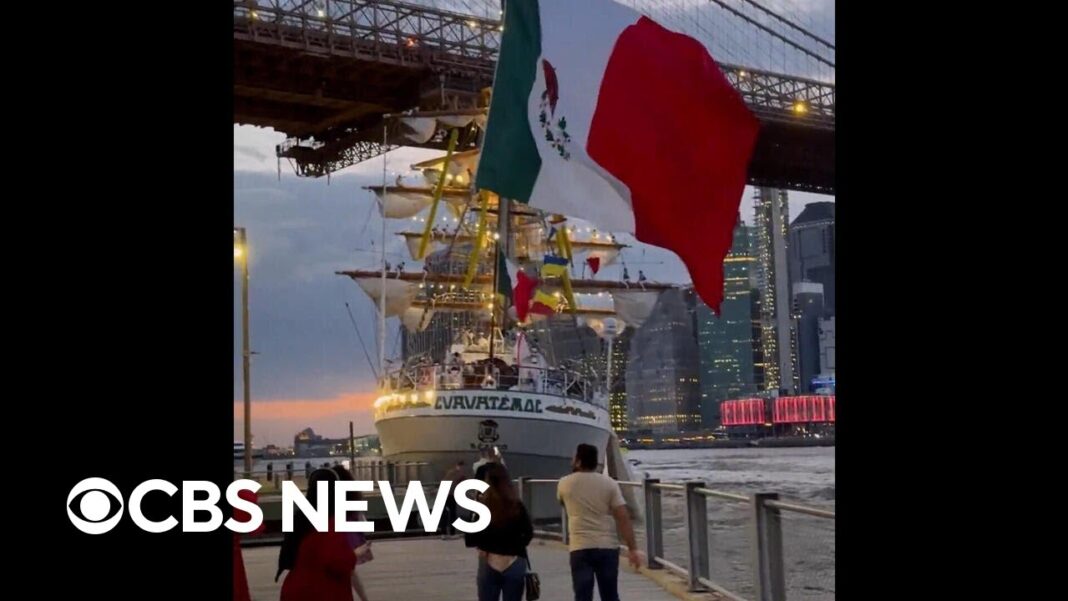
A major maritime mishap unfolded on Saturday night as the Cuauhtémoc, a tall-masted Mexican Navy training ship carrying nearly 300 people, collided with the underside of the iconic Brooklyn Bridge, resulting in significant damage to the vessel and injuries to at least 20 individuals. According to a report on Saturday in The New York Times, the crash occurred just after 8:30 p.m., sending shockwaves through downtown Brooklyn and drawing a swift emergency response from multiple city agencies.
The Cuauhtémoc, a 300-foot-long steel-hulled barque used by the Mexican Navy for training seamen and officers, was making its approach through New York Harbor in advance of Fleet Week—a high-profile annual event that draws naval vessels from around the world to Manhattan. But instead of a routine arrival, the ship’s towering masts—measuring 160 feet—failed to clear the Brooklyn Bridge, which provides a navigational clearance of just 127 feet at high tide.
Video footage posted to social media and cited by The New York Times captured the moment of impact. As the vessel’s gleaming white masts approached the span, onlookers initially assumed it would clear. But then came a sharp and unmistakable sound—the snap of timber and metal. “You could hear it snap,” said Nick Corso, 23, who was dining nearby with friends at a restaurant by the Brooklyn Promenade. “The top lights on the mast disappeared behind the bridge, and I was like, oh, it’s not going to make it.”
When the Cuauhtémoc struck the bridge, its masts crumpled and fractured, forcing the vessel to lurch abruptly but ultimately remain afloat and upright. The ship came to rest near the Brooklyn Promenade, visibly listing, with its once-majestic rigging now mangled.
Authorities moved quickly to secure the area. All lanes of the Brooklyn Bridge were temporarily closed in both directions, as reported by The New York Times, while the Department of Transportation initiated an immediate inspection of the bridge’s structure. Manhattan Borough President Mark Levine confirmed via social media that a full safety assessment was underway to determine whether the historic span sustained any structural damage in the incident.
According to the New York Fire Department, 277 people were aboard the vessel at the time of the crash. Of those, three individuals were critically injured, and 17 others sustained serious injuries. Fortunately, all passengers and crew members were accounted for, though the emotional and physical toll was evident. Emergency responders treated the injured at the scene before transporting the most severely affected individuals to nearby hospitals.
In a statement issued on social media in Spanish, the Mexican Secretariat of the Navy acknowledged the incident, noting that both naval and local authorities were assessing the situation and offering support to those impacted. “The status of personnel and equipment is being reviewed,” the post said, underscoring the seriousness with which Mexican officials are treating the crash.
The Cuauhtémoc, launched in 1982 and named for the last Aztec emperor, has long served as a floating classroom for cadets of Mexico’s Heroic Naval Military School. The ship is considered a symbol of Mexico’s naval heritage and is a frequent participant in international maritime exhibitions and goodwill tours. According to a press release from a prior cruise, the vessel has visited more than 200 ports in over 60 countries and has represented Mexico in major naval parades across the globe.
That rich history, however, did little to insulate the vessel from Saturday night’s navigational miscalculation—one that experts say could have been avoided. Maritime analysts told The New York Times that a failure to account for tidal conditions and mast height relative to the bridge’s clearance likely led to the incident.
The timing of the crash has further heightened scrutiny, as it occurred just days before the start of New York City’s Fleet Week on May 21. The event, beloved by locals and tourists alike, showcases the naval power and pageantry of participating countries, offering ship tours, demonstrations, and celebrations. This year’s Fleet Week was to feature vessels from the United States, Canada, and several allied nations—including, until Saturday night, the Cuauhtémoc.
Now, the ship’s participation is in serious doubt. Its masts and rigging will require substantial repairs, and questions remain about the incident’s implications for broader Fleet Week safety protocols. “It’s too early to say if the ship can be made parade-ready in time,” one event organizer, speaking anonymously to The New York Times, admitted. “But this will certainly be a subject of high-level discussion.”
In a city still reeling from the dangers of crumbling infrastructure and increased scrutiny on public safety, the Brooklyn Bridge incident is also likely to reignite conversations about vessel clearance, harbor traffic control, and international coordination for visiting ships. It also adds to a string of recent close calls and mishaps that have raised red flags about maritime and pedestrian safety alike.
As the investigation into the crash continues, local leaders are urging calm and transparency. “This is a serious incident,” said a spokesperson for the NYPD. “We are working closely with the Coast Guard, the Department of Transportation, and our counterparts in the Mexican Navy to understand what went wrong and to ensure accountability.”
In the meantime, the Brooklyn Bridge remains under inspection, and the Cuauhtémoc sits damaged in the shadow of its arches—a majestic symbol of diplomacy and training now bearing the scars of miscalculation.
Whether the vessel will sail again soon, or become a cautionary tale for future Fleet Week planners, remains to be seen. But as The New York Times report observed, Saturday night’s spectacle was a dramatic reminder of both the beauty and fragility of international outreach—especially when the tides of error rise just a little too high.
