



|
Getting your Trinity Audio player ready...
|
By: Tzirel Rosenblatt
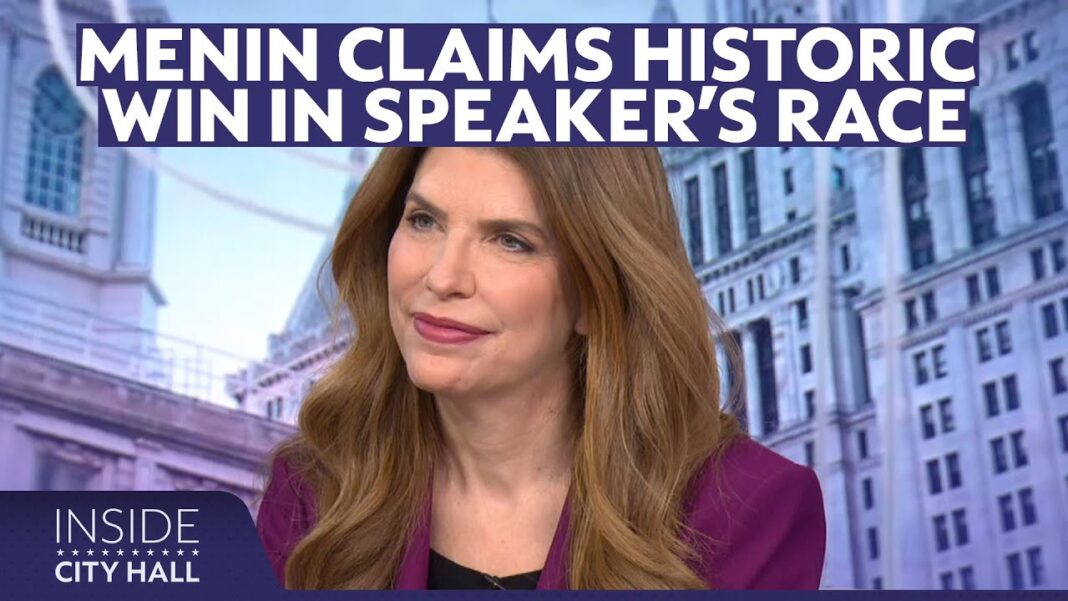
In a dramatic realignment of power inside New York City’s political architecture, Councilwoman Julie Menin announced on Wednesday that she has secured what she called “super majority” support in her bid to become the next speaker of the New York City Council. The news, first reported on Wednesday in The New York Post, instantly transformed what had been a tense, ideologically charged contest into a broader referendum on the direction of the incoming Mamdani administration.
At 58, the Manhattan Democrat has spent her career deftly navigating the city’s political topography. But never before has she faced stakes as acute as these. The speakership, long known as the second-most powerful position in city government, will either function as a stabilizing ballast against Zohran Mamdani’s twenty-first-century experiment in democratic socialism or as a willing partner to the new mayor’s expansive agenda. Which role it plays hinges almost entirely on who wields the gavel in January.
According to the information provided in The New York Post report, Menin has lined up the endorsements of an extraordinarily diverse ideological spectrum within the Council — from progressive Democrat Yusuf Salaam of the Bronx to several Republican members who see in her candidacy a measure of moderation and predictability. That breadth of support, while surprising to some insiders, reflects a climate in which many legislators are privately uneasy about the new mayor-elect’s more radical instincts. Mamdani, whose victory shocked the political establishment and whose rhetoric has rattled traditional Democratic circles, had been widely expected to favor Brooklyn Councilwoman Crystal Hudson for the speakership.
And indeed, The New York Post confirmed through multiple sources that members of Mamdani’s inner orbit scrambled feverishly to lock down votes for Hudson. The effort, however, did not merely fail — it collapsed publicly. One veteran operative told the Post that Mamdani’s team “face-planted,” noting that although individual surrogates — including respected progressive figures — lobbied aggressively for Hudson, the mayor-elect himself may never have been entirely committed to that outcome.
Whether intentional or not, that ambiguity left Hudson exposed. As the tally became impossible to overcome, she issued a concession statement that carried a tone of resigned pragmatism. “I have always said this should be a member-driven process,” she wrote. “And today, my colleagues have made their choice clear.”
Menin’s victory in the endorsement phase immediately recast the political wind patterns of City Hall. If her support holds — and, as insiders cautioned to the Post, a month is an eternity in the volatile ecology of municipal politics — she will become the first Jewish speaker in the Council’s history. The implications of that milestone are far-reaching, carrying symbolic significance for the city’s Jewish community at a time when tensions, antisemitic incidents, and questions about policing and public safety have grown more urgent.
But the history-making headline is only part of the story. As The New York Post reported, Menin has cultivated an image as a thoughtful centrist — a counterweight to what many perceive as Mamdani’s ideological zeal. She left the Council’s progressive caucus in 2023 in direct opposition to its “defund the police” posture. She has expressed skepticism toward the mayor-elect’s proposal for a Department of Community Safety, a reimagining of policing that critics fear would diminish the city’s already strained law enforcement apparatus.
Yet she has simultaneously signaled an openness to aspects of Mamdani’s platform, including his emphatic push for universal childcare and broader affordability initiatives. In her statement, released shortly after securing the necessary commitments, Menin declared that she and her coalition were “ready to partner with Mayor-elect Mamdani’s administration” to make New York more livable by lowering rent and health-care costs and expanding opportunity for middle- and working-class families.
This duality — cooperative but not compliant, constructive but not submissive — is precisely what makes Menin’s impending speakership so consequential. Her rise suggests that the next Council will neither swing fully into Mamdani’s ideological orbit nor revert to the centrist technocracy of prior administrations. What emerges may be a hybrid: a city government far more progressive than the Bloomberg years but far more restrained than the socialist blueprint championed by Mamdani’s closest allies.
The bruising behind-the-scenes contest revealed a rift between the progressive camp’s aspirations and the Council’s appetite for their ascendance. Some of Mamdani’s most prominent supporters — including Councilman Lincoln Restler, Comptroller Brad Lander, and longtime political adviser Patrick Gaspard — spearheaded an intense lobbying effort among council members to boost Hudson. But that effort was marred by strategic miscalculations and, in Gaspard’s case, a notable misalignment with the moment.
Gaspard, who served as a senior official in the de Blasio administration and later as an ambassador under President Barack Obama, attempted to enlist the powerful hospital workers’ union 1199SEIU on Hudson’s behalf. It was a gambit insiders quickly described as tone-deaf. As one operative told the Post, the attempt to secure a union endorsement after Menin had already locked in overwhelming written support was “not a pro move.” Another union adviser was even more blunt, telling the paper that Gaspard’s diplomatic instincts appeared “rusty” and invoking the phrase “too little, too late.”
For observers of New York City politics, the contrast with Eric Adams’ heavy-handed intervention in the 2021 speakership fight is instructive. Adams pushed aggressively — and unsuccessfully — for Francisco Moya, damaging his relationship with current Speaker Adrienne Adams. The Post noted that the Mamdani camp’s maneuvering was comparatively mild, but still clear enough to draw lines between the mayor-elect’s coalition and the broader Council.
The fact that Menin secured the support of 36 members, including moderates, conservatives, social democrats, and even figures aligned with the progressive movement, indicates that Hudson was unlikely to prevail under any circumstances. But the failure of the left’s push raises a deeper question: how much influence can Mamdani exert over lawmakers who are already wary of his more polarizing priorities?
The New York Post’s political desk observed that Menin’s candidacy offers a “moderating force” at a moment when New Yorkers remain deeply divided over public safety, taxation, immigration, and housing. Many in the Council fear that Mamdani’s instinct to disrupt established governance structures, paired with his unwavering ideological commitments — from policing to foreign policy — could destabilize the city’s fragile equilibrium.
Menin’s supporters, a coalition spanning all five boroughs, see her as a serious student of government who can negotiate budgets with rigor and maintain legislative autonomy from the executive branch. Democratic strategist Bill Cunningham, quoted in the Post, emphasized that she “will not be a pushover” when it comes to negotiating big-ticket items.
Perhaps most importantly, Menin’s speakership presents a pathway for the Council to retain its institutional identity in an era when centralized authority in City Hall might otherwise expand under a politically ambitious and ideologically driven mayor-elect.
Despite the obvious tension between their camps, both Menin and Mamdani have already telegraphed a willingness to work together. In a statement given to the Post, Mamdani transition spokesperson Dora Pekec said the mayor-elect “looks forward to working with her and the entire City Council to deliver on our affordability agenda for New Yorkers.”
This olive branch reflects a political reality: whoever becomes speaker will shape the legislative landscape through which Mamdani must travel to pass signature initiatives. A cooperative posture benefits both leaders, yet their ideological divergence virtually ensures regular conflict. Whether those conflicts will remain collegial or grow acrimonious will define the tenor of the 2026–2027 municipal cycle.
The struggle over the speakership, as framed in The New York Post report, is not merely a procedural scuffle over internal Council leadership. It is a philosophical contest over whether New York City should sprint toward a transformative progressive future or adopt a more calibrated, incremental approach to reform. The answer, at least for now, rests with Menin’s ascendant coalition — a coalition that spans ideological boundaries and suggests a hunger for articulated moderation rather than ideological absolutism.
Although insiders insist Menin’s numbers are solid, the Post wisely cautioned that “a month is a long time to hold a group of electeds to a promise.” New York politics has its own gravitational laws, and sudden scandals, unexpected alliances, or eleventh-hour ultimatums can disrupt even the most carefully assembled coalitions.
Yet absent such shocks, the momentum unmistakably favors Menin. Her disciplined coalition-building, her refusal to indulge in polarizing rhetoric, and her ability to speak fluently to both progressive priorities and centrist anxieties have positioned her as the rare council member capable of uniting a fractious legislative body.
In a city as perpetually turbulent as New York, the emergence of such a figure is newsworthy in itself. But in the shadow of an unpredictable, ideologically unapologetic mayor-elect, Menin’s likely ascension to the speakership becomes something even more consequential: the first major political counterweight to Zohran Mamdani — and the opening chapter of a power dynamic that will define New York City’s immediate future.