



|
Getting your Trinity Audio player ready...
|
By: Jeff Gorman
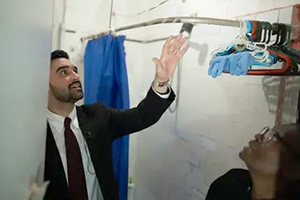
When Zohran Mamdani knelt on the rotting parquet of a Flatbush apartment barely hours after his inauguration as mayor of New York City, the image ricocheted through the city’s political bloodstream. Cameras captured him running a hand along splintered floorboards, peering at corroded faucets, and gazing upward at a ceiling sagging with the weight of years of neglect. For the residents who had endured leaking pipes, infestations of vermin, peeling plaster, broken elevators, and erratic heat, the moment was not theatrical—it was their daily reality. For Mamdani, as Ynet News reported recently, the scene was the embodiment of a central campaign pledge: to defend tenants from predatory real estate practices and to rescue affordable housing from decades of deterioration.
But that tableau, poignant as it was, proved to be only the prologue to a confrontation that would quickly test the new mayor’s political instincts, legal reach, and ideological convictions.
The Flatbush building Mamdani toured was slated to be included in a massive transaction: roughly 5,000 rent-stabilized units across 90 buildings were being offered for sale at an estimated price of $451 million. The buyer was Summit Properties USA, the American arm of Summit Holdings, an Israeli-linked real estate firm controlled by businessman Zohar Levy.
According to the information provided in the Ynet News report, the mayor’s office immediately framed the deal as a red flag. City attorneys argued that Summit lacked both the financial wherewithal and the genuine intention to rehabilitate the decaying properties. They pointed to more than 780 open violations across the portfolio, nearly 290 of them classified as immediately hazardous—conditions ranging from exposed wiring and black mold to structural instability.
The city also highlighted the past: the previous owner, Pinnacle, owed New York more than $12.7 million in unpaid fines. Mamdani’s administration claimed this delinquency gave it standing to intervene and push for an alternative purchaser, one that it believed would be more aligned with tenant welfare.
What followed was a politically charged legal maneuver. City lawyers filed an emergency motion in federal court seeking to delay the sale by 30 days. The goal, they said, was to prevent Summit from assuming ownership before the city could vet its capacity to correct dangerous conditions.
Tenants, many of whom had grown cynical after years of unanswered complaints, rallied outside Midtown Manhattan offices. Ynet News reported that one elderly resident arrived at court clutching a dead cockroach in a plastic bag—a macabre symbol of life inside these buildings. Placards reading “We Deserve Safe Homes” bobbed amid the press cameras, lending the proceedings an almost theatrical intensity.
Yet on Friday, the city’s gambit collapsed. Federal Judge David Jones rejected the emergency motion, allowing the sale to proceed as scheduled. The ruling was swift and unequivocal. Mamdani’s administration had, in the judge’s view, failed to demonstrate sufficient legal grounds to block a private transaction.
Ynet News described the decision as an early and stinging rebuke—one that punctured the aura of momentum Mamdani had cultivated in his first days in office.
Within City Hall, aides privately acknowledged that the fight over the Flatbush properties had become something more than a dispute over maintenance records. Mamdani had campaigned on a platform that criticized the role of foreign capital in New York real estate, portraying it as a force that extracts value while neglecting the city’s most vulnerable residents.
The fact that Summit was linked to an Israeli firm added a layer of complexity that critics were quick to seize upon. Some accused the mayor of politicizing a business transaction, injecting ideology where pragmatic governance was required. Others within his coalition saw the episode as emblematic of a global struggle between local communities and transnational finance.
Ynet News noted that Mamdani’s supporters viewed the legal battle as a moral test case: a line in the sand against what they described as “speculative absentee ownership.” Detractors countered that his approach risked alienating investors at a moment when New York desperately needs capital to address its housing shortage.
Summit Properties did not remain silent. Zohar Levy, speaking to Ynet News, insisted that the company’s intentions had been misrepresented. Far from neglecting the buildings, he said, Summit was preparing to invest heavily in repairs, compliance, and long-term maintenance.
Levy argued that the acquisition would wipe out more than $275 million in accumulated debt associated with the properties, liberating capital that could be redirected toward renovation. Many of the cited violations, he claimed, were already being addressed as part of the transition process.
“We are committed to New York,” Levy told Ynet News. “We want to work with the city and with the tenants to ensure these homes are safe, dignified places to live.”
His tone was conciliatory, but firm. The company denied that the city’s challenge had anything to do with housing safety alone, suggesting that political motivations had clouded the discourse.
For tenants such as Nadge Romulus, a Flatbush resident whose ceiling is fissured with cracks and whose plumbing groans with each use, the courtroom drama is more than a policy debate. It is a question of survival.
Ynet News interviewed Romulus, who said she no longer expects miracles. “I just want the heat to work in winter and the bugs to stop coming,” she said. Whether Summit will deliver on its promises remains uncertain. For residents like her, the legal outcome has replaced hope with apprehension.
The saga unfolds amid a housing crisis that shows no sign of abating. Rents continue to climb, affordable units are vanishing, and middle-class families are increasingly priced out of the city they once anchored.
Mamdani’s defeat in court illustrates the formidable constraints facing any mayor who seeks to transform this landscape. Municipal advocacy must contend not only with entrenched private interests, but also with a legal architecture that prioritizes property rights and contractual freedom.
Ynet News analysts have framed the episode as a microcosm of a deeper tension: the mismatch between populist rhetoric and institutional reality. Mamdani may command the spotlight, but the levers of power remain dispersed across courts, regulatory bodies, and financial markets.
Deputy Mayor for Housing Laila Bozorg attempted to strike a measured tone after the ruling. In a statement cited by Ynet News, she said the administration would continue to monitor Summit’s compliance with housing laws and pursue every available mechanism to protect tenants.
Yet observers note that the mayor’s credibility is already under strain. Having framed the Flatbush case as a defining early victory, Mamdani must now navigate the optics of defeat.
His allies argue that the fight itself mattered—that it signaled a new era of assertiveness in City Hall. His critics counter that symbolism without results risks breeding cynicism among the very communities he seeks to champion.
As Summit moves forward with the purchase, inspectors will fan out across the properties, and tenants will watch for tangible change: repaired boilers, sealed walls, functioning elevators. The city, constrained by the court’s ruling, will be relegated to oversight rather than intervention.
For Mamdani, the Flatbush episode will likely become a touchstone for his administration. It is the moment when campaign slogans collided with the granite face of federal jurisprudence.
Ynet News has suggested that the mayor now faces a choice: double down on confrontational tactics that energize his base but court legal defeat, or pivot toward incremental reforms that may deliver quieter, slower victories.
The image of a mayor kneeling on broken floorboards remains potent. It speaks to the yearning for leadership that sees, literally, the cracks in the system. Yet as this first housing battle demonstrates, empathy alone cannot mend structural decay.
The war over New York’s affordable housing will not be won in photo ops or press conferences. It will be decided in zoning codes, compliance audits, financing structures, and the patient, grinding work of enforcement.