



|
Getting your Trinity Audio player ready...
|
By: Fern Sidman
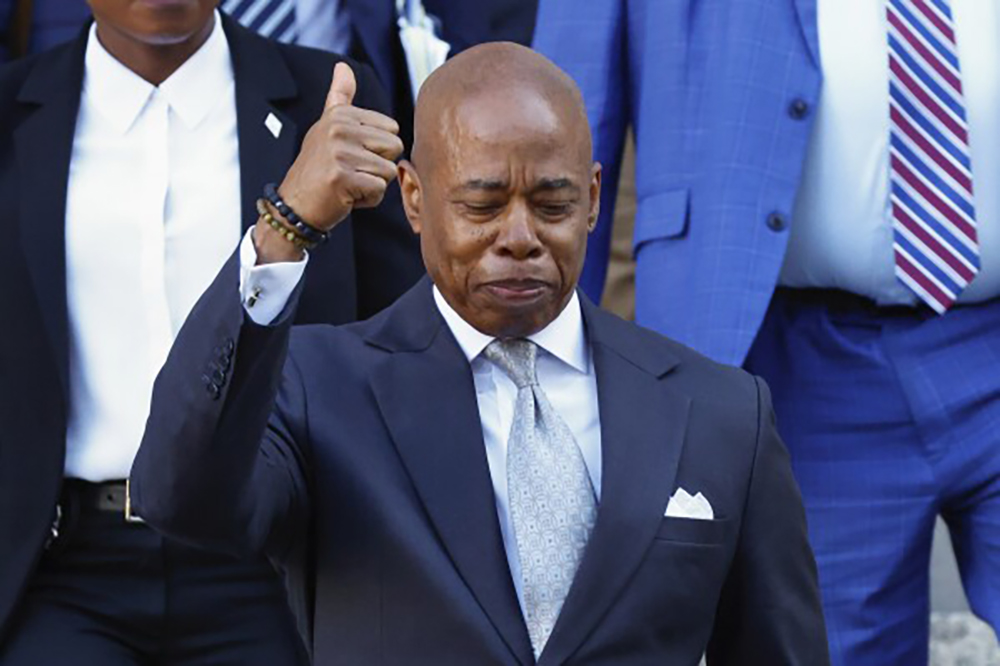
In a decisive gesture that underscored both solidarity and urgency, New York City Mayor Eric Adams paid an unannounced visit to Manhattan’s Park East Synagogue on Monday, arriving, directly from a nine-day overseas trip to meet the shaken congregation still reeling from a hostile demonstration that unfolded outside their sanctuary last week. As VIN News reported on Monday, an anti-Israel mob had gathered at the entrance of the historic synagogue, shouting extremist chants including “globalize the intifada” and “death to the IDF,” leaving worshipers and local residents alarmed by the tenor and aggression of the demonstrations.
Mayor Adams’s appearance at the storied Upper East Side congregation signaled not only his condemnation of the hateful displays but also an acknowledgment of the deep anxiety that the Jewish community is experiencing amid a dramatic surge in antisemitic rhetoric and activity across New York City. According to the information provided in the VIN News report, Adams made Park East his very first stop upon returning to the city, reflecting the gravity with which his administration views the growing threat of antisemitism and communal intimidation.
Posting images of the visit on X (formerly Twitter), the mayor wrote that he came “to show up, not back down,” standing shoulder to shoulder with Rabbi Arthur Schneier, the synagogue’s venerable spiritual leader and a Holocaust survivor whose firsthand experience with antisemitic violence imbues the recent events with haunting historical resonance. The VIN News report noted that Adams walked through the synagogue, greeting congregants, touring the premises, and offering words of reassurance that New York City “will stand firm against hate.”
The mayor’s message was unequivocal: “I came to celebrate Jewish life and reaffirm our unshakable bond with Israel,” he said. “Antisemitism and all forms of hate have no place in New York City.” These remarks, cited in the VIN News report, were meant to directly counter the hostile chants that had sought to make Jewish worshipers feel unsafe in their own house of prayer.
Park East Synagogue, founded in 1890 and internationally renowned for its interfaith work, educational outreach, and diplomatic engagement, is no stranger to moments of international attention. Over the decades, world leaders, diplomats, and dignitaries have visited the synagogue, seeking counsel from Rabbi Schneier, who has spent much of his life building bridges between nations, faiths, and communities.
Yet the events of last week thrust the synagogue into the spotlight in a very different and deeply troubling context. As congregants prepared to attend a scheduled event, protesters assembled outside the building’s entrance, shouting slogans that the VIN News report described as “extremist and explicitly violent.” Chants such as “globalize the intifada” and “death to the IDF” created an atmosphere of fear and intimidation, drawing comparisons from some community members to earlier eras when Jews were singled out, harassed, or threatened on the streets of major Western cities.
Many observers were quick to point out that these chants—particularly “globalize the intifada”—carry an unmistakably violent implication. The VIN News report emphasized that the phrase is widely understood to call for an internationalized extension of the violent Palestinian uprisings that included suicide bombings, shootings, and other lethal attacks on Israeli civilians. For Jewish New Yorkers, such rhetoric, shouted aggressively outside a synagogue, is not a matter of political protest but an explicit threat.
Rabbi Schneier, now 95, who survived the horrors of the Holocaust as a young boy in Vienna, has spoken openly about the trauma of witnessing modern-day antisemitic intimidation mere feet from the sanctuary where he has preached for more than six decades. As the VIN News report recalled, Rabbi Schneier has often described seeing his childhood synagogue burned during Kristallnacht as police stood by. To see a crowd today chanting hostile slogans outside a Jewish synagogue in Manhattan is therefore, for him and many others, not merely offensive but existentially painful.
Mayor Adams’s visit to Park East was significant not only symbolically but also politically. His decision to prioritize the synagogue upon his return sent a clear message: that the city’s leadership recognizes the seriousness of the threat and is not willing to cede public spaces or houses of worship to intimidation.
In his remarks shared by VIN News, Adams stressed that New York City would continue to protect Jewish institutions with the full force of municipal resources, including increased police presence, intelligence coordination, and inter-agency cooperation. For Jewish communities still processing last week’s events, such assurances were welcomed but also tinged with concern that protests could escalate into violence if not addressed swiftly and unequivocally.
Adams has long cast himself as a supporter of Jewish communities, consistently attending communal events, meeting with religious leaders, and speaking out boldly against the scourge of antisemitism. Yet the severity of recent incidents—combined with global tensions surrounding the Israel-Hamas conflict—has infused his statements with a sense of urgency unprecedented even for his administration.
The events at Park East did not occur in isolation. As VIN News has documented extensively, antisemitic hate crimes in New York City have surged sharply in the past year. Jewish schools, synagogues, and community centers have reported incidents ranging from vandalism and harassment to physical assaults. Online incitement, often linked to foreign propaganda campaigns, has spilled into real-world rallies, where extremist slogans have become increasingly normalized.
This troubling trend has prompted Jewish communal institutions to strengthen their own security measures. Many now routinely employ private security, coordinate with the NYPD’s intelligence division, and engage in training exercises to prepare for potential threats.
Adams, cognizant of these realities, used his visit to emphasize that the city is committed not only to responding to incidents but to preventing them. According to the information provided in the VIN News report, he spoke with several congregants about improving security coordination and ensuring that worshipers feel safe entering and leaving the building.
The mayor’s visit also has significant political resonance. For many Jews in New York, the hostile demonstration outside Park East was a watershed moment—one that forced them to confront the uncomfortable reality that antisemitic hatred had not merely resurfaced in isolated pockets but had reentered mainstream protest culture. Seeing a mob chant violent slogans outside an iconic synagogue on the Upper East Side felt to many like a violation of the city’s fundamental promise of safety and pluralism.
By appearing at Park East and standing with Rabbi Schneier, Adams sought to reassert that promise. His message, as reported by VIN News, was that the city will not tolerate intimidation, nor allow extremist rhetoric—no matter its political wrapper—to victimize religious minorities.
The mayor’s posture also implicitly challenged city officials and community leaders who may have hesitated to unequivocally condemn the protests. In recent months, Jewish organizations have voiced frustration that some public figures have responded to antisemitic incidents with tepid or ambiguous statements, often framing them within larger geopolitical narratives rather than addressing their local impact.
Adams’s forceful stance—“show up, not back down”—was thus widely interpreted as an attempt to set the tone for moral clarity at a time when many institutions struggle to define the boundaries between protest and hate speech.
Few figures embody the moral weight of this moment more than Rabbi Arthur Schneier, who stood beside the mayor during the visit. As the VIN News report reminded readers, Rabbi Schneier’s life story spans some of the darkest chapters of Jewish history: from the rise of Nazism to the Holocaust, from the postwar struggle for Jewish renewal to decades spent advocating for human rights and interfaith understanding.
At Park East, he has hosted presidents, prime ministers, and religious leaders. His work has been recognized by international bodies, governments, and organizations across the world. For such a figure—with a legacy rooted in reconciliation—to witness aggressive antisemitic chants outside his own synagogue is a deeply symbolic indictment of the moment.
s the city continues to grapple with rising tensions, Adams’s visit represents an important step—but only the beginning of a broader effort to ensure that Jewish New Yorkers are safe, supported, and heard. The mayor’s commitment reinforces that combating antisemitism is not merely a matter of law enforcement but a moral imperative tied to the character and identity of New York City.
The events at Park East Synagogue have jolted many into recognizing the fragility of communal safety in an era of escalating extremism. But the sight of the mayor standing alongside Rabbi Schneier, declaring an unshakable bond with the Jewish community, provides a counter-image—one of resilience, unity, and unwavering refusal to allow hate to dictate the narrative of New York’s future.