



|
Getting your Trinity Audio player ready...
|
By: Russ Spencer
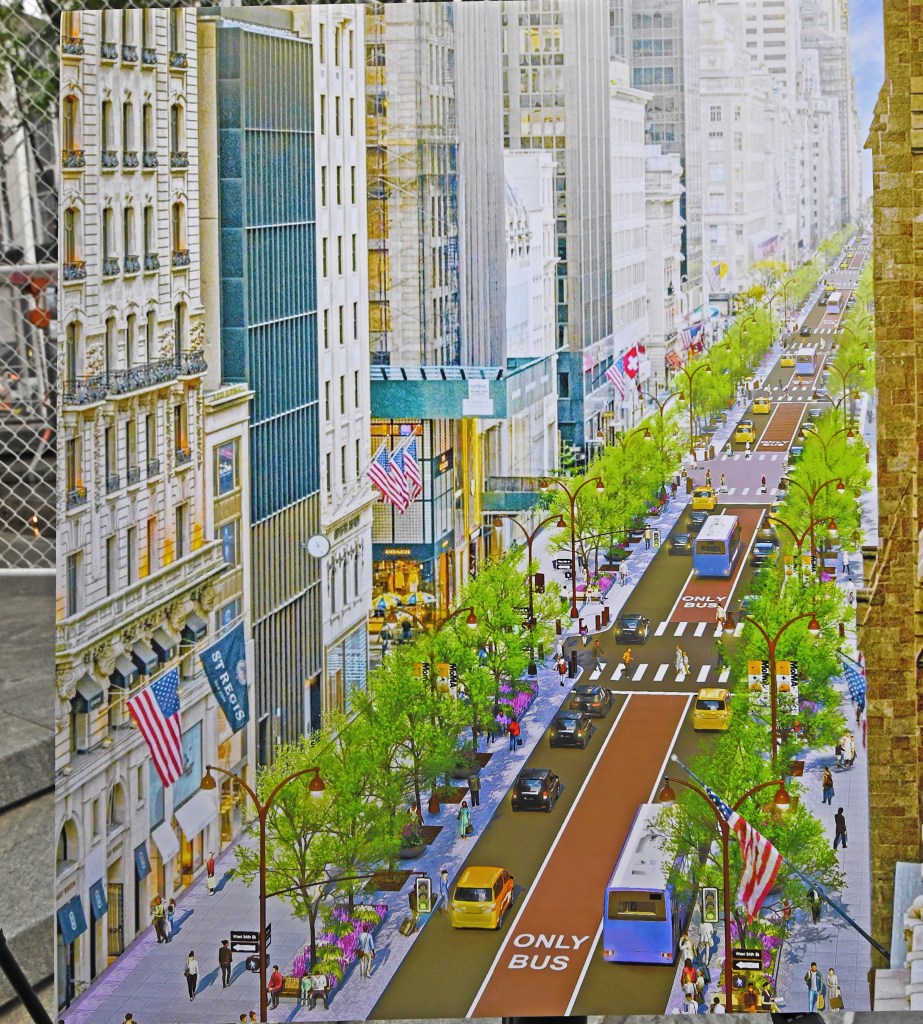
Fifth Avenue — New York City’s world-famous thoroughfare of luxury storefronts and historic grandeur — is poised for a once-in-a-century overhaul. As reported by VIN News on Thursday, Mayor Eric Adams on Wednesday unveiled an ambitious $400 million initiative to reimagine the stretch from Bryant Park to Central Park South, focusing on pedestrian access, retail revitalization, and a more inviting urban environment.
The sweeping redesign — the first in Fifth Avenue’s 200-year history — aims to nearly double sidewalk space, cut traffic lanes from five to three, and incorporate new landscaping, benches, and upgraded lighting. City officials say the transformation is part of a broader push to revitalize Manhattan’s retail economy and reorient public space toward people rather than vehicles.

“This investment reclaims space for everyday New Yorkers and strengthens Fifth Avenue as a magnet for tourism and jobs,” Mayor Adams stated, according to the VIN News. He projected that the investment would yield long-term returns through higher sales revenue and increased property tax contributions, ultimately paying for itself within several years.
While the plan has earned praise for prioritizing pedestrians and enhancing the city’s urban fabric, transit advocates have sharply criticized it for omitting dedicated infrastructure for buses and bicycles — two of the most heavily used and environmentally friendly modes of travel in the city.
“Without protected lanes, buses and bikes are left behind — again,” said Danny Pearlstein of the Riders Alliance, speaking to VIN News. He noted that Manhattan already has some of the slowest bus routes in the country, and Fifth Avenue remains a critical corridor for commuters who depend on public transit.
Cycling advocates echoed those frustrations. “Fewer cars mean safer streets,” said Neile Weissman of the New York Cycle Club. “It’s a step in the right direction, but we need to go further to ensure everyone — not just pedestrians — is supported in this redesign.”
Despite the scope of the announcement, construction is not expected to begin until 2028. In the meantime, city planners are working closely with a range of stakeholders, including the Central Park Conservancy and the Bryant Park Corporation, to finalize design details and implementation strategies.
The city is also pursuing complementary transportation initiatives. According to the information provided in the VIN News report, the Adams administration is advancing plans for a new dedicated busway on 34th Street, intended to accelerate commutes for the tens of thousands of New Yorkers who use the corridor daily. That project aims to alleviate pressure on clogged surface transit routes and align with the broader goal of making Manhattan’s core more efficient and less car-dependent.
At the heart of the Fifth Avenue redesign is a belief that the economic vitality of the corridor — long dominated by luxury retailers and iconic institutions — can only be sustained by making the area more accessible, vibrant, and human-centered.
By expanding sidewalks nearly 50%, officials hope to encourage increased foot traffic and a more pleasant urban experience, one that entices tourists and benefits local businesses. Green spaces, improved lighting, and new seating areas are expected to give the corridor a refreshed aesthetic appeal and greater usability year-round.
Yet, as the VIN News report noted, the project faces a difficult balancing act: revitalizing a commercial artery without sacrificing the needs of everyday commuters who rely on it. With concerns about transit equity and climate-conscious infrastructure growing louder, the lack of dedicated space for buses and cyclists may continue to fuel public debate.
Mayor Adams’ $400 million vision for Fifth Avenue represents a bold reimagining of one of New York’s most storied streets — one that prioritizes walkability, aesthetics, and economic growth. But as transit and cycling advocates push for more inclusive design, the conversation is far from over. With construction years away, there remains both time and opportunity for the city to adapt its plans to better serve the full spectrum of New Yorkers who rely on the public realm every day.

Sounds like the are beginning work on the 15-minute city concept: Everyone will be prisoners in open-air restricted areas…and you’ll LIKE it.
Yeah…no..BAD IDEA. Most likely ill-conceived, as always, by liberals who embrace fascism as the new republic