



|
Getting your Trinity Audio player ready...
|
By: Chaya Abecassis
In a sweeping effort to make New York City’s streets and public transit more accessible for all, Mayor Eric Adams and Department of Transportation (DOT) Commissioner Ydanis Rodriguez announced a $40 million investment to install seating at approximately 8,750 bus stops that currently lack benches or leaning bars. The ambitious ten-year initiative, unveiled this week and reported by VIN News on Thursday, aims to transform the everyday experience of New York’s 1.4 million daily bus riders—particularly older adults, parents with young children, and individuals with disabilities—by ensuring that no bus stop in the five boroughs is without a place to rest.
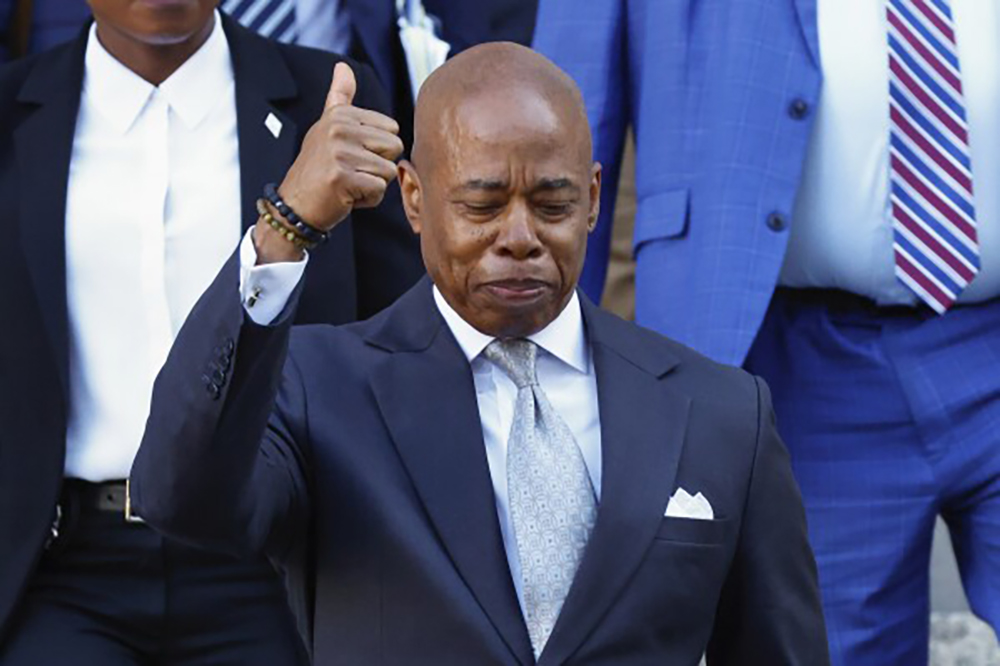
“To make New York the best place to raise a family and grow old in, we must take care of both the big and small things,” Adams said at a press event outside a busy stop on the Upper West Side. “This $40 million investment will transform the bus-riding experience for thousands of people.”
The mayor framed the announcement as part of his broader agenda to enhance quality of life for working families and seniors, calling attention to the city’s ongoing efforts to modernize infrastructure and prioritize inclusivity in public spaces. As the VIN News report observed, the initiative represents one of the most tangible quality-of-life improvements of Adams’s tenure—a move that ties transportation equity to comfort and dignity in the public realm.
Beginning in November, the DOT will begin installing 875 benches and leaning bars each year for the next decade while maintaining and upgrading existing seating. By the end of the 10-year plan, every one of the city’s 15,000 bus stops will have some form of seating, according to details released by the Mayor’s Office and reported by VIN News.
Commissioner Rodriguez emphasized the importance of accessibility in transit planning. “For many New Yorkers, having a place to sit isn’t just a matter of comfort—it’s whether they can take the bus at all,” he said. “With 15,000 bus stops serving 1.4 million daily riders, this is a critical step forward.”
Currently, nearly two-thirds of eligible bus stops lack seating, an absence that poses significant barriers to mobility for older adults and riders with disabilities. The DOT already maintains more than 2,600 public seating locations citywide and has installed benches at over 5,000 bus stops, but that still leaves a gap of more than 8,000 stops without any resting place.
As the VIN News report highlighted, the city’s new seating plan builds on smaller pilot projects under the Adams administration’s “Streets for People” framework—initiatives that have included wider sidewalks, bus priority lanes, and “pedestrianized” plazas. But this marks the first time New York has committed to universal bus stop seating, reflecting a shift toward equity-driven urban design.
Transit advocates and accessibility leaders have hailed the announcement as a long-overdue win for inclusivity.
“Additional bus stop seating will decrease children’s exposure to moving traffic and provide pregnant and disabled riders the respite they need to travel safely,” said Christine Serdjenian Yearwood, founder and CEO of UP-STAND, a nonprofit dedicated to accessible transit design for caregivers and expectant mothers.
Likewise, Jolyse Race of the Riders Alliance praised the mayor’s plan as both practical and symbolic. “Bus riders work the jobs that make New York possible. We deserve both a seat at the table and a seat at every bus stop,” she told VIN News.
The phrase has since become a rallying cry among transit advocates, encapsulating how something as simple as a bench can represent fairness, dignity, and civic belonging.
According to the report at VIN News, advocates have long argued that the lack of seating disproportionately affects lower-income riders and essential workers—those who rely most heavily on bus transit rather than subways or cars. Many of these riders are older adults or caregivers who spend extended time waiting for buses in adverse weather conditions.
“Accessibility isn’t a luxury,” Race added. “It’s a right. This investment acknowledges that bus riders matter as much as any other commuters.”
The DOT’s design plans, obtained by VIN News, indicate that the new benches will be modular, weather-resistant, and designed for easy maintenance. The city is expected to prioritize installations in outer-borough neighborhoods where bus ridership is highest—particularly in The Bronx, Queens, and Brooklyn—and where public seating has historically been limited.
Rodriguez told VIN News that the agency has been working with community boards and accessibility consultants to ensure that designs accommodate a range of physical needs, including leaning supports for people who cannot sit for long periods and extra space for wheelchair users.
“We’re designing for the full range of human experience,” Rodriguez said. “For parents with strollers, for someone recovering from surgery, for older adults—everyone deserves to wait for the bus with dignity.”
The seating rollout will coincide with other major DOT infrastructure projects, including bus lane expansions and Vision Zero pedestrian safety upgrades.
The announcement also intersects with the city’s ongoing Vision Zero initiative to eliminate traffic fatalities and serious injuries. As VIN News reported, the Mayor’s Management Report for Fiscal Year 2025 recorded a 24% drop in total traffic fatalities, including an 8% decrease in pedestrian deaths, a 31% drop in motor vehicle occupant deaths, and a 39% decline in motorized two-wheeler fatalities.
City officials attribute these improvements to a combination of traffic enforcement, redesigned intersections, and programs such as Safe Streets for Seniors, which upgrades pedestrian infrastructure in areas with high concentrations of older residents.
Mayor Adams emphasized that the bus seating initiative is part of this same continuum of safety and accessibility. “We’re not just putting benches on sidewalks—we’re designing streets where people can live, move, and age safely,” Adams said. “The ability to rest, to wait comfortably, to travel without fear or fatigue—these are human rights in a city that prides itself on compassion.”
As the VIN News report noted, advocates have increasingly framed such measures as integral to the city’s resilience strategy, arguing that accessible transit infrastructure supports both social equity and environmental goals.
The timing of the initiative also coincides with broader conversations about New York’s post-pandemic transit recovery and the city’s push toward sustainable, people-centered urbanism. With climate resilience and public health top of mind, bus infrastructure has emerged as a key battleground for improving both equity and environmental outcomes.
Experts interviewed by VIN News highlighted how incremental design choices—like adding seating, shade, and clear signage—can dramatically increase bus ridership while reducing car dependency. “Small changes add up to systemic transformation,” said one urban design researcher. “A bench might seem trivial, but it signals care, permanence, and belonging in the urban landscape.”
Mayor Adams echoed this sentiment, calling the investment “a down payment on the future of mobility in New York. Every bus stop is a story about who we are as a city,” he said. “By making them accessible to everyone, we’re saying that every New Yorker matters.”
According to project documents obtained by VIN News, the city will begin installations in high-priority transit corridors, including Queens Boulevard, Fordham Road, Flatbush Avenue, and Staten Island’s Bay Street. The first 875 bus stops slated for upgrades will be selected based on ridership, geographic equity, and community input.
The DOT will also launch an online portal where residents can request or track seating installations in their neighborhoods—a move aimed at increasing transparency and accountability.
Public response has been overwhelmingly positive, with residents from outer-borough neighborhoods praising the initiative as “common-sense government at its best.” One Bronx commuter interviewed by VIN News summed it up succinctly: “I’m just glad they’re finally thinking about people like us—people who take the bus every day.”
While $40 million is a modest figure in the context of New York’s multi-billion-dollar infrastructure budget, experts told VIN News that its potential social return is enormous. A bench costs only a few thousand dollars to install and maintain, but its impact on quality of life, accessibility, and equity is incalculable.
Dr. Samuel Keller, a transportation historian, told VIN News, “Public seating isn’t just about waiting. It’s about belonging. It’s the city saying, ‘You have a place here.’”
With the new initiative, New York joins other global cities—from London to Tokyo—that are embracing “human-scale” transit infrastructure as a cornerstone of urban planning.
For Mayor Adams and Commissioner Rodriguez, the $40 million seating program is as much about symbolism as infrastructure—a message that New York City remains committed to dignity, inclusivity, and progress at every level of civic life.
As the VIN News report noted, the city’s investment “turns something as ordinary as a bus stop into a statement of shared humanity.”
After years of uneven transit experiences and rising accessibility concerns, New Yorkers can look forward to something rare in urban policy: a simple promise that touches every neighborhood, every borough, and every rider—one seat at a time.
